I've seen photos of Romanesco broccoli online, identifiable by the fractal arrangement of its florets.
Fractals are basically self-similar patterns, with the same characteristics at various levels of scale. Romanesco has at least 3 levels of self-similarity, with groupings of smaller florets on the larger florets.
I finally saw this visually interesting vegetable in the supermarket for the first time, so I knew I had to get it! I wanted to see how it tasted.
Below are some photos I took, with both a regular & a macro lens. The last photo is the result - the steamed Romanesco broccoli for dinner, with baked chicken and waffle fries w/ Sriracha.
It was definitely more bland than regular broccoli, but I always spice up my veggies anyway. I like the texture of the Romanesco much better. It didn't have the little leaflets on regular broccoli that get stuck in your teeth.
Anyway, I will definitely get it again for other dishes. Besides, I love to look at the fascinating fractal form, so it's worth getting for that alone!
I noticed that fractal Mandlebrot set resembled the Universe in this medieval picture of "God the Geometer"
I have shared this documentary before, but this is one that is worth reposting. I just watched it again the other night, and it is an excellent intro to the mathematical concept of fractal geometry.
The main quality of a fractal is recursion, which means repeating characteristics. These self-similar qualities are found throughout the natural world, and are a fundamental property of The Universe on all scales. Using relatively simple formulas, complex patterns can be generated with computers that reflect these iterative qualities.
These patterns can be represented by visual data and graphics, to produce the eye-catching artwork that is now so familiar. I have created many pieces of abstract art using fractal software. Here are some examples:
One of my favorite topics is the mathematical field of fractals. I think it is one of the most important conceptual tools to understanding the nature of reality.
The animation shows the fractal branching pattern that forms in so many natural processes. This mysterious, self-organizing pattern maximizes the use of a given area, and is present in phenomena as diverse as blood vessels, leafs & plants, rivers & waterways, and lightning.
Fractals have always been a subject of deep fascination for me. I've created fractal images & posted about the fractal-like qualities of reality here many times.
Fractals are mathematical formulas that result in infinitely complex images when plotted point by point. When calculated on a computer, it's possible to "zoom" in & out of the image to render the image at different resolutions. In fact, I like to think of fractals as being 2.5 dimensions, because there is a "virtual" dimension of depth when you zoom throughout the image.
The main feature of fractal geometry is the recursive nature of the visual elements. As you zoom into & out of the picture, there are self-similar features that continuously appear. I wouldn't go so far as to say the the Universe is a fractal, but it definitely contains fractal-like qualities & features.
On Awakening Our Truth, I saw this animation of a zoom into the Mandelbrot fractal, named after the discoverer of fractal geometry, Benoit Mandelbrot. It is 15 minute long & shows the endless continuum of features that a simple fractal formula can produce.
In my last post, I wrote about the profound effects digital technology has had on communication. Art & design is another area where innovation in computers has led to the possibility of previously unimaginable creations.
I've always had adeep interest in fractals. I think they are fundamental in understanding the nature of reality.
Through iterative fractal software, it is possible to generate visual forms that would be impossible to render otherwise. With improvements in software & computing power, it's now also possible to create videos of these extraordinary fractal structures in motion.
The very recent phenomenon of 3D printing now allows us to bring these impossible objects into the physical domain.
Here are some "Fabergé Fractal Sculptures" created by artist Tom Beddard on his website subblue. Tom is also the creator of the awesome fractal app that I downloaded & explore frequently, called Frax.
These intricate sculptures are reminiscent of the kaleidoscopic, hyper-dimensional forms described by the late, great Terence McKenna.
A single form encompasses
the multitude of dharmas,
all of which are interconnected
Within the Net of Indra.
Layer after layer, there is no point at which it all ends.
Whether in motion or still,
ALL is fully interpenetrating.
- Zhitong (d.1124)
Even though my career is in graphic art, I have always been interested in science.
In high school & college I took physics courses because I loved the way it analytically uncovered the mysteries of our Universe. However, I also realized that scientists, like everyone else, are just making up stories.
Yes, science is more self-consistent than other intellectual endeavors. It is fairly obvious though, that scientific theories are only limited cases, that do not describe the totality of happenings within the reality we inhabit. Old theories are replaced with new ones as more information becomes available. "Laws" such as thermodynamics are applied to idealized situations. Even previously immutable physical constants are shown to be not as "constant" as we once believed.
Scientists can sometimes be like priests when it comes to holding onto questionable premises as dogma. The Big Bang, dark matter, and the use of various constants to make equations do what they are expected to do... these are just some examples of faulty premises that have become doctrine that cannot be questioned without fierce resistance from the scientific community.
Maybe it's because I'm also inclined to a mystical point-of-view, but I tend to look beyond the monkey grunts & crude symbols that we use to try to explain the world. Science & math may be more refined than most ways of thinking, but they are still the products of our limited monkey mind.
The Universe is Infinity.
All we are doing (with any system of knowledge) is looking at bits & pieces of that Infinity, and trying to connect the few stray pieces we can comprehend at any given time.
All that being said, I recently watched this video by Nassim Haramein about new ways of looking at the atomic realm & how it relates to other scales of Reality. It takes alot to blow my mind these days, but this video really made me think about the world in a new way. *Disclaimer: I am not claiming to fully believe everything he has to say, or that his theories are without flaws. However, to argue about this stuff would be missing the forest for the trees. What he brings is a new vision for understanding the Universe at different scales.
I think fractals are a key to understanding the nature of Reality.
Nassim very much incorporates a fractal view of nature, which I think is crucial to a unified view of the Universe. I don't think that a "Unified Theory of Everything" is actually possible. However, we can always find ways to integrate more & more aspects of scientific theory into more elegant and useful forms.
Scientifically-minded people may hear "sacred geometry" and be immediately repulsed by the mystical implications. However, symbols like 'The Flower of Life' are simply geometric forms studied in an attempt to find underlying patterns in natural processes. There does not need to be anything about "God" or metaphysics injected into the discussion.
I also feel that there is definitely a "zero point" energy inherent in the quantum field. One day, with sufficient understanding and technology, we will be able to extract this infinite energy source, that exists within us & around us, throughout the Universe. When our energy problems are solved, many other difficulties faced by the human race will also be overcome. We will be able to harvest unlimited energy, bend gravity, & travel to the stars, freeing us from the womb of planet Earth- so we can guarantee our survival as a species.
All revolutionary ways of thinking are at first ridiculed by those who have fooled themselves to think they know how things really are. The truth is, we know relatively nothing! However, I think Nassim's talk opens doors to new ways of approaching the way we look at the Universe.
We must keep our mind open and realize that everything, including "truth" & scientific understanding, is subject to change.
Fractal geometry is the closest conceptual model we have to the recursive & endlessly detailed structure of our world.
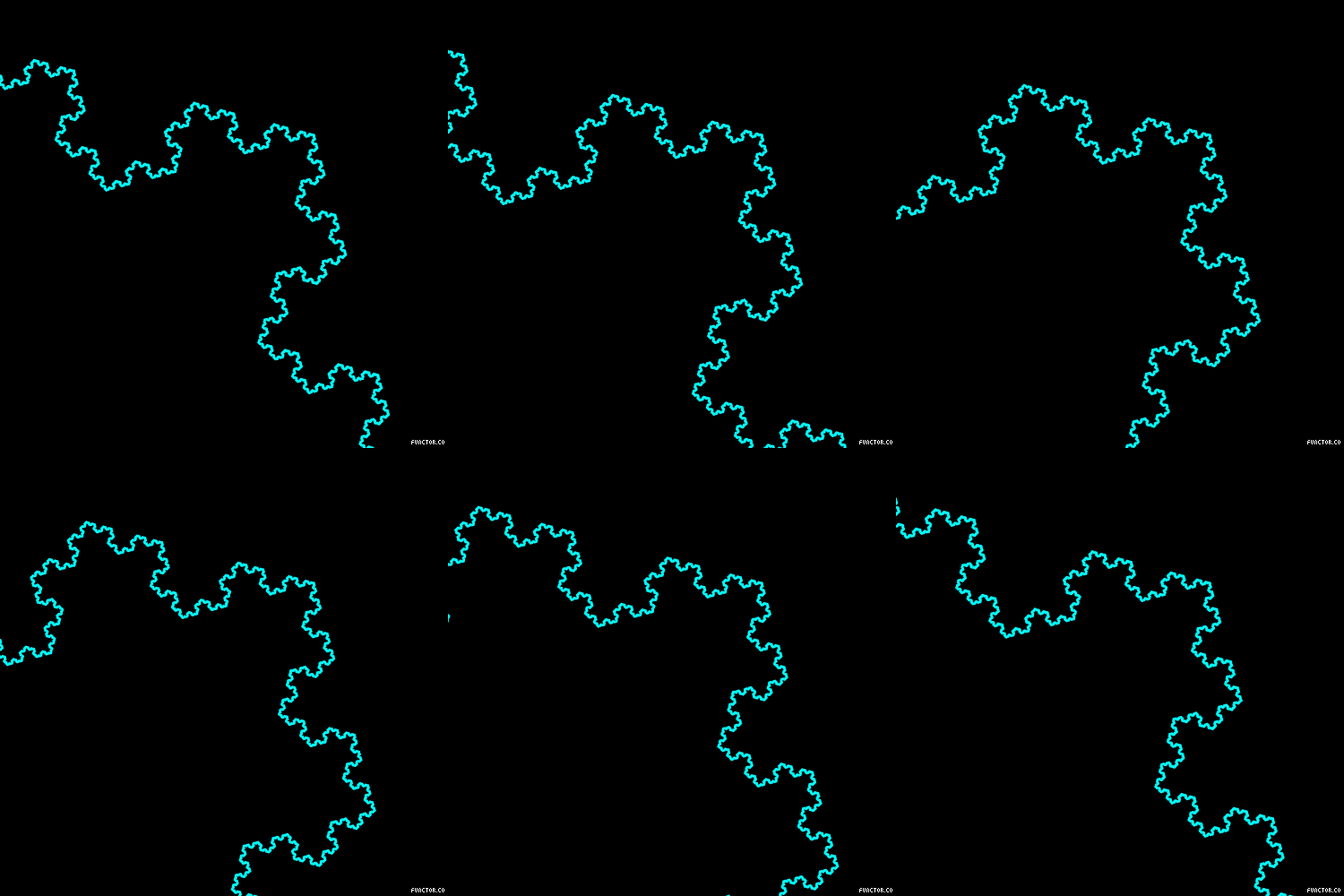
This is a hypnotic animation I saw on Oerbital, of a particular fractal edge known as a Koch Snowflake.
Like all fractal animations, it's basically a 2.5 dimensional image- a flat picture, but with virtual "depth" that can be zoomed in & out in infinite, self-similar detail:
Whenever I see a reference to a "Theory of Everything" in physics, I can't believe that people seriously discuss such an absurd concept.
I understand that it usually refers to the goal of unifying general relativity & quantum mechanics, but the name gives the false impression that there's some way to mathematically model all the physical systems in The Universe in a formulaic manner.
It's nice to know there are scientists who don't buy into that fantasy.
It's been many years since taking any courses on the subject, but I still enjoy learning about physics. The more I learn, though, the more apparent it becomes that Reality is relatively infinite in complexity & cannot be fully defined by any set of man-made symbols.
Equations can calculate (& scientific theories can generalize) many different phenomena in this world. However, despite the modelling power of calculus, fractals, & other mathematical tools, they are still very limited. The Universe has dimensions & properties that we haven't even discovered yet. How can we accurately model something we can't fully comprehend?
Physicists will continue to describe & measure the many fascinating aspects of this world. They will continue to try to simplify & consolidate general theories. In response, The Universe will continue to grow in detail as people peer ever-deeper into its mysteries.
This is a good reminder that there is only the present moment. The past, future, & whole the idea of a linear historical time line are part of our collective imagination.
My last post was about the creative & marketing insights of Steve Jobs, which helped to jump-start the era of the personal computer.
In this 1974 video that precludes the creation of Apple Computers by several years, Arthur C. Clarke correctly theorizes about the potential application of computerized devices. At the time, the primitive computers were big enough to fill a small room, but his predictions about compact digital devices that would allow people to instantly communicate throughout the world proved to be accurate.
The infinite intricacies of Fractals have revolutionized our understanding of the universe & have spawned endless applications, from generative computer art to the internal antennas of cell phones.
I personally believe that fractal properties give valuable insights into many aspects of the world we live in.
One cannot begin to understand the nature of Reality without thoroughly studying & understanding fractal geometry.
Fractals have been a favorite subject of mine & I think it is conceptually at least as important as Relativity.
One new thing I learned from watching this program was that cell phone antenna circuitry is designed according to fractal properties. Generally speaking, it seems like we are figuring out the language of the Universe so we can tap into the Universe.
I don't enjoy math at all & have a general aversion to numbers, but fractals are one area that I've always found endlessly fascinating. This is probably due to the visual aesthetic that results from translating these self-repeating formulas in to graphic form. It is a unique merger of art & math that hints at the very nature of reality.
Here is a video showing part of the infinite "zoom" that makes a fractal a 2.5-Dimensional conceptual object- somewhere between flat 2 dimensional space & 3D...
The infinitely recursive wonder of Fractals is one of my favorite topics. I recently saw this video linked on a couple different sites & thought it was pretty mind-blowing.
I'd recommend seeing the full size video several times. Just try to wrap your head around it (& through it..)
It's very strange to think we are perceiving a seemingly solid structure that doesn't exist in the physical world. It is an object of pure imagination.
Perhaps that jackass Plato was actually onto something with his theories of abstract, idealized forms.
With the emerging technology of 3D printing, creating an 'impossible' object like this will simply be a matter of ever-increasing resolution, like the DPI (dots per inch) in current imaging processes.
Is it just a bunch of meaningless mystical mumbo-jumbo?... or the ultimate key to understanding our experience in the universe?
The answer: Both!!! (:D Visually, fractal forms are endlessly fascinating and reflect the dynamic chaos of nature.
It's amazing that people have figured out how to manipulate numbers & math to approximate 'messy' phenomena that are as irregular as coastlines and plant life.
...or is the seeming 'chaos' in the economy due to inhuman levels of malfeasance?
I've posted alot about the amazing mathematic & graphic constructs known as "fractals".
The fractal is an expression of chaos theory, which attempts to quantify complex, 'chaotic' systems.
Colorful fractal designs are also very interesting from an aesthetic point of view.
I saw this article that ponders the chaotic nature of our economic marketplace and the possibility of a better understanding their dynamic nature:
That whole article, though, seems like a bunch of crap after reading one of the astute comments that really hits the nail on the head:
"We have criminals in charge and they ran a pyramid scam on the American people disguised as a real estate "boom". You don't need a complicated mathematical model to predict how a pyramid scam will end, unless you're stupid."
The capstone of America's Greatest Pyramid Scam is topped by the figurehead & puppetmaster that are supposed to be dutifully managing The United States of America: George Bush & Dick Cheney. Now can we impeach these scumbags & let them go down in history as the national disgrace that they are? Please? Pretty please?
I've always been interested in holograms and their relationship to the nature of our universe. Reality and our integrated human minds experiencing & existing within it have been shown to possess holographic qualities that are still barely understood.
I've noticed a few articles on the progression of holographic display & data storage technologies. I really think that we're getting to the point that almost anything the human mind can visualize can be either represented virtually or actually created in the physical world. Holograms, like fractals, are one of those topics that make less 'sense' the more you really try to understand them.
It's cool to see these amazing artworks given a forum to be presented, compared, & even judged by the father of fractal geometry, Benoit Mandelbrot.
Although not showing the same skill as the contest entries, I'm adding a few of my own fractal images here. I have to get an online gallery of my artwork up soon...
I saw this animation linked on BoingBoing.com & I was shaking my head in disbelief. First of all, I remember seeing these segments as a kid when they aired on Sesame Street back in the day. All I remember is that these colorful circles were dancing around to weird music!
Now, I can watch this & recognize the fascinating sacred geometry lesson that was being presented - in a wordless, transcendent fashion. As a designer I have a deep interest in all forms of art theory. By studying all these ideas such as Sacred Geometry, the Golden Ratio, Fractals, etc, we get a more creative view of reality.
This animation specifically deals with the concept of the "Flower of Life" symbol. This is a field of equally overlapping circles that forms a repeating pattern of shapes and lines. My interest in the esoteric background of this ancient symbol led me to design and create the game Da Vinci's Challenge. (My brother & I were joking that I must have been hypnotized by this video on Sesame Street when I was little.) It's interesting to wonder how much forgotten imagery & experiences from the distant past still influences your everyday life.
Fractals = Complex shapes which look the same at a wide variety of scale factors.
Fractals are one of my favorite topics because it is a unique synthesis of art & science which trancends the qualities we normally look for in those disciplines. This post "Fractals for Food" has a nice collection of pictures of fractal geometry in natural forms.
I can't believe that this particular cauliflower, Chou Romanesco, even exists! It looks like it was made with a computer program.