Showing posts sorted by date for query star trek. Sort by relevance Show all posts

Sunday, January 12, 2020

Neuralink Brain-Computer Interface


Well, it took only 10 years... but technology is finally catching up with my concept for the "iThink" Apple-branded brain/computer interface.

The Neuralink tech that is being developed by Elon Musk's company uses thread-like electrodes that are embedded into the brain using a device similar to a sewing maching. The threads are implanted directly into the brain, but not directly connected to neurons.

Engadget:

This concept is truly dystopian & frightening to many people, but I think it is the next logical step in the "meta-volution" of the human mind.

As much I love the natural world and feel like it is good to disconnect from the web & devices from time to time, the organic structure of the brain will soon need to be augmented beyond the external digital tools we are currently using. The rate of digital information flow and capabilities of A.I. are just advancing too quickly for biological evolution to keep up.

Some of the abilities that could result from tech like Neuralink are:

• "Telepathic" brain-to-brain communication

• Instantaneous mathematical and scientific calculation

• Access to an unlimited databank of multi-sensory media

• Virtual or augmented reality that is directly experienced in the mind

• Expanded multi-dimensional consciousness beyond our current "single point" awareness

• Real-time language translation

• GPS combined with Google Maps to facilitate information-rich navigation

• Etc., etc., etc.

Yes, this technology has the potential for negative uses (mind hacking, unwanted advertising, inability to disconnect)... but ALL tools have that risk. This is the danger that sci-fi classics such as Star Trek's "Borg" and The Matrix have tried to warn us about. However, the same tools that could be extremely dangerous also have the potential to create amazing beauty & benefit for humanity.

As the late, great Timothy Leary said:

•••••••••••••••••••••••••••••••••••••••••••••••

"The level of intelligence has been tremendously increased, because people are thinking and communicating in terms of screens, and not in lettered books. Much of the real action is taking place in what is called cyberspace. People have learned how to boot up, activate, and transmit their brains.  

Essentially, there’s a universe inside your brain. The number of connections possible inside your brain is limitless. And as people have learned to have more managerial and direct creative access to their brains, they have also developed matrices or networks of people that communicate electronically. 

There are direct brain/computer link-ups. You can just jack yourself in and pilot your brain around in cyberspace-electronic space." 

-Timothy Leary (Chaos & Cyber Culture) 

•••••••••••••••••••••••••••••••••••••••••••••••

Below is the Apple iThink concept that I envision back in 2009:

The Monkey Buddha Achives:


Sunday, October 06, 2019

Visualizing the Speed of Light


The nature of light, including the speed at which it propagates through space, is something that's difficult for the human mind to understand fully.

Add relativity into the mix, and the properties of energy and light become downright mysterious.

This GIF by James O'Donoghue using NASA imagery, although showing the speed that light travels, really highlights the vast cosmic distances that exist beyond our human & planetary scales.


This visualization illustrates the difficulty that the human race is going to have with space travel by "conventional" means - by which I mean trying to accelerate through physical space to a percentage of light speed to reach other star systems.

I think the answer is the development of technology that has been imagined in Star Trek and described by Bob Lazar, who claim to have worked on reverse-engineering spacecraft at the S-4 facility near the once-secret, now-infamous Area 51 test site.

We need to create technology that is able to manipulate gravity in such a way that it can warp space-time, so that the traveler is warped to the destination faster than light would be able to travel through the same space. I think the ideas of Nassim Haramein are leading us in the direction of technology.

Whether it's eventually feasible remains to be seen, but it seems to be the only way to travel through interstellar space without taking generations of humans, or centuries of sending out AI-driven machines.

Perhaps another option is to become beings of pure light ourselves, so that relativistically time stops altogether. However, then our need to explore and physically experience things would be irrelevant anyway...

Sunday, January 07, 2018

Vitas "7th Element"


I saw this video mocking the "Bitcoin bubble" posted in a Reddit comment about cryptocurrency. I thought the actual music video used was crazy & hilarious. In the video comments, someone gave the name of the original song- "7th Element" by Vitas:


Here's another version:


Apparently, the Latvian singer Vitas also has a "normal mode".

As far as digital forms of monetary exchange are concerned, the economy is all numbers and digital signals, anyway. I think Bitcoin & cryptocurrency is an interesting approach to society's economic needs. There's no reason that traditional money or economics has to be the only game in town. As technology progresses, all our currently held systems or institutions will be eliminated or adapted. 

Eventually, society should evolve into a post-currency mode, such as the fictional model used in Star Trek:

The Monkey Buddha Archives:

Friday, October 21, 2016

Common Planet Economics

http://earthvote.org/common-planet.html

One of the major sources of misery & distress in this world is the economic system that has been set up to regulate human activity. It is a system based on debt and fiat currency that only has value because the central banks say it has value.

Economics is one of those areas in which the status quo has been entrenched for so long, that people just accept how shitty it is and don't think of better solutions. Luckily, there are people who take the time to dream of better possibilities & think of new ways of doing things. Sometimes new ideas start out as fiction, such as the the post-scarcity economics of Star Trek.

The Monkey Buddha Archives:

I came across this introduction to a "Common Planet" manifesto on Phroyd's World and believe it's the type of thinking we need to transform our economic system. It seems outrageously idealistic and impossible to implement in our current situation, but only by presenting ideas and new perspectives can we even begin to change our society and its institutions.

earthvote.org:

The plan has aspects of Universal Basic Income, an approach of eliminating welfare programs & poverty by guaranteeing a basic income to every person.

This would be paid for by redistributing wealth from the very top of the economic pyramid, which is now basically extracted from circulation and hoarded for personal score-keeping, instead of used to benefit all of society. Anyone who argues against wealth redistribution from the top>down is making a de facto argument in favor of wealth redistribution from the bottom>up. Some of the same people who lament the disappearance of the "middle class" vehemently argue against raising taxes on the top 1%. The wealth of not just this country but of this world is being siphoned from the average population & into the bank accounts of the ultra-rich at an unsustainable rate. This is an indisputable fact, and something must be done to regain some sense of fairness in the economic priorities of the human race.

Perhaps change will be slowly implemented over decades or centuries, maybe we are stuck with this system for the foreseeable future. However, if people formulate, analyze, and discuss new ways of thinking, then the possibility of improving our state of being becomes much more likely. These approaches need to gain recognition in the collective consciousness, and will result in people demanding & creating a better world.

Thursday, November 05, 2015

Star Trekonomics


I have been a fan of Star Wars my entire life. Although I was never really as into the other major sci-fi franchise, Star Trek, I can appreciate the vision of a future that is more directly related to people of Earth & humanity's place in the galaxy.

There is going to be a new Star Trek series produced for TV. That news prompted me to post this article I read recently, after wondering how the fictional economy of the Federation worked.

Medium.com:

It seems as if both the Star Trek & Star Wars civilizations use a medium called "Credits'. However, the economic systems appear to be much different, overall .

Star Wars seems more capitalist, in the sense that Credits act like currency, as we know it. Credits can be accumulated by corporate entities & individuals- while others without access to this wealth are poor, or even slaves. Although the Empire is a fascist dictatorship, with the Emperor directly in control of the military machine and the industries that feed it, regular individuals can still use Credits for goods and services like we use money.

The Star Trek Federation, on the other hand, has no currency, per creator Gene Roddenberry's rule. Federation Credits exist to facilitate an accounting of energy and resources in certain cases, but money is not needed for basic existence. There is also currency among the various alien races and other means of exchange of goods & services. However, there is no poverty among the Federation member planets, and society's main goal is the enrichment of all people- not accumulation of personal wealth. Thanks to technology, such as replicators, the need for physical "things" is easily fulfilled. The real goal becomes to create a better society, so all people benefit. The article above explores some of the technical possibilities behind this model of a galactic economy.

Star Trek Wikia Alpha:

What I like about these kind of fictional models, like the one used in Star Trek, is that they are an opportunity for human beings to dream a new reality into existence.  Collectively, we should constantly be re-thinking the way we do things.

People usually can't think beyond the existing possibilities- of Capitalism, Communism, Socialism, Fascism, etc. Perhaps there is a way to conduct society that is completely outside any of these traditional modes. Bitcoin is one system that is a step in breaking free of the bounds of familiar economic models.

Nature.com:

The ideas of 'money', 'capitalism', or even 'economics', are not universal. One day, they will be replaced by new ways of interacting.

Practicality should not be as much of a concern for creating new paradigms, as much as simply imagining alternative possibilities. If humanity has a goal, we can most likely achieve it together. The details can be worked out through ingenuity & cooperative activity. If that goal is the eradication of poverty and de-emphasis on greed and wealth acquisition, then it can be realized.

Science fiction and visionary stories about our future gives us an outlet to manifest creative solutions to problems & situations that the human race may encounter.

No matter how much we try to envision these situations, though, the future will still manage to bring us outcomes that we currently cannot even imagine...

Thursday, December 04, 2014

Game Review: Mass Effect 3


I just finished Mass Effect 3, the final installment in what has become my one of my favorite video game series.

Here is my review for the first Mass Effect-

The Monkey Buddha Archives

I've also played Mass Effect 2, but didn't write a review for it. Most of the good things I had to say about the first game apply to the whole series. However, I've been so blown away by the Mass Effect games that I wanted to write my thoughts after finishing the trilogy.

This is a work of fiction that is on par with Star Wars, Star Trek, or any other great work of sci-fi. The virtual galaxy you can explore is full of unique planets, alien creatures, and ponderous questions which our entire species must face. I'll repeat them again, because I think they are so vital to consider:

• Is there other Life in the universe, sentient or otherwise?

• What happens when interplanetary species begin to contact each other?

• What is humanity's place in the cosmic order? What role does the individual play in this order?

Is it possible for ANY form of intelligence, or even information, to survive the incomprehensibly vast cycles of cosmological time, on the scale of billions of years?

Mass Effect takes place in the future, after 2147 CE, when humanity has found alien devices & "Element Zero" in our solar system. These artifacts allow us to develop FTL (Faster Than Light) Travel. The subsequent discovery that Pluto's moon, Charon, is actually a "Mass Effect" Relay allows humanity to instantaneously travel to other Relays throughout the galaxy. A vibrant galactic civilization already exists, with a 45km-long space station, called The Citadel, acting as its capital. All advanced alien races are represented here, and after the events of the first two games, humanity has become a major force in galactic affairs.

Your character is Commander Shepard, and you can carry over your character's traits from previous games' save information. Humanity's high standing in the galaxy is, in part, due to the earlier actions of Shepard- most notably fending off an attack on The Citadel by a Reaper.

The Reapers are central to the Mass Effect series. Tens of thousands of these gigantic, conscious machine creatures come out of deep space every 50,000 years to "harvest" sentient organic life, for their genetic information. It is a mysterious cycle that has gone on for at least a billion years and was initiated by an "Intelligence" that's even older than the Reapers.

It turns out this seemingly destructive cycle is actually meant to preserve life, since any advanced biological species will eventually create synthetic Artificial Intelligence (A.I.) that inevitably wipes out all organic beings. The "Intelligence" sees this cyclical harvesting as a way to maintain order and allow new species to evolve. It is revealed that the Mass Effect Relays and the Citadel itself are actually part of an elaborate trap, developed by the Reapers to accelerate the harvesting process of sentient beings and make it more efficient.

In this game, the merciless Reapers have arrived, landing on the home planets of the advance species throughout the galaxy, including Earth. The game starts with an awesome sequence in Vancouver, Canada, where imposing Reapers, taller than skyscrapers, are completely annihilating the city. This is the threat you face from the very beginning, and gives a sense of enormity that such an existential threat would pose to us. In addition to the numerous & varied enemies throughout the game, you actually get to face down a few Reapers in different situations.


It is a rich story, that touches on many deep issues that the human race may one day have to consider. As literally out-of-this-world as this game is, I feel that it is a visionary & realistic depiction of what humanity may one day experience when we are able to travel among the stars...

The planets and alien races are fantastic, yet convincing. The number and uniqueness of the locations throughout the galaxy made it endlessly visually interesting. Although you can no longer land on & explore planets as side missions, I'm glad that the act of scanning planets for resources was made much less tedious than in ME2.

As far as the actual gameplay, there's a perfect balance of customization, role-playing elements, and intense combat. The RPG aspects of the game include dialog options, morality choices, and engaging characters. The combat is excellent, with the ability to use five weapons and a half-dozen powers. The weapon variety and the ability to freeze the action to switch weapons on the fly don't interfere with the intensity of the battles. 


I chose to be in an Adept class, so my character had biotic powers that were effective and fun to use, such as- • the ability to project a destructive warp field • launching a shockwave that throws enemies in the air • creating a mini black hole, a singularity, that holds enemies. The ability to also coordinate your teammates' powers with your own attacks makes the combat much more strategic.

Overall, I was engaged the whole time and couldn't wait to see what the next mission or story sequence would bring. Games like this are such monumental creations, and why I still play critically acclaimed titles such as this one. Even though I've played video games my whole life, I am still awestruck by the technical achievement as much as the game play. It's pretty common for me to just wander around an area, observing visual details and marveling at the artistry behind the level design.

One of the very few reasons I can't give it a 10 is because the game's ending left me unimpressed. I picked the ending where Shepard can take control of The Reapers, using technology developed by an ancient race. I thought there should have been a more cinematic finale, with more impact for the end of such an action-packed story.

Despite my slight disappointment with the ending, the rest of the game was so superb & awe-inspiring that it didn't diminish my overall view of a great game and a undeniably epic series.

• The Monkey Buddha's official rating: 9.75

Thursday, September 18, 2014

Size Comparison of Science Fiction Spacecraft

In my last post, I explored the unimaginably vast distances of outer space. The question facing us mere mortals is, "How do we travel across these seemingly impossible distances?"

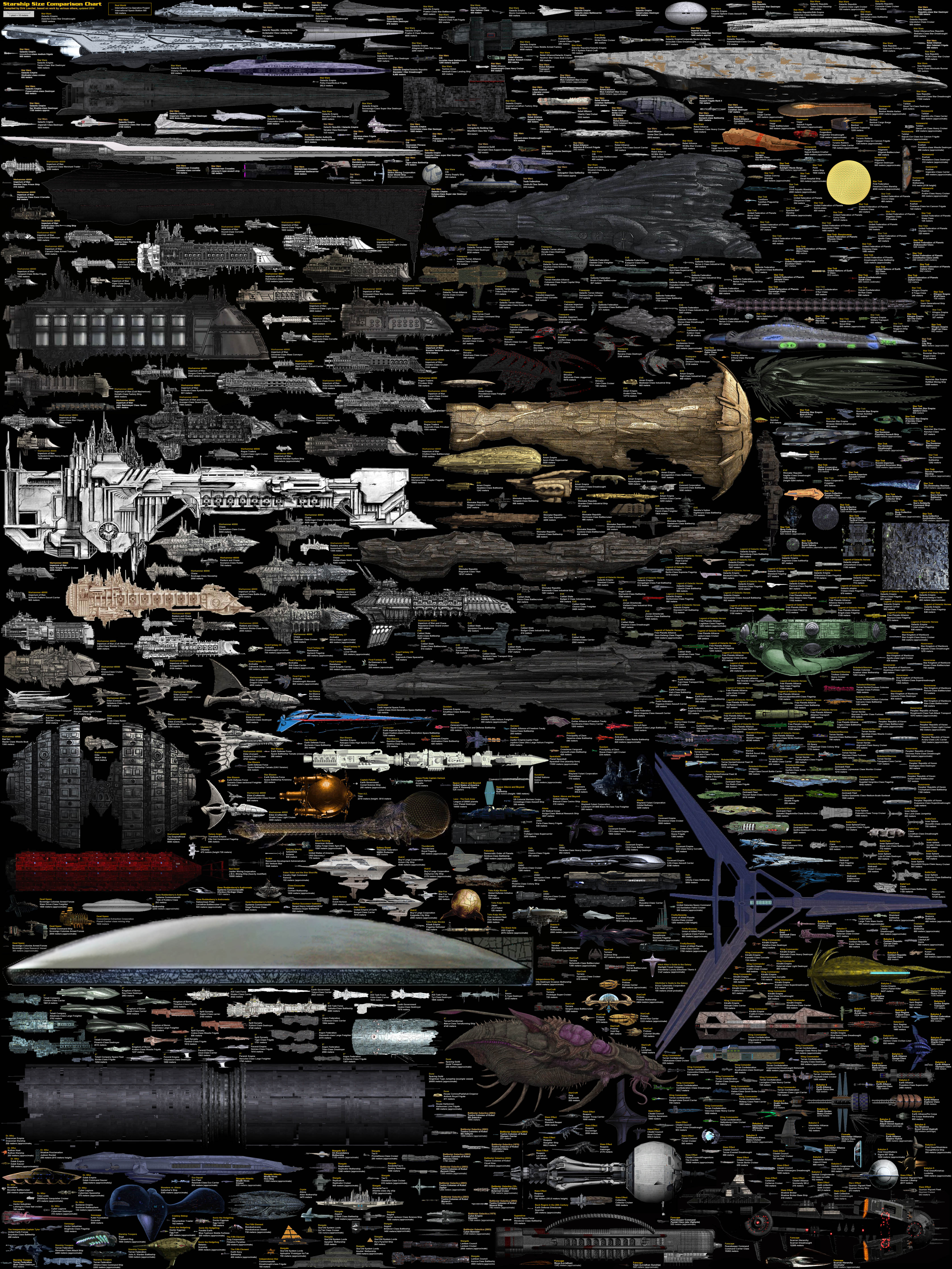
In the past I've posted the awesome charts, made by DeviantART user DirkLoechel, that compare the size of fictional spacecraft from a wide number of sources- such as the popular movies Star Wars & Star Trek, and video games such as Starcraft & one of my favorite games, Mass Effect

On Gizmodo, I saw (what he claims to be) the last update to this awe-inspiring collection of fictional space vehicles. They include ships of mind-boggling size, up to 24,000 meters, or almost 15 miles long! The beauty of building in space is that there really is no size limitation due to gravity fields or restrictions on the area that a vessel can take up.

by DirkLoechel

(click for larger image)
http://fc06.deviantart.net/fs70/f/2014/171/0/1/size_comparison___science_fiction_spaceships_by_dirkloechel-d6lfgdf.jpg


Thursday, July 03, 2014

Traveling Among the Stars

In my last post, I linked to articles about the Hubble Telescope's view into the infinite expanse of cosmic space surrounding us.

After you really try to ponder the incomprehesible size of our own galaxy (not to mention the rest of the Universe), a fundamental question arises:

How can human beings, in our current physical incarnation, ever hope to travel over such impossibly vast distances?

People are dreamers & explorers by nature, so it's no suprise that humanity's brightest minds are at work on solving this seemingly insurmountable problem.

The most promising answer so far relies on some sort of "warp drive"  Such a propulsion system would warp space-time itself around a vehicle, to allow it to bypass the relativistic effects of traveling close to the speed of light.

Like many precursors to modern technology, this is a concept that has been explored in sci-fi, like the classic Star Trek warp drive. Another example is the excellent video game Mass Effect puts you in a future scenario where Earth has joined a galactic civilization, connected by "mass effect" technology that warps gravity- allowing faster-than-light (superluminal) speeds.

Interestingly, a warp drive is how Bob Lazar claimed alien UFO technology worked. Lazar was an engineer who came out with information about Area 51, where he said he worked on reverse-engineering alien craft.


Here are some articles on the advancement of humanity's attempts to develop interstellar space travel.


Gizmodo:


Another possibility would be creating space settlements for generations of humans to live within, as it travels between the stars. I've always been facinated by concept art for these kinds of space stations, such as this set of NASA images:


Sunday, October 13, 2013

Size Comparison of Sci-Fi Spaceships

Several years ago, I posted a chart showing the sizes of various spacecraft from science fiction:

The Monkey Buddha Archives:

I recently came across an even more expansive chart, comparing the sizes of a large number of sci-fi spaceships, from such stories as Star Wars, Star Trek, and even games like Halo & Deadspace.

It is an awesome reference guide to the endless possible ways that we can travel among the stars!

The chart was made by DeviantART user, DirkLoechel:

Click for a hi-res view:

Wednesday, January 04, 2012

10 Technology Breakthroughs of 2011


This is a little late, but here is a good list of some really mind-boggling innovations that have been emerging recently.

Gizmowatch:

I never stop being amazed at the ability of the human mind to physically realize what it can imagine. My Dad always comments about how visionary Star Trek was back in the 60's, but he doesn't even know just how much of that sci-fi tech is now really being developed.

Infographic:

When I see things like 'Brain-like CPUs', 'Cloud Computing', 'Auto-Repairing Circuits', & 'Nanorobotics', it's clear that an 'Apple iThink' computer is closer than ever.

From Paul's Portrait

Monday, October 18, 2010

Preparation for the Landing

Did I miss this somehow?....


As with all bizarre things that amuse me, I had to look into this further. The old lady pretending to be a space princess is Ruth Norman aka Uriel of Unarians, who sadly passed away in 1993. We could only wish our time was as "progressive & positive" as she predicted. I'd much rather have any visiting alien life resemble her vision of luminous benevolent beings, instead of reptilian overlords or killer microbes...not that I'd have a choice.

My Dad, a fan of the classic Star Trek series, recently asked me if I thought there were aliens. My response began with the usual disclaimer: I really don't know... but my guess would be there has to be life out in the vast Universe. However, until I see some astonishing proof I'll admit it's speculation. If anything, higher beings would probably view Earth like a giant zoo or safari to visit & observe.

The interesting thing is that if there is life elsewhere, that can possibly be proven one day, regardless of how far off. If, however, Earth is alone in the universe by some unfathomably cruel twist of reality, then human existence will forever be an infinite journey of unfulfilled searching.

At least we can make & watch crazy videos while we're at it!