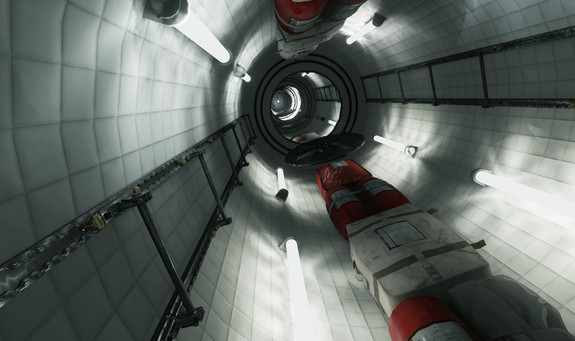
It was a cool game, my only complaint is the ending was kind of abrupt. The idea is that you are an elite modern soldier equipped with a virtual heads-up display that gives you all kinds of real-time control over battlefield intel & other units.
Although it was engaging, it didn't blow me away or anything, so I'm not gonna spend alot of time on it...
• The Monkey Buddha's official rating: 7.5
The interesting thing about games like Ghost Recon that use 'augmented reality' tech is that it's an extrapolation of the information delivery systems that are already being developed. My friend recently lent me the intense space horror, "Dead Space," which also conceptualizes the practical applications of personal augmented reality devices.
Just like sci-fi literature, video games & simulations can be an incubator for development of new ideas.
On the other hand, one of the biggest criticisms of video games throughout their history- the use of violence & other 'objectionable' material. I saw this link on BoingBoing to the audio documentary about the history of military games:
I've played some 'violent' games over the years from Contra to Doom to Wolfenstein 3D to Mortal Kombat to Hitman to the greatest offender of all, Grand Theft Auto. Despite participating in these arguably 'corrupting' experiences, I have always been a total pacifist & of a sound mind (right?, right?, right?). Granted video games are designed to manipulate one's emotions & mental state, but what immersive fiction isn't- whether it be books, movies, or games?
The danger is someone who is already mentally unbalanced- but such a person could be set off by any negative stimulus. If video games really affected normal people's behavior, there would be many dozens of killings, crimes, & generally crazy things going on in every town, every single day.
Conflict, sex, & survival are fundamental elements of human life, so as long as we inhabit our physical bodies, we will continue incorporating them into our games & other forms of creative expression.
Even though I haven't really had a chance to played video games lately, I had a little time over the holiday weekend to play some PS3 w/ friends. I've been a casual gamer since I was 5 years old, so I've seen plenty of systems & titles in my time.
Now my nephews, nieces & friends' kids are starting to play video games on iPads & the traditional console systems. Luckily, I'm from a generation that doesn't feel like one should give up something they enjoy just because they're getting older.
I came across this video on Neatorama that starts out with Pong & Atari, then works its way through the many memorable games over the years to virtual reality-like quality of the current-gen consoles.
I'm not even sure where to start when reviewing Assassin's Creed 2, other than, "Holy Crap, that was impressive."
Since I don't spend crazy amounts of time playing video games, I try to only pick titles that I know I'll enjoy after reading reviews & watching previews. That's why many of the games I've reviewed are 9.0's, because I don't waste my time if I don't think it'll be really good.
The story behind the Assassin's Creed series actually takes place in the modern day. The main character, Desmond Miles, is a descendant of a line of members of a secret historical faction, the Assassins. Their rival faction, The Templars, have been fighting for control of a mysteriously advanced technology over the course of hundreds of years.
Through experimental technology known as "The Animus", memory imprints can somehow be extracted from a person's genetic makeup. This DNA 'memory' is used to mentally re-create the historical experiences of Desmond's ancestors in a virtual reality experience. The player takes the role of Desmond- accessing his ancestors' memories to learn deeper truths about mankind's forgotten history.
I played the first Assassin's Creed a couple years ago. The original game takes place in the Holy Land during the Crusades, as Desmond's ancestor Altaïr Ibn-La'Ahad. I thought the re-creation of these ancient sites such as Jerusalem were awesome. Despite the fact that I like to try completing a game's side missions, though, they started getting very repetitive. Then, the game kept freezing every time I reached a certain point, & I couldn't continue playing. I sure as hell wasn't starting over, so I said 'screw it' & gave up on it.
Even though I didn't plan on playing any other games in the series after that, one of my brothers had Assassin's Creed 2. It is set in Renaissance Italy (which seemed really interesting) & got overwhelmingly positive reviews, so I decided to give it go. I'm extremely glad I did because it is an amazing game, with a superior level of production value that still has me awe-struck.
The sequel continues with Desmond trying to flee a Templar mega-corporation, Abstergo, that has been using him in experiments with The Animus. After he escapes with the help a small band of collaborators who have their own Animus machine, Desmond begins to recall the genetic memories of his Italian ancestor, Ezio Auditore da Firenze.
Being a designer & art history scholar, I found the opportunity to virtually explore cities of Renaissance Italy to be enjoyable in itself. Like most games that are produced with this high level of quality, I often found myself just wandering around the expansive locales- observing the meticulous detail of all the costumes, textures, architecture, and atmospheric effects that most people probably take for granted. As someone who has been playing video games since Pac-Man on the Atari 2600, I find the graphic quality of modern games like this to be spectacular.
I couldn't stop marveling at the impressive feat of reconstructing multiple, highly-detailed whole towns in an historically accurate way. Ezio gets to explore the sights & sounds of urban Florence, the country setting of Tuscany, and the canals of Venice. The crazy final sequence also takes you to Rome. The last scene takes place inside the Sistine Chapel, whose ceiling has not yet been painted by Michelangelo.
In addition to the beautiful graphics, Assassin's Creed 2 incorporates some actual art history into the gameplay. Ezio's family estate, Villa Auditore, is initially in disrepair. Throughout the game, items that you aquire help you improve the villa. One way to do this is to buy paintings by contemporary artists, like Leonardo da Vinci, Sandro Botticelli, & Titian. By the end of the game, you collect a large gallery of virtual paintings that would be any art lover's dream.
Another aspect of the game which I think is really cool is the deeper thread in the story, concerning the search for the mysterious origins of mankind and ancient knowledge, lost to history. This is a theme that was similarly explored in a book I read over the summer, Fingerprints of the Gods, by Graham Hancock.
The search in Assassin's Creed revolves around "Pieces of Eden" which are technological devices from a now-extinct civilization of beings who created humans as slave labor. (It's sort of like the Ancient Astronaut Theory, but these beings were from Earth- just older & more advanced than mankind.) Some humans rebelled against their masters & stole one of the artifacts, The Apple, that controls human neurological functions. Using this power, they recruited other humans to wage war against their creators. However, both groups became so caught up in their conflict that they neglected a cosmic threat that nearly destroyed them all. There were enough humans scurrying around like cockroaches to rebuild with the help of the few survivors from the First Civilization, who were now regarded as gods by their primitive creations.
To uncover details of this mystery, you must find clues left by Altaïr & the mysterious 'Subject 16', whose mind has become trapped in the virtual worlds of The Animus. An awesome aspect of this game is that Leonardo da Vinci appears throughout the game to supply equipment upgrades & also to help in deciphering the Codexes left by Altaïr. There are also mysterious 'glyphs' hidden in certain areas that open very challenging puzzle sequences. These make you feel like a genius when you figure them out. I'm proud to say that I figured out all the puzzles without looking up any answers. I did come really close to cheating on a few of the puzzles, after staring at the screen for a 1/2 hour or more trying to figure them out! Unlocking these scattered clues help piece together the story behind the age-old battle between the Assassins & the Templars for the powerful Pieces of Eden, which has occurred behind the scenes of history's major events.
Unlike the first one, Assassin's Creed 2 never lost my interest or seemed repetitive. I was enthralled by the visuals, the gameplay, and the story... all the way to when the end credits rolled, during which there is still a bit more of the game to play!
The only complaint I'd personally voice would be that the targeting and combat can be annoyingly inaccurate at times, but it doesn't hinder the overall experience.
The depth of this game is mind-boggling. Elements as diverse as Renaissance art, ancient mysteries, and ponderous philosophical questions are weaved between the open world free-running & the brutal assassination missions in a masterful way.
I'm planning on writing a post about the idiotic argument over whether video games can be considered works of art. This excellent game is 'Exhibit A' in the assertion that video games can actually represent the pinnacle of creative effort & are indeed artistic masterpieces unto themselves. • The Monkey Buddha's official rating: 9.0
I'm looking forward to experiencing the Oculus one day, but it should be clear to anyone that the possibilities of immersive VR are limitless.
Far from being a useless or escapist distraction from the "real" world, virtual reality is simply a new way to receive novel information & sensory input. It's no different than a movie, TV, a book, fine art, or any other human creation that can stimulate our minds.
Video games are a primitive form of virtual reality, in which you are able to explore situations & worlds that exist only in the human imagination, both individual & collective. Although I like to exist in the physical world, I've always enjoyed video games. They are almost an 'alternate consciousness' consisting of explorations into engaging scenarios & mental states.
By synergizing our brains with electronic media (or other future tech that we can't imagine), perhaps we will eventually create parallel streams of experience. We might also be able to fractalize our minds, creating numerous embedded levels of simultaneous thought.
Below are a few Oculus Rift applications that I think are especially cool-looking. Some of them deal with one of my favorite topics, and the source of humanity's future in the Universe, ...Outer Space.
Being a huge Star Wars fan, the idea of using lightsabers in virtual reality is immediately appealing. This demo looks pretty awesome:
I think it's interesting how there are video games in some of these virtual
worlds... games within games, realities within realities. Its similar to the idea of fractally embedded consciousness I mentioned before.
Finally, here's a very funny video, showing the reaction of a Ugandan security guard who loses himself within the Oculus VR:
Although the game play & story are extremely important in making a quality video game, being a graphic artist makes me especially interested in the visual aspects of games.
I was born in 1978, and my first game console was Atari 2600. Through the years my brothers & I had the Atari, Commodore 64, Nintendo NES, Sega Genesis, and the Sony Playstations.
I've personally watched the evolution of gaming progress from using monochrome, blocky pixels to the photorealistic, immersive 3D graphics we see today. In fact, I feel like my life has progressed in parallel to the development of video game technology.
Pitfall, 1982
Uncharted 3: Drakes Deception, 2007
As new systems (including virtual reality interfaces like Oculus Rift) are developed, we will be opening new possibilities of what the human mind can experience.
The distinction between the "real" world and digital worlds will continue to be merged. People will keep exploring new ways for our nervous system to interface with the infinite possibilities that arise from the realms of our imagination.
I've elaborated on the overall storyline in my previous posts (linked above), but there is basically a struggle going on between 2 secret societies- the Assassins and the Templars. This struggle is based on both sides' attempts to find powerful ancient relics, from a civilization that existed on Earth before humanity. This "First Civilization" were an advanced race that actually genetically-engineered human beings, but were wiped out after a cosmic cataclysm- specifically, a massive solar flare tens of thousands of years ago. Relics of their advanced technology are scattered around the globe, and the Assassins and Templars have been in a millennia-old race to find these artifacts.
One tool that is being used to find where these artifacts have been used throughout time is called "The Animus". It is a virtual reality simulation, which reads DNA to unlock the genetic memories of one's ancestors. Essentially, in Assassin's Creed you are playing a historical simulation within the simulation of the video game itself. In the game, you can also step outside the Animus into the "modern" day, in which the Templars have established a front company for their activities, called Abstergo Industries. This global corporation has now set up Abstergo Entertainment, a video game company that brings The Animus technology to the masses. In reality, though, it is a subversive way for the Templars to get more people to scan history for the location of the Artifacts from the First Civilization.
I love how the storyline for the Assassin's Creed games works on the different levels. There is plenty of thought-provoking material about ancient mysteries, conspiracies, and puzzles in each title. At their core, though, these games are action & stealth-based historical simulations.
The last installment that I played, Assassin's Creed 3, was set in the Revolutionary War. Though it was a good American history lesson, it wasn't as fun to play as previous AC games. I was hoping that Black Flag, a pirate game set in the Caribbean before AC3, would be more enjoyable.
Thankfully, I wasn't disappointed. If I were to describe Assassin's Creed: Black Flag in one word, it would be- EPIC.
All the AC games are huge in scope, with expansive maps full of detailed scenery. However, Black Flag might have been my favorite so far. I loved the tropical setting- full of islands, cities like Havana, and even Mayan ruins deep in the jungle. Even though I'm still playing on a PS3, the graphics look great. I always appreciate the meticulous details in the various environments throughout the game.
The most expansive environment is, of course, the ocean. In Black Flag, you get to travel over the sea with a crew aboard your ship, The Jackdaw. As you play the game, you collect sea shanties, different songs for your crew to sing as you sail from place to place. Although you can travel by ship to any location on the map, you can also use "fast travel" options as you unlock different areas. I still found myself sailing to many places, just because it's fun to control the ship & also raid merchant vessels along the way.
By building up your ship's guns & armor, you wage battle on ships from various countries also sailing the seaways. If you can overpower a ship through superior firepower and tactics, you can approach and board it. Depending on the type of vessel you are trying to take over, once you board it you may have to defeat a certain number of enemies, climb up the mast to destroy their flag, or blow up gunpowder stockpiles on the deck. Once this is accomplished, you gain whatever cargo the ship holds & either lower your wanted level or repair The Jackdaw. These battles on the high seas are exciting & really capture the feel of a pirate raid.
In addition to sailing over the water, you can explore the ocean depths in certain areas, using a diving bell. These underwater areas contain shipwrecks full of treasure, and caves with dangerous eels and jellyfish. There are also aggressive sharks patrolling, which you can evade by hiding in clumps of seaweed or the ruins of a sunken ship. The diving sequences were a great addition to the gameplay.
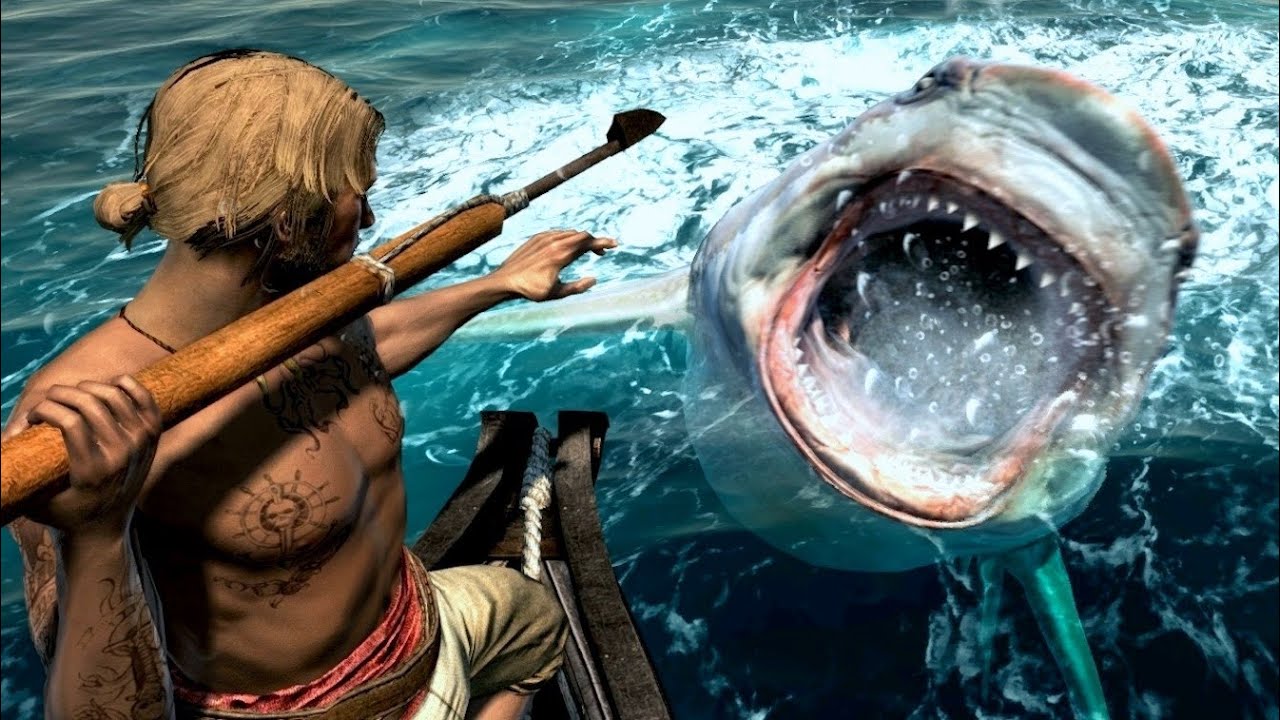
Another unique feature is the ability to get into a rowboat at certain places and hunt sea creatures with a harpoon, such as sharks, whales, and orcas. These are very intense encounters, especially when you don't have your equipment upgraded.
Even when just sailing around, you are bound to see dolphins or whales jumping out of the water. There are also a wide variety of land animals that can be hunted, such as jaguars, deer, crocodiles, and monkeys. Any materials you gain from an animal can be used to craft items for your inventory. There are also domesticated animals that you can't kill, but can pet or feed, like cats, dogs, cows, and chickens. It is a vibrant virtual world that reflects the ecology of the American tropics.
Most of the gameplay should be very familiar to anyone who has played other Assassin's Creed titles. The combat and free-running controls are still very fluid. You can climb almost anywhere- on buildings, trees, walls, and up the sides of ships. I tend to want to run from place to place, but I also try to slow down & walk so I can take in the virtual scenery and people that give an accurate sense of what that time period was like.
Throughout the game, you interact with historical figures from the age of piracy, such as Calico Jack, Anne Bonny, and Blackbeard himself. This adds to the feeling of being immersed in the pirate culture of the time.
Because I play video games so sporadically & leisurely, this game took me months to finish. I completed the main story, but also have tried to finish all the side missions and find all the items located around the map. There are also treasure maps with clues to find booty hidden throughout the many islands. I'm currently at 95% completion, so I've experienced most of what the game has to offer. I can say that it offers quite a lot!
My only complaint would be the abruptness of the story's ending, although the final scene during the credits was good & ties back into AC3. This tendency to end out of nowhere seems to be the case with all AC games... all of a sudden, it's over! I also would've liked more elements about the First Civilization or the Observatory that is discovered during the game.
These minor concerns are insignificant compared to the amazing amount of work, thought, and detail that went into this title. If you enjoyed other Assassin's Creed games, are interested in experiencing history, or just think pirates are cool, you should definitely play Black Flag. As I said in the beginning of this review, it is a truly epic experience.
Unfortunately, America's news cycle has been dominated by yet another tragic mass shooting. This particular incident is of a truly horrible nature, because it took place at Sandy Hook Elementary School- in which very young children were senselessly slain.
Last night, I was at Sunday dinner over my parents' house. As I played with the kids, my preschool-age nephews & a little girl who is like family, my mind reeled at the thought of someone harming a defenseless child. How could someone so brutally destroy the innocent, joyful lives of those little kids?!?! I don't usually resort to vulgarities on this blog... but it's pretty goddamn nauseating.
The cynically realistic part of me recognizes that it's just one example of the endless atrocities and tragedies inherent in human existence. There are tens of thousands of children dying every day, from hunger alone. Life can be a horrible, messy business. However, you'd have to have a total lack of empathy to not be outraged by such a revolting act as happened in that school.
The main social issue currently rearing it's head, once again, is the debate over "gun control". Personally, I don't think the desire for the outright banning of legal firearms is ultimately as effective as gun safety & regulation.
Despite always having been a pacifist & not really a 'gun person', I recognize the possible need for deadly force- if used for defense. I think citizens should be able to own weapons & guns... stockpiles of them, if they want. Even though it can be argued that the rights of the 2nd Amendment apply only to well-regulated militias, I wouldn't interpret it that strictly. Even though alot of people may disagree, I think citizens should even be allowed to own heavy weaponry like assault rifles.
My main argument for widespread gun ownership is for self-defense of the population, against:
1) government tyranny 2) personal crime or 3) foreign invasion.
As long as we inhabit this dangerous physical realm, individuals & communities should have sufficient means to defend themselves from more heavily-armed threats.
I know the right-wingers are freaking out that Obama's coming to get their guns, but I don't think the extent of the paranoia is warranted. I'm not saying there aren't elements in the government who would love to see a disarmed populace. That's when the real "systems of control" would kick in. I just think there's so many friggin' guns out there, it would be tough for Big Brother to snatch 'em all up. Frankly, I don't think anybody really knows what the hell to do about the regulation of guns in this country!
I do think there needs to be some balance between legal ownership of firearms, & the inability for mentally impaired people to have access to them. Of course, there will never be a perfect system, but there is always room for improvement.
One thing that's always emphasized on the news, which I find to be a complete red herring, is the perennial idea that video games are the problem with society. I've played the most violent & depraved games out there. However, I have never had the urge to do physical harm to another human being. As I said before, I'm a pacifist at heart- no matter what crazy ass things I see on TV, in movies, or in video games. Sure, there are impressionable people out there who are easily influenced by certain media. Does that mean everyone else has to be scapegoated for it?
Like pretty much anything else... guns & video games are only hazardous when used by people who are mentally unstable in the first place.
The underlying problem which people are beginning to recognize, is our country's social schizophrenia, its treatment of mental disorders, & the lack of publicly available health care, in general.
One aspect of this nation's health problem is the over-medication of the country's youth, using psychoactive prescription drugs. The modern answer to dealing with people's troubled minds is to prescribe the appropriate pill. These synthetic substances are tested in clinical trials, but it's all a farce. There's no way you can truly predict all the toxic effects of a potent chemical cocktail- especially when it comes to altering the function of a undeveloped & unstable mind.
Some people think the answer is to have more God & prayer in schools. Mandating religion & prayer is not going to prevent a rampage like this. A murderous lunatic could be inspired by 'God's Will' as much as anything else, so belief in God won't stop a madman. Whatever you think it is,"God" is clearly not going to stop the madness, either... despite any prayers that might be offered. Nobody's keeping kids from praying in their own heart while they're in school. They can go to their respective religious services or gatherings outside of the classroom to find spiritual community.
I'd prefer to see the widespread utilization of "Mindfulness Meditation" classes, as part of all health curriculum from K-12. I would also like for the government to subsidize free lessons at community colleges or libraries. It would be the best investment the government ever made. Meditation classes do not need to be connected to spiritual content at all, in order to be effective at bringing peace of mind.
Mindfulness is simply the practice of quieting the mind & cultivating self-awareness.
This type of instruction would go a long way to giving people of all ages techniques to soothe the chaos in their mind.
Coincidentally, I just came across this NY Times article about meditative practice:
There will NEVER be perfect, universal peace in this corporeal world.
This is a harsh truth.
However- if we can provide more effective mental health care & tools for self-improvement to individuals, society at large will be less likely to suffer these kind of preventable tragic events.
There are many people in the world suffering greatly. Some are simply unable to cope with the dissonant realities being perceived by their senses & mind. No healthy person can contemplate the depths of madness that would lead a person to carry out something so evil.
Thankfully, this kind of behavior is still an anomaly. We can hope that these tragedies force people to confront these big issues that need to be addressed. It's only through awareness, intelligent debate, and the open sharing of solutions that society can overcome its many serious problems.
It makes sense that people who immerse themselves in simulated game worlds would also be more active in the mental simulation of dreams.
I've talked about some of my dreams before, but there are many times that I barely remember what I was dreaming about once I wake up. Only the occasional dream really sticks in my memory.
Nightmares or a sense of fear are almost non-existent in my dream world. When I was younger I used to dream of falling from the second floor of my house, but never monsters or crazy stuff like that. The worse dream I'll have now is maybe an awkward social situation or forgetting a locker combination.
On the other hand, I also never have dreams of crazy fantasy worlds or really out-of-the-ordinary things. The wildest thing I can remember is the ability to fly through the atmosphere. Most dreams I'm interacting normally with other people or trying to get from place to place.
A few years ago, I reviewed the ground-breaking game, "Batman-Arkham Asylum", in which Batman fights his way through the infamous asylum for the criminally insane. Arkham had become a giant trap, set by the Joker & his other arch-enemies.
Due to the glacially slow pace at which I play video games, I've only recently gotten around to playing the sequel, "Batman- Arkham City". After beating the campaign & all the side missions, I finally found every single Riddler trophy & hidden item on all the maps. It took me a while & I finally called it quits to move on to the next title.
Arkham City was just as excellent as the first game. The same iconic look, dark mood, & mechanics in both games made it feel like a true sequel that was just as faithful to the Batman mythos. This time, instead of being confined to the grounds inside the asylum, a whole section of old Gotham City has been cordoned off to hold criminals & gangs in a "prison city".
The leaders of the various gangs are well-known Batman villains, such as Penguin, Two-Face, Mr. Freeze, and of course the Joker. All the characters, including Batman, are handled pretty much perfectly. At first I was like, "the Penguin has a British accent?!?!" ..but he's great in the game, a ruthless jerk. These games make brilliant use of the entire roster of Batman's many foes.
click to enlarge
This is a huge complement coming from me, because I'm a harsh critic when it comes to comic book movies or games. I drive my one brother nuts, because I'm always nitpicking plot details or stylistic choices in the superhero genre. I simply know that I could do things better! The Avengers was the one movie that I thought was as close to flawless as I've seen. Man of Steel was a pretty good one that I've seen recently, & I couldn't believe they didn't release a licensed game to coincide with the movie. We'll see what happens with the upcoming Batman vs. Superman movie. Ben Affleck was totally mis-cast as Bruce Wayne/Batman, but I'll wait to tear apart the decision further until after I see the trailers.
As far as a superhero game goes, the Batman: Arkham titles quite convincingly put you into the role of Batman fighting his way through the grittiest areas of Gotham. Playing as 'The World's Greatest Detective' is an immersive experience, that combines combat, stealth, & puzzle-solving that truly uses the many facets of Batman's character. You really get into the experience of the man behind the mask.
click to enlarge
The only major complaint I have about the game mechanics is that the melee combat always felt clunky & repetitive. The stealth aspects of the game are great, though. You're kind of forced to play silently & intelligently, since more than a couple thugs with guns can take you out quickly. Batman is just a man in body armor, after all. This recognition of Batman's vulnerability makes the game that much more convincing. The controls involved in climbing, grappling, & gliding make traveling around the many cool areas of Arkham City fun, in a way that superhero games should be.
Spoiler Alert!...
My only other complaint, about ending, is that you don't even fight The Joker. He just dies. It's kind of anti-climatic. Also, I finished the story mode when it said the game was only "40% Complete" on the save screen. I guess there are Catwoman missions that are a large chunk of the game, but I didn't download them. This percentage threw me off & thought there was alot more of the main campaign to play. I still enjoyed playing the remaining side missions, the challenge maps, & searching all the areas to find the Riddler items.
Speaking of The Joker, the voice acting by Mark Hamill, aka Luke Skywalker, is one of the best parts of these games- despite his lame demise at the end. He also voiced 'The Clown Prince of Crime' in the Batman cartoons. The portrayal of Batman's arch-nemesis in these games is the best anywhere.
Playing these games, I was thinking back to the old Batman game I had for the Commodore 64 computer. I remember seeing the neat graphics on the box & dying to play it.
I was already jaded with computer graphics as a kid & wasn't really impressed by the game once I tried it. Even though they were trying to deliver similar elements to the current Batman games, I thought it sucked & was a pain in the ass to play, even at the time. Looking back, I was just biding my time, until the gaming technology got to its current state.
Oh... the humanity!!!!!
The graphics on these modern games are so damn ridiculous, though, that I often find myself wandering around the open world game maps- simply exploring & finding every hidden item, just so I can see every inch of the area. I can spend as much time scrutinizing the countless details in the amazing virtual worlds as I do actually playing the game! (That's also why it takes me so long to finish a well-produced title with alot of content like this.)
Anyway, I finally had to put this great game aside & move onto my next virtual adventure- which will probably take me at least a few months, at the rate I play.
Batman: Arkham City is a definite "must-play" for any comic book or superhero fan. It's as close as you can get to the experience of being 'The Caped Crusader'. Truly an awesome & epic game...
Ralph H. Baer was the inventor of the Magnavox Odyssey, the first home video game system.
Before Baer's conception of an electronic "game box", video games were confined to public arcades.
Thanks to his inventions & efforts, we have the sophisticated game systems today that are high definition virtual realities. These detailed, immersive digital creations evolved from the simple 2D pixel representations used in these first game consoles.
I'm continuing my theme of video game posts, going back into the history of gaming.
The Internet Archive has made available games from retro video game consoles, such as Atari 2600, Sega Master System, and Magnavox Odyssey- the first home console system.
You can click on one of the consoles to see the games that have been emulated for playing in most browsers:
I actually hate playing retro games, I find them to be tedious and not fun at all. However, I think it's great that the software is being emulated & preserved for historical purposes.
My first video game system was the Atari 2600. Even when I was a child, I knew that this was primitive technology and was slightly frustrated by its limitations.
I've also played Mass Effect 2, but didn't write a review for it. Most of the good things I had to say about the first game apply to the whole series. However, I've been so blown away by the Mass Effect games that I wanted to write my thoughts after finishing the trilogy.
This is a work of fiction that is on par with Star Wars, Star Trek, or any other great work of sci-fi. The virtual galaxy you can explore is full of unique planets, alien creatures, and ponderous questions which our entire species must face. I'll repeat them again, because I think they are so vital to consider:
• Is there other Life in the universe, sentient or otherwise?
• What happens when interplanetary species begin to contact each other?
• What is humanity's place in the cosmic order? What role does the individual play in this order?
• Is it possible for ANY form of intelligence, or even information, to
survive the incomprehensibly vast cycles of cosmological time, on the
scale of billions of years?
Mass Effect takes place in the future, after 2147 CE, when humanity has found alien devices & "Element Zero" in our solar system. These artifacts allow us to develop FTL (Faster Than Light) Travel. The subsequent discovery that Pluto's moon, Charon, is actually a "Mass Effect" Relay allows humanity to instantaneously travel to other Relays throughout the galaxy. A vibrant galactic civilization already exists, with a 45km-long space station, called The Citadel, acting as its capital. All advanced alien races are represented here, and after the events of the first two games, humanity has become a major force in galactic affairs.
Your character is Commander Shepard, and you can carry over your character's traits from previous games' save information. Humanity's high standing in the galaxy is, in part, due to the earlier actions of Shepard- most notably fending off an attack on The Citadel by a Reaper.
The Reapers are central to the Mass Effect series. Tens of thousands of these gigantic, conscious machine creatures come out of deep space every 50,000 years to "harvest" sentient organic life, for their genetic information. It is a mysterious cycle that has gone on for at least a billion years and was initiated by an "Intelligence" that's even older than the Reapers.
It turns out this seemingly destructive cycle is actually meant to preserve life, since any advanced biological species will eventually create synthetic Artificial Intelligence (A.I.) that inevitably wipes out all organic beings. The "Intelligence" sees this cyclical harvesting as a way to maintain order and allow new species to evolve. It is revealed that the Mass Effect Relays and the Citadel itself are actually part of an elaborate trap, developed by the Reapers to accelerate the harvesting process of sentient beings and make it more efficient.
In this game, the merciless Reapers have arrived, landing on the home planets of the advance species throughout the galaxy, including Earth. The game starts with an awesome sequence in Vancouver, Canada, where imposing Reapers, taller than skyscrapers, are completely annihilating the city. This is the threat you face from the very beginning, and gives a sense of enormity that such an existential threat would pose to us. In addition to the numerous & varied enemies throughout the game, you actually get to face down a few Reapers in different situations.
It is a rich story, that touches on many deep issues that the human race may one day have to consider. As literally out-of-this-world as this
game is, I feel that it is a visionary & realistic depiction of what
humanity may one day experience when we are able to travel among the
stars...
The planets and alien races are fantastic, yet convincing. The number and uniqueness of the locations throughout the galaxy made it endlessly visually interesting. Although you can no longer land on & explore planets as side missions, I'm glad that the act of scanning planets for resources was made much less tedious than in ME2.
As far as the actual gameplay, there's a perfect balance of customization, role-playing elements, and intense combat. The RPG aspects of the game include dialog options, morality choices, and engaging characters. The combat
is excellent, with the ability to use five weapons and a half-dozen powers.
The weapon variety and the ability to freeze the action to switch
weapons on the fly don't interfere with the intensity of the battles.
I
chose to be in an Adept class, so my character had biotic powers that were effective and fun to use, such as- • the
ability to project a destructive warp field • launching a shockwave that throws enemies in the air • creating a mini black hole, a singularity, that holds enemies. The ability to also coordinate your teammates' powers with your own attacks makes the combat much more strategic.
Overall, I was engaged the whole time and couldn't wait to see what the next mission or story sequence would bring. Games like this are such monumental creations, and why I still play critically acclaimed titles such as this one. Even though I've played video games my whole life, I am still awestruck by the technical achievement as much as the game play. It's pretty common for me to just wander around an area, observing visual details and marveling at the artistry behind the level design.
One of the very few reasons I can't give it a 10 is because the game's ending left me unimpressed. I picked the ending where Shepard can take control of The Reapers, using technology developed by an ancient race. I thought there should have been a more cinematic finale, with more impact for the end of such an action-packed story.
Despite my slight disappointment with the ending, the rest of the game was so superb & awe-inspiring that it didn't diminish my overall view of a great game and a undeniably epic series.
Having grown up owning most of the major video game systems ever created, from Atari 2600 to the PS3, I have witnessed first hand the evolution of the art & technology involved.
Playing games like Pitfall & PacMan were adequate back when I was 5yrs old, but even then I had some idea that there was room for alot of improvement.
Experiencing a game like Bioshock is like a whole different universe. Modern games like this one engage the player on multiple levels. There is the intense action of a first person shooter, as well as the intellectual challenge of puzzles & moral choices. Of course, the amazing HD graphics on games like this can make you want to just look around at the virtual environment. As a designer, I am easily enthralled by the detail that goes into the visual aspects of a game. Bioshock's locations have a unique look inspired by early 20th century Art Deco style, but the twisted fate of the place is reflected in the deteriorating facade.
In Bioshock, you find yourself at the bottom of the ocean- in a city called Rapture, one man's utopia gone wrong. The city has degraded due to addiction to a genetic tonic that gives people superhuman powers. There are now zombie-like genetic mutants called Splicers roaming the areas that you encounter. You acquire different superpowers as the game progresses, and you end up having an awesome arsenal of ordinary weapons like guns on one hand & crazy powers like incinerate, freeze, telekenesis, etc. on the other.
The undersea environment gives the game a unique mood that is effectively creepy & very cool. This is enhanced by the occasional rumblings of a large creature in a diving suit walking around, called a Big Daddy. These behemoths protect eerie girls called Little Sisters who harvest the genetic tonic from Splicer corpses around the city.
These Little Sisters are the source of tonic for your powers, so you have to deal with them by either saving them... or harvesting the parasite inside them & killing them- which makes you feel like an evil bastard, but gives you significantly more tonic for your powers. To get to these Little Sisters, though, you have to take down the Big Daddies protecting them, which ends up being a major battle.
The addition of moral decisions & emotional responses to situations give depth to game that really puts you into it. I played through saving almost all of the Little Sisters, but the ending still made me out to be a bad guy, which was weird. Apparently you have to save ALL of the Little Sisters to get the 'good' ending.
My only complaint about the game is the repetitive act of having to 'hack' devices through constantly completing the same puzzle- arranging a maze of pipes with liquid flowing through them. Gets old quick.
The game is definitely challenging but I enjoyed it & thought it was great overall. The 'evil' ending I got kind of disappointing, but the entirety of the game is so exceptional that it didn't bug me as much as it might otherwise.
A friend of mine teaches art at the school. Another teacher he knows remembered I have experience in game design & development.
I enjoy getting out of the studio to help kids understand the possibilities in commercial art and other creative fields. This was especially fun to see the ideas the kids came up with.
The theme was "Solving America's Energy Problems". There were several takeoffs of 'Monopoly' & 'Chutes & Ladders', but there were also some good original ideas. Since the games were energy-related, many focused on Green Energy, or the Middle East. Several games used the faces of leaders like Obama, King Saud, and Hillary Clinton on play money. One team made clay sculptures- of a pyramid, the Sphinx & Hosni Mubarak on a mummy sarcophaghus! All the kids, though, put at least some kind of effort into the project.
There were over a dozen teams & the games were set up in the cafeteria. The students were told to get up & move over to a different game at certain points. This way people could try other teams' games.
Meanwhile, the teachers & I walked around observing the teams and their projects. I quickly came up w/ a 3 point system to quickly rate the teams as I stopped by each table.
I'd place a dot next to their name for each of the above qualities I thought they met. I made official-looking Winner Certificates on parchment paper for the top 3 teams & the whole event went very well.
Before I went in there to judge, the teacher asked me to make a brief video (posted above) for the students to watch- recounting my experiences in creating games and other products. I used my efforts in producing Da Vinci's Challenge to help describe the process.
My brother works in A/V & film editing so I asked him to help me put together the video. He has awesome editing skills & was indespensible in getting it done.
Since we both also saw it as a cool project to use on his Youtube video page, we put waaaay more voluntary work into it then we needed to.
The result is a basic intro to graphic design & the process of product development that we think turned out well, considering the filming and time constraints.
Since I received a PS4 from my wife last Christmas, I have been primarily playing 2 games - Star Wars Battlefront II and Assassin's Creed Origins. Assassin's Creed has occupied most of my limited gaming time for the past 4 months, due to the sheer expansiveness of the game.
I previously posted about the use of The Flower of Life motif in the game, but since I just finished the main storyline I can write a full review.
Let me start by saying that this game is absolutely awe-inspiring. This is coming from someone who has played video games all my life... and I can say that this is as close to the perfect game as I have ever had the privilege to experience!
Because of the camera feature, I was able to screenshot images of some of the amazing visuals that can be seen throughout the game. All the images in this post are from my gallery below. There is so much to see & experience in Origins that it is impossible to document it all.
The main story is very engaging, and I never got tired or bored of the missions or even the side quests. It follows Bayek of Siwa, who is a Medjay (Magi) or protector of Egypt. He and his wife Aya seek justice for the murder of their son by the Order of the Ancients. The Order searches for relics from a lost "First Civilization" that they use to control mankind. Bayek & Aya eventually form the Brotherhood of Assassins (the "Origin" of the Assassins in the other games of this series) to destroy this Order of the Ancients.
I love history, especially ancient history, and have always been fascinated with ancient Egypt. AC: Origins is set in Ptolemaic Egypt- which was a couple thousand years ago, but the Giza pyramids were already thousands of years old, even back then. These pyramids, as well as other landmarks such as The Great Sphinx, Djoser's pyramid, and countless temples are all present and can be fully explored and climbed upon like everything else in the game.
The Great Pyramid of Giza,
with it's limestone casing & gold capstone in place
Yes, you can climb to the top of the Great Pyramid!
(It takes awhile to climb, but you can slide down the side to get down)
The Great Sphinx, with the paint still intact.
(although the head was probably originally a jackal, guardian of the underworld)
The Egyptian temples were absolutely stunning.
There are many more photos in my gallery linked above
Not only is Egyptian architecture and culture showcased, but ancient Greek influence in Egypt at the time is also heavily represented. Alexander the Great and the Ptolemaic pharaohs from Greece had a lasting impact on Egyptian society, through the establishment of Alexandria and the infusion of the Greek pantheon of gods & their temples.
The legendary tomb of Alexander the Great.
At the top of The Pharos, or lighthouse of Alexandria.
One of the many temples influenced by Greek architecture.
In addition to the historic landmarks, Assassins Creed titles always put the player in the presence of famous historical figures and situations. In this one, you are involved with pivotal events involving Cleopatra, Julius Caesar, Ptolemy XIII, and Pompey the Great.
Talking with Cleopatra along the Nile River.
Cleopatra becoming acquainted with Julius Caesar.
This is how you encounter Pompey the Great-
decapitated & impaled on a spike by Caesar's army.
As with all the Assassin's Creed games, the historic events are masterfully woven into the main storyline. The great thing about these games, however, is that you are not forced into a linear playthrough. You can go off onto side quests, or just explore at your leisure. It is a true sandbox style experience, where you can go anywhere or just do nothing but look around at all the captivating scenery, if you want.
Even though there are important figures from history in the story, my favorite aspects were just the ordinary slices of life that are captured everywhere. The level of detail is so astounding, that I was often in total disbelief that something like this could even be created! It truly is an epic work of art that gives a better sense of human history at all levels than any textbook or class could ever approach.
A random merchant's stall, with a dozen detailed items to inspect.
A closer look at the merchant's goods.
The level of detail, even in this little section, is crazy.
Just some dudes hanging out at the baths.
Street musicians entertaining passersby.
On the other end of the spectrum, another aspect of Assassin's Creed games that make them great are the mythical elements, revolving around the mysterious "First Civilization". This is a race of technologically-advanced beings who created humanity, but were destroyed by a cosmic cataclysm in the distant past. They have left seemingly magical artifacts and "Vaults" containing knowledge incomprehensible to the human race. Although there wasn't as much about Those Who Came Before in this installment, the aspects that were included were pretty cool.
One of The Vaults from the First Civilization
was hidden below the Great Pyramid
Bayek and Aya discover another Vault,
with a holographic map of the Earth.
They obviously think this is some sort of magic.
The settings in the game, both natural and man-made, are very immersive. There is abundant wildlife, common people doing their daily routines, and beautiful architecture throughout the ridiculously vast map. I still haven't explored and unlocked anywhere near all the areas, despite finishing the story.
The various landscapes and vistas in the cities, towns, and surrounding wilderness are enough to make you often just stop and observe. Then you may be jolted into action by an attacking alligator or cobra out of nowhere!
Crazy random shit happens, like wild animals attacking each other...
...or wild animals attacking you!
One really cool feature is the ability to use of your hawk Senu as a scout, to get a literal birds-eye view of the locations, including the enemies and treasures there. You can also use the camera while in Senu mode to get awesome aerial shots.
There's just so damn much to rave about with this game... I put off writing the review because I knew it would take me at least a couple hours. If you've read this far, and haven't been convinced to play this 1st class title, then there's nothing more I can say to persuade you. It's an absolute masterpiece.
I will leave you with a final picture of, not a Monkey Buddha, but of Babi the baboon god... I guess it's close enough!