Since I work on alot of packaging & product design for games, I like to learn about the history of gaming. My interest in ancient cultures was one of the reasons I created the game Da Vinci's Challenge™ to resemble an artifact from classical times.
Games have been around as long as human society. The act of playing games of skill or chance is an extension of the basic pattern-forming capacity of our brain. Games are a way to explore possibilities and a fun way to stimulate the mind.
Historically, people with the most leisure time had the most opportunities to play games. The wealthy could indulge in enjoyable pastimes more than a toiling peasant. Also, priests in cultures that followed the movement of the stars spent long nights observing the skies. I can imagine it was common for those at a temple or a royal court to pass the time with games of varying complexity.
Common people can make dice out of bones or simple carved objects. The elite had more intricate creations- like the Royal Game of Ur, a board game found in royal tombs in what is now Iraq. However, there were also games like the Egyptian board game Senet that were enjoyed by the royalty and regular people alike.
From the excellent article above, I learned a bit of trivia -
• The first mass-produced board games in the U.S. were Travelers' Tour Through the United States and Travelers' Tour Through Europe, both published by New York booksellers F. & R. Lockwood in 1822.
Here are some other links about Mohenjo-daro, one of the oldest human settlements ever discovered. The archaeological site is littered with game & play-related artifacts.
It was a cool game, my only complaint is the ending was kind of abrupt. The idea is that you are an elite modern soldier equipped with a virtual heads-up display that gives you all kinds of real-time control over battlefield intel & other units.
Although it was engaging, it didn't blow me away or anything, so I'm not gonna spend alot of time on it...
• The Monkey Buddha's official rating: 7.5
The interesting thing about games like Ghost Recon that use 'augmented reality' tech is that it's an extrapolation of the information delivery systems that are already being developed. My friend recently lent me the intense space horror, "Dead Space," which also conceptualizes the practical applications of personal augmented reality devices.
Just like sci-fi literature, video games & simulations can be an incubator for development of new ideas.
On the other hand, one of the biggest criticisms of video games throughout their history- the use of violence & other 'objectionable' material. I saw this link on BoingBoing to the audio documentary about the history of military games:
I've played some 'violent' games over the years from Contra to Doom to Wolfenstein 3D to Mortal Kombat to Hitman to the greatest offender of all, Grand Theft Auto. Despite participating in these arguably 'corrupting' experiences, I have always been a total pacifist & of a sound mind (right?, right?, right?). Granted video games are designed to manipulate one's emotions & mental state, but what immersive fiction isn't- whether it be books, movies, or games?
The danger is someone who is already mentally unbalanced- but such a person could be set off by any negative stimulus. If video games really affected normal people's behavior, there would be many dozens of killings, crimes, & generally crazy things going on in every town, every single day.
Conflict, sex, & survival are fundamental elements of human life, so as long as we inhabit our physical bodies, we will continue incorporating them into our games & other forms of creative expression.
A few years ago, I reviewed the ground-breaking game, "Batman-Arkham Asylum", in which Batman fights his way through the infamous asylum for the criminally insane. Arkham had become a giant trap, set by the Joker & his other arch-enemies.
Due to the glacially slow pace at which I play video games, I've only recently gotten around to playing the sequel, "Batman- Arkham City". After beating the campaign & all the side missions, I finally found every single Riddler trophy & hidden item on all the maps. It took me a while & I finally called it quits to move on to the next title.
Arkham City was just as excellent as the first game. The same iconic look, dark mood, & mechanics in both games made it feel like a true sequel that was just as faithful to the Batman mythos. This time, instead of being confined to the grounds inside the asylum, a whole section of old Gotham City has been cordoned off to hold criminals & gangs in a "prison city".
The leaders of the various gangs are well-known Batman villains, such as Penguin, Two-Face, Mr. Freeze, and of course the Joker. All the characters, including Batman, are handled pretty much perfectly. At first I was like, "the Penguin has a British accent?!?!" ..but he's great in the game, a ruthless jerk. These games make brilliant use of the entire roster of Batman's many foes.
click to enlarge
This is a huge complement coming from me, because I'm a harsh critic when it comes to comic book movies or games. I drive my one brother nuts, because I'm always nitpicking plot details or stylistic choices in the superhero genre. I simply know that I could do things better! The Avengers was the one movie that I thought was as close to flawless as I've seen. Man of Steel was a pretty good one that I've seen recently, & I couldn't believe they didn't release a licensed game to coincide with the movie. We'll see what happens with the upcoming Batman vs. Superman movie. Ben Affleck was totally mis-cast as Bruce Wayne/Batman, but I'll wait to tear apart the decision further until after I see the trailers.
As far as a superhero game goes, the Batman: Arkham titles quite convincingly put you into the role of Batman fighting his way through the grittiest areas of Gotham. Playing as 'The World's Greatest Detective' is an immersive experience, that combines combat, stealth, & puzzle-solving that truly uses the many facets of Batman's character. You really get into the experience of the man behind the mask.
click to enlarge
The only major complaint I have about the game mechanics is that the melee combat always felt clunky & repetitive. The stealth aspects of the game are great, though. You're kind of forced to play silently & intelligently, since more than a couple thugs with guns can take you out quickly. Batman is just a man in body armor, after all. This recognition of Batman's vulnerability makes the game that much more convincing. The controls involved in climbing, grappling, & gliding make traveling around the many cool areas of Arkham City fun, in a way that superhero games should be.
Spoiler Alert!...
My only other complaint, about ending, is that you don't even fight The Joker. He just dies. It's kind of anti-climatic. Also, I finished the story mode when it said the game was only "40% Complete" on the save screen. I guess there are Catwoman missions that are a large chunk of the game, but I didn't download them. This percentage threw me off & thought there was alot more of the main campaign to play. I still enjoyed playing the remaining side missions, the challenge maps, & searching all the areas to find the Riddler items.
Speaking of The Joker, the voice acting by Mark Hamill, aka Luke Skywalker, is one of the best parts of these games- despite his lame demise at the end. He also voiced 'The Clown Prince of Crime' in the Batman cartoons. The portrayal of Batman's arch-nemesis in these games is the best anywhere.
Playing these games, I was thinking back to the old Batman game I had for the Commodore 64 computer. I remember seeing the neat graphics on the box & dying to play it.
I was already jaded with computer graphics as a kid & wasn't really impressed by the game once I tried it. Even though they were trying to deliver similar elements to the current Batman games, I thought it sucked & was a pain in the ass to play, even at the time. Looking back, I was just biding my time, until the gaming technology got to its current state.
Oh... the humanity!!!!!
The graphics on these modern games are so damn ridiculous, though, that I often find myself wandering around the open world game maps- simply exploring & finding every hidden item, just so I can see every inch of the area. I can spend as much time scrutinizing the countless details in the amazing virtual worlds as I do actually playing the game! (That's also why it takes me so long to finish a well-produced title with alot of content like this.)
Anyway, I finally had to put this great game aside & move onto my next virtual adventure- which will probably take me at least a few months, at the rate I play.
Batman: Arkham City is a definite "must-play" for any comic book or superhero fan. It's as close as you can get to the experience of being 'The Caped Crusader'. Truly an awesome & epic game...
I am going to use this post to keep an ongoing record of all the print and web articles that mention or feature the Da Vinci's Challenge board game. Rowan University Magazine Micarelli's Game is Serious Business
I'm not even sure where to start when reviewing Assassin's Creed 2, other than, "Holy Crap, that was impressive."
Since I don't spend crazy amounts of time playing video games, I try to only pick titles that I know I'll enjoy after reading reviews & watching previews. That's why many of the games I've reviewed are 9.0's, because I don't waste my time if I don't think it'll be really good.
The story behind the Assassin's Creed series actually takes place in the modern day. The main character, Desmond Miles, is a descendant of a line of members of a secret historical faction, the Assassins. Their rival faction, The Templars, have been fighting for control of a mysteriously advanced technology over the course of hundreds of years.
Through experimental technology known as "The Animus", memory imprints can somehow be extracted from a person's genetic makeup. This DNA 'memory' is used to mentally re-create the historical experiences of Desmond's ancestors in a virtual reality experience. The player takes the role of Desmond- accessing his ancestors' memories to learn deeper truths about mankind's forgotten history.
I played the first Assassin's Creed a couple years ago. The original game takes place in the Holy Land during the Crusades, as Desmond's ancestor Altaïr Ibn-La'Ahad. I thought the re-creation of these ancient sites such as Jerusalem were awesome. Despite the fact that I like to try completing a game's side missions, though, they started getting very repetitive. Then, the game kept freezing every time I reached a certain point, & I couldn't continue playing. I sure as hell wasn't starting over, so I said 'screw it' & gave up on it.
Even though I didn't plan on playing any other games in the series after that, one of my brothers had Assassin's Creed 2. It is set in Renaissance Italy (which seemed really interesting) & got overwhelmingly positive reviews, so I decided to give it go. I'm extremely glad I did because it is an amazing game, with a superior level of production value that still has me awe-struck.
The sequel continues with Desmond trying to flee a Templar mega-corporation, Abstergo, that has been using him in experiments with The Animus. After he escapes with the help a small band of collaborators who have their own Animus machine, Desmond begins to recall the genetic memories of his Italian ancestor, Ezio Auditore da Firenze.
Being a designer & art history scholar, I found the opportunity to virtually explore cities of Renaissance Italy to be enjoyable in itself. Like most games that are produced with this high level of quality, I often found myself just wandering around the expansive locales- observing the meticulous detail of all the costumes, textures, architecture, and atmospheric effects that most people probably take for granted. As someone who has been playing video games since Pac-Man on the Atari 2600, I find the graphic quality of modern games like this to be spectacular.
I couldn't stop marveling at the impressive feat of reconstructing multiple, highly-detailed whole towns in an historically accurate way. Ezio gets to explore the sights & sounds of urban Florence, the country setting of Tuscany, and the canals of Venice. The crazy final sequence also takes you to Rome. The last scene takes place inside the Sistine Chapel, whose ceiling has not yet been painted by Michelangelo.
In addition to the beautiful graphics, Assassin's Creed 2 incorporates some actual art history into the gameplay. Ezio's family estate, Villa Auditore, is initially in disrepair. Throughout the game, items that you aquire help you improve the villa. One way to do this is to buy paintings by contemporary artists, like Leonardo da Vinci, Sandro Botticelli, & Titian. By the end of the game, you collect a large gallery of virtual paintings that would be any art lover's dream.
Another aspect of the game which I think is really cool is the deeper thread in the story, concerning the search for the mysterious origins of mankind and ancient knowledge, lost to history. This is a theme that was similarly explored in a book I read over the summer, Fingerprints of the Gods, by Graham Hancock.
The search in Assassin's Creed revolves around "Pieces of Eden" which are technological devices from a now-extinct civilization of beings who created humans as slave labor. (It's sort of like the Ancient Astronaut Theory, but these beings were from Earth- just older & more advanced than mankind.) Some humans rebelled against their masters & stole one of the artifacts, The Apple, that controls human neurological functions. Using this power, they recruited other humans to wage war against their creators. However, both groups became so caught up in their conflict that they neglected a cosmic threat that nearly destroyed them all. There were enough humans scurrying around like cockroaches to rebuild with the help of the few survivors from the First Civilization, who were now regarded as gods by their primitive creations.
To uncover details of this mystery, you must find clues left by Altaïr & the mysterious 'Subject 16', whose mind has become trapped in the virtual worlds of The Animus. An awesome aspect of this game is that Leonardo da Vinci appears throughout the game to supply equipment upgrades & also to help in deciphering the Codexes left by Altaïr. There are also mysterious 'glyphs' hidden in certain areas that open very challenging puzzle sequences. These make you feel like a genius when you figure them out. I'm proud to say that I figured out all the puzzles without looking up any answers. I did come really close to cheating on a few of the puzzles, after staring at the screen for a 1/2 hour or more trying to figure them out! Unlocking these scattered clues help piece together the story behind the age-old battle between the Assassins & the Templars for the powerful Pieces of Eden, which has occurred behind the scenes of history's major events.
Unlike the first one, Assassin's Creed 2 never lost my interest or seemed repetitive. I was enthralled by the visuals, the gameplay, and the story... all the way to when the end credits rolled, during which there is still a bit more of the game to play!
The only complaint I'd personally voice would be that the targeting and combat can be annoyingly inaccurate at times, but it doesn't hinder the overall experience.
The depth of this game is mind-boggling. Elements as diverse as Renaissance art, ancient mysteries, and ponderous philosophical questions are weaved between the open world free-running & the brutal assassination missions in a masterful way.
I'm planning on writing a post about the idiotic argument over whether video games can be considered works of art. This excellent game is 'Exhibit A' in the assertion that video games can actually represent the pinnacle of creative effort & are indeed artistic masterpieces unto themselves. • The Monkey Buddha's official rating: 9.0
I've elaborated on the overall storyline in my previous posts (linked above), but there is basically a struggle going on between 2 secret societies- the Assassins and the Templars. This struggle is based on both sides' attempts to find powerful ancient relics, from a civilization that existed on Earth before humanity. This "First Civilization" were an advanced race that actually genetically-engineered human beings, but were wiped out after a cosmic cataclysm- specifically, a massive solar flare tens of thousands of years ago. Relics of their advanced technology are scattered around the globe, and the Assassins and Templars have been in a millennia-old race to find these artifacts.
One tool that is being used to find where these artifacts have been used throughout time is called "The Animus". It is a virtual reality simulation, which reads DNA to unlock the genetic memories of one's ancestors. Essentially, in Assassin's Creed you are playing a historical simulation within the simulation of the video game itself. In the game, you can also step outside the Animus into the "modern" day, in which the Templars have established a front company for their activities, called Abstergo Industries. This global corporation has now set up Abstergo Entertainment, a video game company that brings The Animus technology to the masses. In reality, though, it is a subversive way for the Templars to get more people to scan history for the location of the Artifacts from the First Civilization.
I love how the storyline for the Assassin's Creed games works on the different levels. There is plenty of thought-provoking material about ancient mysteries, conspiracies, and puzzles in each title. At their core, though, these games are action & stealth-based historical simulations.
The last installment that I played, Assassin's Creed 3, was set in the Revolutionary War. Though it was a good American history lesson, it wasn't as fun to play as previous AC games. I was hoping that Black Flag, a pirate game set in the Caribbean before AC3, would be more enjoyable.
Thankfully, I wasn't disappointed. If I were to describe Assassin's Creed: Black Flag in one word, it would be- EPIC.
All the AC games are huge in scope, with expansive maps full of detailed scenery. However, Black Flag might have been my favorite so far. I loved the tropical setting- full of islands, cities like Havana, and even Mayan ruins deep in the jungle. Even though I'm still playing on a PS3, the graphics look great. I always appreciate the meticulous details in the various environments throughout the game.
The most expansive environment is, of course, the ocean. In Black Flag, you get to travel over the sea with a crew aboard your ship, The Jackdaw. As you play the game, you collect sea shanties, different songs for your crew to sing as you sail from place to place. Although you can travel by ship to any location on the map, you can also use "fast travel" options as you unlock different areas. I still found myself sailing to many places, just because it's fun to control the ship & also raid merchant vessels along the way.
By building up your ship's guns & armor, you wage battle on ships from various countries also sailing the seaways. If you can overpower a ship through superior firepower and tactics, you can approach and board it. Depending on the type of vessel you are trying to take over, once you board it you may have to defeat a certain number of enemies, climb up the mast to destroy their flag, or blow up gunpowder stockpiles on the deck. Once this is accomplished, you gain whatever cargo the ship holds & either lower your wanted level or repair The Jackdaw. These battles on the high seas are exciting & really capture the feel of a pirate raid.
In addition to sailing over the water, you can explore the ocean depths in certain areas, using a diving bell. These underwater areas contain shipwrecks full of treasure, and caves with dangerous eels and jellyfish. There are also aggressive sharks patrolling, which you can evade by hiding in clumps of seaweed or the ruins of a sunken ship. The diving sequences were a great addition to the gameplay.
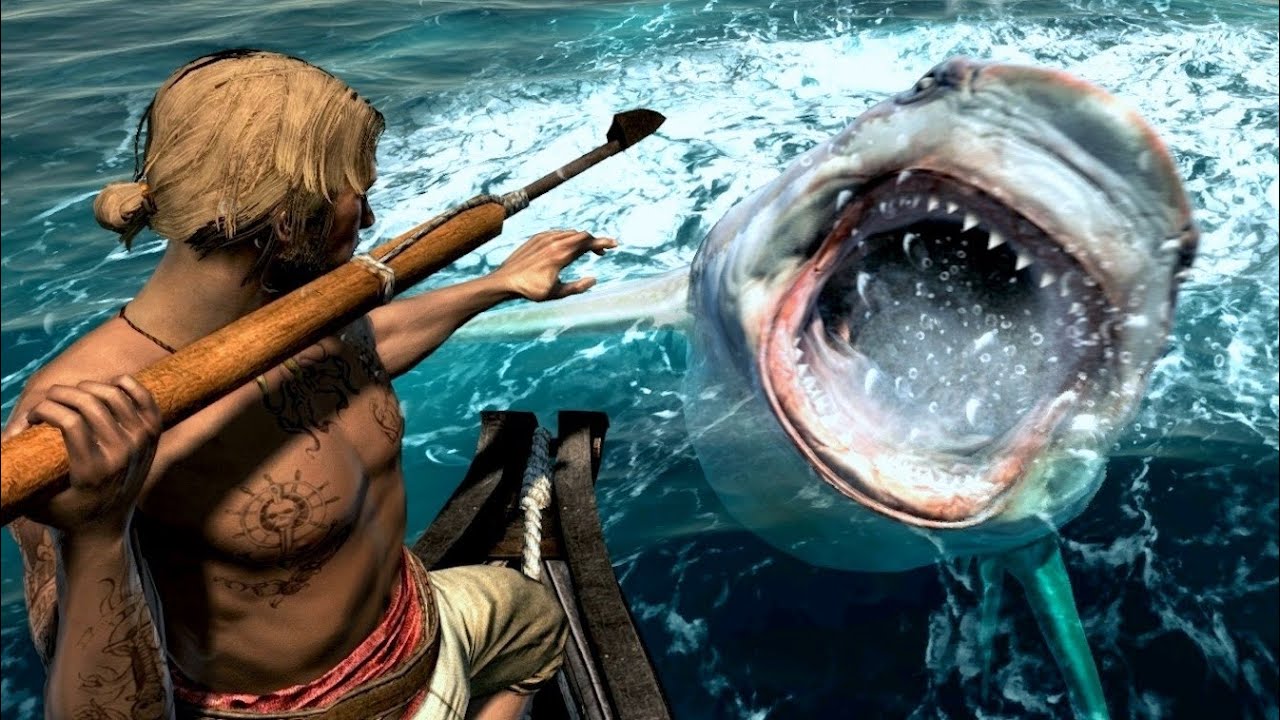
Another unique feature is the ability to get into a rowboat at certain places and hunt sea creatures with a harpoon, such as sharks, whales, and orcas. These are very intense encounters, especially when you don't have your equipment upgraded.
Even when just sailing around, you are bound to see dolphins or whales jumping out of the water. There are also a wide variety of land animals that can be hunted, such as jaguars, deer, crocodiles, and monkeys. Any materials you gain from an animal can be used to craft items for your inventory. There are also domesticated animals that you can't kill, but can pet or feed, like cats, dogs, cows, and chickens. It is a vibrant virtual world that reflects the ecology of the American tropics.
Most of the gameplay should be very familiar to anyone who has played other Assassin's Creed titles. The combat and free-running controls are still very fluid. You can climb almost anywhere- on buildings, trees, walls, and up the sides of ships. I tend to want to run from place to place, but I also try to slow down & walk so I can take in the virtual scenery and people that give an accurate sense of what that time period was like.
Throughout the game, you interact with historical figures from the age of piracy, such as Calico Jack, Anne Bonny, and Blackbeard himself. This adds to the feeling of being immersed in the pirate culture of the time.
Because I play video games so sporadically & leisurely, this game took me months to finish. I completed the main story, but also have tried to finish all the side missions and find all the items located around the map. There are also treasure maps with clues to find booty hidden throughout the many islands. I'm currently at 95% completion, so I've experienced most of what the game has to offer. I can say that it offers quite a lot!
My only complaint would be the abruptness of the story's ending, although the final scene during the credits was good & ties back into AC3. This tendency to end out of nowhere seems to be the case with all AC games... all of a sudden, it's over! I also would've liked more elements about the First Civilization or the Observatory that is discovered during the game.
These minor concerns are insignificant compared to the amazing amount of work, thought, and detail that went into this title. If you enjoyed other Assassin's Creed games, are interested in experiencing history, or just think pirates are cool, you should definitely play Black Flag. As I said in the beginning of this review, it is a truly epic experience.
I'm looking forward to experiencing the Oculus one day, but it should be clear to anyone that the possibilities of immersive VR are limitless.
Far from being a useless or escapist distraction from the "real" world, virtual reality is simply a new way to receive novel information & sensory input. It's no different than a movie, TV, a book, fine art, or any other human creation that can stimulate our minds.
Video games are a primitive form of virtual reality, in which you are able to explore situations & worlds that exist only in the human imagination, both individual & collective. Although I like to exist in the physical world, I've always enjoyed video games. They are almost an 'alternate consciousness' consisting of explorations into engaging scenarios & mental states.
By synergizing our brains with electronic media (or other future tech that we can't imagine), perhaps we will eventually create parallel streams of experience. We might also be able to fractalize our minds, creating numerous embedded levels of simultaneous thought.
Below are a few Oculus Rift applications that I think are especially cool-looking. Some of them deal with one of my favorite topics, and the source of humanity's future in the Universe, ...Outer Space.
Being a huge Star Wars fan, the idea of using lightsabers in virtual reality is immediately appealing. This demo looks pretty awesome:
I think it's interesting how there are video games in some of these virtual
worlds... games within games, realities within realities. Its similar to the idea of fractally embedded consciousness I mentioned before.
Finally, here's a very funny video, showing the reaction of a Ugandan security guard who loses himself within the Oculus VR:
Since I received a PS4 from my wife last Christmas, I have been primarily playing 2 games - Star Wars Battlefront II and Assassin's Creed Origins. Assassin's Creed has occupied most of my limited gaming time for the past 4 months, due to the sheer expansiveness of the game.
I previously posted about the use of The Flower of Life motif in the game, but since I just finished the main storyline I can write a full review.
Let me start by saying that this game is absolutely awe-inspiring. This is coming from someone who has played video games all my life... and I can say that this is as close to the perfect game as I have ever had the privilege to experience!
Because of the camera feature, I was able to screenshot images of some of the amazing visuals that can be seen throughout the game. All the images in this post are from my gallery below. There is so much to see & experience in Origins that it is impossible to document it all.
The main story is very engaging, and I never got tired or bored of the missions or even the side quests. It follows Bayek of Siwa, who is a Medjay (Magi) or protector of Egypt. He and his wife Aya seek justice for the murder of their son by the Order of the Ancients. The Order searches for relics from a lost "First Civilization" that they use to control mankind. Bayek & Aya eventually form the Brotherhood of Assassins (the "Origin" of the Assassins in the other games of this series) to destroy this Order of the Ancients.
I love history, especially ancient history, and have always been fascinated with ancient Egypt. AC: Origins is set in Ptolemaic Egypt- which was a couple thousand years ago, but the Giza pyramids were already thousands of years old, even back then. These pyramids, as well as other landmarks such as The Great Sphinx, Djoser's pyramid, and countless temples are all present and can be fully explored and climbed upon like everything else in the game.
The Great Pyramid of Giza,
with it's limestone casing & gold capstone in place
Yes, you can climb to the top of the Great Pyramid!
(It takes awhile to climb, but you can slide down the side to get down)
The Great Sphinx, with the paint still intact.
(although the head was probably originally a jackal, guardian of the underworld)
The Egyptian temples were absolutely stunning.
There are many more photos in my gallery linked above
Not only is Egyptian architecture and culture showcased, but ancient Greek influence in Egypt at the time is also heavily represented. Alexander the Great and the Ptolemaic pharaohs from Greece had a lasting impact on Egyptian society, through the establishment of Alexandria and the infusion of the Greek pantheon of gods & their temples.
The legendary tomb of Alexander the Great.
At the top of The Pharos, or lighthouse of Alexandria.
One of the many temples influenced by Greek architecture.
In addition to the historic landmarks, Assassins Creed titles always put the player in the presence of famous historical figures and situations. In this one, you are involved with pivotal events involving Cleopatra, Julius Caesar, Ptolemy XIII, and Pompey the Great.
Talking with Cleopatra along the Nile River.
Cleopatra becoming acquainted with Julius Caesar.
This is how you encounter Pompey the Great-
decapitated & impaled on a spike by Caesar's army.
As with all the Assassin's Creed games, the historic events are masterfully woven into the main storyline. The great thing about these games, however, is that you are not forced into a linear playthrough. You can go off onto side quests, or just explore at your leisure. It is a true sandbox style experience, where you can go anywhere or just do nothing but look around at all the captivating scenery, if you want.
Even though there are important figures from history in the story, my favorite aspects were just the ordinary slices of life that are captured everywhere. The level of detail is so astounding, that I was often in total disbelief that something like this could even be created! It truly is an epic work of art that gives a better sense of human history at all levels than any textbook or class could ever approach.
A random merchant's stall, with a dozen detailed items to inspect.
A closer look at the merchant's goods.
The level of detail, even in this little section, is crazy.
Just some dudes hanging out at the baths.
Street musicians entertaining passersby.
On the other end of the spectrum, another aspect of Assassin's Creed games that make them great are the mythical elements, revolving around the mysterious "First Civilization". This is a race of technologically-advanced beings who created humanity, but were destroyed by a cosmic cataclysm in the distant past. They have left seemingly magical artifacts and "Vaults" containing knowledge incomprehensible to the human race. Although there wasn't as much about Those Who Came Before in this installment, the aspects that were included were pretty cool.
One of The Vaults from the First Civilization
was hidden below the Great Pyramid
Bayek and Aya discover another Vault,
with a holographic map of the Earth.
They obviously think this is some sort of magic.
The settings in the game, both natural and man-made, are very immersive. There is abundant wildlife, common people doing their daily routines, and beautiful architecture throughout the ridiculously vast map. I still haven't explored and unlocked anywhere near all the areas, despite finishing the story.
The various landscapes and vistas in the cities, towns, and surrounding wilderness are enough to make you often just stop and observe. Then you may be jolted into action by an attacking alligator or cobra out of nowhere!
Crazy random shit happens, like wild animals attacking each other...
...or wild animals attacking you!
One really cool feature is the ability to use of your hawk Senu as a scout, to get a literal birds-eye view of the locations, including the enemies and treasures there. You can also use the camera while in Senu mode to get awesome aerial shots.
There's just so damn much to rave about with this game... I put off writing the review because I knew it would take me at least a couple hours. If you've read this far, and haven't been convinced to play this 1st class title, then there's nothing more I can say to persuade you. It's an absolute masterpiece.
I will leave you with a final picture of, not a Monkey Buddha, but of Babi the baboon god... I guess it's close enough!
I usually prefer to play open-world games, where you are free to roam around and engage missions whenever you choose. Since I only play casually, the vast amount of content & area to explore in these games means it takes me months to finish a title. (Recently, my Playstation has been mostly a Batman & Assassin's Creed machine...)
The rich, vivid re-creations of historical cities in all the Assassin's Creed games make the virtual time-traveling well worth it. "Assassin's Creed II", & "Brotherhood", both took place in Renaissance Rome, following the adventures of the Italian assassin Ezio Auditore. "Revelations" takes Ezio to Constantinople, the city in modern-day Turkey that was the center of the Byzantine empire. It was also a Roman & Ottoman capital at different times- a cosmopolitan city where Eastern & Western culture intermingled.
The Eastern influences in the Byzantine architecture, clothing, & decoration in the city are an interesting change from the styles seen in the Italian cities in "AC II" & "Brotherhood". The amazing level of detail in the cities are probably the thing I enjoy the most about these games. They are the closest thing we currently have to experiencing what the world was like back then. The talent & vision of the teams who create these virtual environments is truly impressive. As I've said in other game reviews, I spend alot of time just roaming around & observing the many details in different
parts of the map.
The game play is not much different from the other AC titles. Most of the missions involve stalking targets using stealth tactics, tailing people without being seen, or battling large groups of enemies. It is not repetitive enough to be boring, but there is nothing really novel in the mission objectives. Still, the story & side missions are fun overall.
There's a fair amount of platforming & environmental challenges, but not as many as previous games. The one that stands out was climbing the inside of the famous landmark the Hagia Sophia. I have a slight aversion to heights & platforming segments that simulate high areas always makes my hands sweat a little! By the time I had reached the top of the Hagia Sophia's interior, climbing across ropes & precarious ledges, my heart rate had definitely gone up.
In "Revelations", the story of Ezio is masterfully intertwined with Altaïr, the assassin from the Middle Ages who was featured in the original "Assassin's Creed". The story follows the historical struggle between two secret groups, the Assassins & the Templars. These two factions are trying to control powerful technology, in the form of relics from The First Civilization. This is a race of highly-advanced humanoid beings who existed before mankind. In fact, they originally created humans as a type of slave labor, similar to the myths of the Sumerian Annunaki.
Thousands of years ago, the genetically-engineered humans rebelled against their masters. The resulting war distracted everyone from a cosmic cataclysm, that almost wiped out both races. Afterward, they tried to come together & rebuild, but for various reasons the First Civilization ended up becoming extinct. They left behind remnants of their advanced tech & holographic avatars to guide the hybrid descendants of humans & "Ones Who Came Before". The hope is that, with enough warning, precautions can be taken to prevent another catastrophe from wiping out the planet's inhabitants yet again.
With this story as a backdrop, you are actually playing as Desmond Miles, the modern day descendant of the assassins. He has been accessing his ancestors' "genetic memories," via a virtual reality machine called The Animus. So, when you play as Ezio or Altaïr, you are really playing as Desmond virtually experiencing the lives of his ancestors. He was held captive by the Templar front company Abstergo, but is now back with his fellow Assassins as everyone is searching for technology called "Pieces of Eden".
In this game, Desmond's mind has begun to fragment, from the strain of all his virtual trips into The Animus. To prevent his mind from completely falling apart, his consciousness is stored in some deep part of the computer. It manifests in an area called "Animus Island," where he must go through several 1st-person environmental mazes. These sequences take place in minimalistic, but surrealistic dream-like architecture. Desmond's missions on Animus Island are a side aspect of the game that can be accessed from the menu at any time.
Of course, most of the action follows Ezio as he carries out missions & searches for keys that will allow him to unlock Altaïr's library, where a Piece of Eden has been hidden.
This was a very satisfying conclusion to Ezio's storyline, even if you have to wait until the end to really get some "Wow!" moments. He was a well-developed character, who was alot of fun to play. Following the many events in the lives of both Ezio & Altaïr give you a deep sense of identifying with the historical struggle of these characters to keep their secret order alive, while they were also trying to grow personally.
If you are willing to invest the time, the Assassin's Creed series is a quality production of the highest order. The visuals are stunning, gameplay is engaging, and the storyline makes you think about ideas like virtual reality, the mysteries of genetic information, and the interconnected history & future of humanity.
A friend of mine teaches art at the school. Another teacher he knows remembered I have experience in game design & development.
I enjoy getting out of the studio to help kids understand the possibilities in commercial art and other creative fields. This was especially fun to see the ideas the kids came up with.
The theme was "Solving America's Energy Problems". There were several takeoffs of 'Monopoly' & 'Chutes & Ladders', but there were also some good original ideas. Since the games were energy-related, many focused on Green Energy, or the Middle East. Several games used the faces of leaders like Obama, King Saud, and Hillary Clinton on play money. One team made clay sculptures- of a pyramid, the Sphinx & Hosni Mubarak on a mummy sarcophaghus! All the kids, though, put at least some kind of effort into the project.
There were over a dozen teams & the games were set up in the cafeteria. The students were told to get up & move over to a different game at certain points. This way people could try other teams' games.
Meanwhile, the teachers & I walked around observing the teams and their projects. I quickly came up w/ a 3 point system to quickly rate the teams as I stopped by each table.
I'd place a dot next to their name for each of the above qualities I thought they met. I made official-looking Winner Certificates on parchment paper for the top 3 teams & the whole event went very well.
Before I went in there to judge, the teacher asked me to make a brief video (posted above) for the students to watch- recounting my experiences in creating games and other products. I used my efforts in producing Da Vinci's Challenge to help describe the process.
My brother works in A/V & film editing so I asked him to help me put together the video. He has awesome editing skills & was indespensible in getting it done.
Since we both also saw it as a cool project to use on his Youtube video page, we put waaaay more voluntary work into it then we needed to.
The result is a basic intro to graphic design & the process of product development that we think turned out well, considering the filming and time constraints.
The students' assignment was to create a board game for a social studies class, based on the theme "Solving America's Energy Problems".
It was alot of fun & some of the kids had very good ideas. There were several of versions of Monopoly and Chutes & Ladders, but there were original games as well. Several teams used faces of world leaders like Obama, King Saud, and Hu Jintao on Monopoly money, which was funny. There was alot of creative ideas for gameplay & the materials used to make the different projects.