Showing posts sorted by relevance for query singularity. Sort by date Show all posts

Monday, August 06, 2012

The Evolution(?) of Man

My Dad, Big Paul, has a funny outlook on technological progress.

He always insists that technology is changing us in such a way that humans are going to end up as immobile blobs, with video screens attached to their faces.

The movie Wall-E had a similar premise:


Considering that I & my siblings have iPhones that we're always on, I can see how he'd think his prediction is being vindicated.

I saw this amusing animated GIF below on Memebase & I immediately thought of my Dad's theory:


I personally think that even with future technology (like an "Apple iThink") humans will still physically function as we do now. However, our senses, perceptions, & mental abilities will be enhanced beyond limits we can currently imagine.

Maybe there will eventually be movements of people, "Naturals," who vigorously oppose the inevitable melding of man & digital machine.

One day in the farther future, however, there might be a point where, as the late, great Terence McKenna claimed, we may 'shed our monkey bodies' & enter hyperspace, no longer confined by the physical constraints of our current biological existence.

Until then... I'll just continue to enjoy the many pleasures & novel sensory experiences of this mortal, humanoid form.

(...although I would appreciate augmented memory & perceptions with multiple, parallel streams of consciousness.)

To illustrate this jump into the Singularity, below is a techno-eschatological self-portrait I submitted to the website, "Can You Draw the Internet?":

From The Monkey Buddha Visual Archive:

"A digital self-portrait
representing the mind integrating with &

transcending physical technology
through immersion into the realm of pure energy.

The Internet is the beginning of a conduit
into a non-local experience of consciousness."


Monday, September 17, 2007

Holograms are Virtually Here!

..pun intended...
There were a couple ideas in science fiction that always seemed to be waaay to technologically difficult to overcome anytime soon - teleportation, faster-than-light travel, laser guns, fighting robots, etc. In the mind-boggling time that we live in, these hurdles seem to be much more feasible with each passing day, approaching the information singularity, perhaps?. One future tech that I always thought to be especially tough would be holographic displays. Despite living in a holographic universe, the idea of creating images in thin air seemed far-fetched. Of course, human ingenuity can be surprisingly ingenious.

"Rendering for an Interactive
360ยบ Light Field Display"

Link to story on Engadget


How appropriate that they chose an image of a TIE fighter,
since the next step for this technology is:


Tuesday, July 07, 2009

Apple "iThink" Concept- in MacLife!

(click to enlarge)


It is always cool to see any of my work published, but I was really excited when an editor at the magazine MacLife contacted me - & wanted to include a concept that I created for fun in one of their issues. They ended up publishing my letter, "Future Influencers", and both images!

Unfortunately, I didn't get my hands on a print copy of the magazine, but here is a link to the digital edition that I came across recently:


A year or two ago, I put together some graphics for a concept that I had floating around in my head for awhile: an Apple-branded computer w/ a brain interface, that I dubbed the "iThink".

I am re-posting the 'specs' and the artwork at the bottom of this article. Here is a link to my previous entry where I improved the graphics a little:

Monkeybuddha.com:
Apple iThink-Upgraded

I have seen others comment online about this idea from around the world, which itself is amazing to me. Ex. (1) (2) (3)

People's views have ranged from very enthusiastic to completely horrified at the possibility of our brains being directly connected to The Machines. As one girl I know exclaimed when she saw it, "You thought of this?... My God, you're the enemy!!!" For some reason, I was totally amused by this reaction.

Regardless of how one feels about the inevitable progression of technology, digital-neural interfaces are becoming more of a reality- even since I first posted the original artwork. I saw the following article linked on Monochrom & realized I might not have been all that far-sighted:


So here is the iThink, presented again in light of it's print debut in MacLife
(as well as the impending Singularity).

click to enlarge

iThink Technical Specifications

• Size:

1.5 x 1.5 x .5 inches

• Symbiosis™ Neural Interface:
Direct brain-computer link means your mind and computer are one!

• Intel Fusion™ Quantum Processing:
Uses the power of the atom to instantly compute at the speed of thought.

• Holographic Data Storage:
The iThink’s tiny internal holochip has a staggering individual capacity of over 666 Yottabytes (1000^8), for seemingly infinite augmented memory

• Intra-neural Communication:
Mentally allow or block any kind of signal you want to send or recieve instantly over the wireless iThink global network

• Perceptual Immersion:
Images, sound, & other data are projected virtually into your sensory fields by directly connecting into your brain’s activity

• Integrated GPS and Google Earth:
Receive directions and location information anywhere on the planet, and the ability to be located in case of an emergency


*My favorite web comment so far:
"This looks much more congenial than the long anticipated converted pneumatic cattle dropper designed to stuff an rs-232 micro socket somewhere above the hairline. And it appears to be short range wireless, which eliminates any need for hygienic socket maintenance. Bravo puppet masters! Soon we’ll all be dancing around like multi-mode idiot savants, knowing all while aware of nothing! Can’t wait for my turn up on the rack."

Tuesday, October 16, 2007

Data Backup for the Apocalypse

The one thing that's always bothered me about keeping a blog is the impermanence of the media.

In the event of a much-anticipated Armageddon / End Times / Singularity, the work of millions of people would disappear. Perhaps we are in the process of developing a Hall of Records type depository where the recorded thought patterns of humanity can be stored.

I saw this on boingboing & thought that it's as good a start as any.

Nuclear Hardened Data Center

Of course, in the face of a cosmic cataclysm, such precautions (along with the rest of the entire human legacy) will be erased like a drawing in the sand.

If things become so bad where this type of backup is needed, people aren't really going to be worried about screwing with computers...

Tuesday, April 30, 2013

The Impossibility of Immortality


My last post was about the inevitability of death & perspectives on our mortality.

Despite our brief flash of existence in this world, mankind has always strove to achieve immortality, or at least a more enduring legacy. Part of the reason is the fear of what happens when our life force leaves the body. Another motivation is the desire to connect with other people in a different time & place.

I see the situation both ways. On the one hand, it's human nature to want to preserve some aspect of ourselves beyond our physical lives. On the other hand... a billion years into the future, it's possible that absolutely no trace of humanity will remain anyway!

The idea of our existence being completely devoid of inherent "purpose" or "destiny" is terrifying to most people. It's incomprehensible to the ego-driven mind that the entire enterprise of human civilization could one day... vanish.

The Buddhist are wise to emphasize non-attachment to the world, because it is a fundamental truth that "All Composite Phenomena Are Impermanent".

I think the creations with the best chance of surviving the ages are sculptures carved into granite mountains, like Mt. Rushmore, Georgia's Stone Mountain, or the Crazy Horse Memorial. I can imagine post-apocalyptic humans coming across these monuments in the far future, and wondering if these were carvings of leaders, mythic heroes, or perhaps even gods.

Here are a few proposed projects that seek to defy impermanence & extend human presence into the (relatively) far-off future:

• The "10,000 Year Clock" is an interesting attempt to defy our impermanence. It is a massive, yet precise timekeeping system that will be enclosed inside a mountain! It is being designed to operate with minimal human intervention for many millenia. The only major human creations that have lasted anywhere near that long are Stonehenge & The Great Pyramid. (These structures were also primarily designed to encode knowledge of time.) 10,000 years is a mind-boggling time span, however, it's only a cosmic blink of the eye!

The Long Now:


As an engineering feat, this clock will be one of man's most impressive & lasting to date.

IEEE:

The main problem I see with this idea is how people of the future would know the clock is inside this particular mountain.

If humanity is still around thousands of years from now & they can find the clock, it would be interesting to see how people react to it...


"The Last Pictures" conceived by artist Trevor Paglen, is another far-sighted project- to preserve remnants of humanity on a disc of photos.

Singularity Hub:


Again, the problem I see would be in the possibility of humans actually finding this artifact in the distant future. If it's in a satellite & ends up in an orbital junkyard, it may never be found... or it may be collected by space robots & treated like scrap.

"Voyager's Golden Record" This was NASA & Carl Sagan's approach to creating a vehicle for preserving the record of humanity indefinitely. Launched in 1977 (the year before I was born), the Voyager spacecraft are the first human creations to have left the solar system, containing media that may (...or may not) be able to be interpreted by other lifeforms if it's ever encountered.


• The next major hurdle is the preservation of the massive amounts of data now being generated & shared in the digital age:

Science Daily:

Besides the durable media needed to record the data, we also need a place to keep it all secure:

BoingBoing: 

Ultimately, the only way humanity can have a continued legacy is to travel into the Universe &  beyond our home world. To stay connected, we will have to figure out how to network throughout interstellar space:

SpaceRef:

Our main functions, into the foreseeable future, will continue to be survival of the species & increasing connectivity on all levels. 

As time goes on, we will also evolve and change into new forms- for as long as the human lineage endures.

Wednesday, November 05, 2008

Election Thoughts


"OBAMA!!!!"
"OBAMA IS A MACK-DADDY!"


Wow - I've always liked the long-legged freak, but I really, truly thought that there was no way in hell that enough Americans would actually vote for someone named Barack Hussein Obama.

• 'Obama/Biden' is so close to 'Osama Bin Ladin' that it has to be a cosmic joke.

• Yeah, the guy's half-black. This is historic only because America is still full of haters & morons.

• What's more important, as a practical matter - the new President is actually going to be SMART, ELOQUENT, & COMPETENT. Imagine that!

• I always try to prepare myself for the worst scenarios in any given situation. When things actually work out nicely, it ends up seeming like a miracle.

• This result of this election is like an 'anti-9/11', in the sense that our entire county of millions joined together. Except, instead of horror, sadness, and anger... the outcome was full of joy and
celebration.

• We are obviously oscillating towards the singularity.

• God clearly doesn't like the Republican party anymore.

• Besides his pandering to the design industry, the Obama campaign's use of art & media was very impressive. Also impressive has been the positive influence Barack's campaign has has on the art community.

Tina Fey & Katie Couric helped
save our Republic from further zombification.

• Barack Obama is powerless against magnetic pole reversals, solar flares, and every other natural phenomenon.

• CNN is the NASA of infographics & Sith technology.

• I kind of felt bad for McCain when he called himself a failure in his final speech. The guy should be proud of himself. Even if I personally thought he wasn't the better candidate, he should be respected as a hero.

• It was McCain's clueless She-Bush sidekick who was unbearable to me & the rest of America. If Sarah Palin wins in 2012, then I will assume that the Mayan doomsday is at hand.

• Obama is crazy for even wanting this responsibility. The dude seems unbelievably motivated, though. Compared to the rogue's gallery that Bush put together, Obama's executive leadership might actually start being effective.

• Fortunately (as the supreme jerk, Donald Trump, said in this interview), "He cannot do worse than Bush... he's been a catastrophe." What he says about Condoleeza is hysterical too.

• 'The Donald' is basically clarifying what cannot ever be emphasized enough: George W. Bush has been a complete failure in every respect & has been an unholy curse on this nation. Good &*%&^&! riddance.

Saturday, February 14, 2009

Linking to the Hive Mind


There are 100 billion neurons in the human brain. There are about 7 billion people on earth- maybe not enough to make a 'brain' yet, but the levels of connectivity permeating our lives is accelerating faster than any one person can fully grasp.

The world's becoming enveloped by broadband, satellites, wi-fi, cellular communication, and all the other magical ways people are exchanging information using pulses of patterned energy. An external hive mind is now steadily increasing in connectivity and content as each moment passes.

When I was a kid in grade school, I knew there had to be a better way to learn and get new ideas than just the Encyclopedia or the Library. In the days before the emergence of the World Wide Web, though, I had no idea what that improved system could be. I just knew back then that getting information solely by looking it up in books really, really sucked.

Now, we have instantaneous information, creativity, and communication through "The Web". Although I'm satisfied with the current state of the internet & its capabilities, the march of progress continues. As technology becomes more ubiquitous and wireless, it's becoming a networked cloud, continuously sharing the collective experiences of humanity.

It seems we are becoming permanent participants in a technological mindstream. Perhaps we will soon be linked up to the hive mind via our iThink and be able to learn even the most difficult lessons instantly. Maybe one day we'll even shed physical networking systems altogether, when we discover how to tap into the Akashic Field. There is, of course, the crappier possibility that humanity will be destroyed before any of this happens.

The future of computing, networking, and how they relate to a global consciousness is something that is compelling to think about. These are links to great articles about the coming Overmind that have caught my attention so I wanted to post them:

Sunday, December 30, 2012

Terence McKenna Omnibus 2012

The late Terence McKenna was one of the extraordinary minds of the 20th century. I became aware of him at the end of his life around the turn of the millennium. I've listened to many of his loquacious, humorous, & mind-expanding talks since then.

He was a true visionary who was unafraid to look deeply into reality, human nature (in all its weirdness), & the infinite mystery before us.

Most people would find his ideas to be waaaay 'out there', but I see him as a true Crazy Wisdom master.

One of the few things I really thought he was off the mark was his "TimeWave Zero" theory. He postulated that on Dec. 21, 2012, the end of the Mayan Long Count cycle, there would be some kind of manifestation or emergence of a Singularity. In this scenario, "Time," as we know it, would collapse. Consciousness would expand into a higher dimension or state of being.

Based on calculations using his fractal timewave theory, McKenna called this history-ending event: "The Transcendental Object at the End of Time". There may still be some kind of event that alters global consciousness at some point, but he was obviously mistaken to pin it on a specific date.

Over the past year. I've been watching the progress of a video series, documenting McKenna's ideas & lectures. The final episode was recently uploaded to coincide with the end of 2012, so here is the link to the series & the first video embedded:


Tuesday, July 29, 2008

Introducing the "iThink"

I love Apple computers.

Besides providing modern necessities such as internet & email, the computer is pretty much my sole source of creative output. I started using Macs in my college design classes & was glad to be rid of Windows from my life after growing up with DOS & Windows 3.0.

As a senior, one of my semester projects was to design a computer of the future & relevant promo materials. Mine was basically a powerful handheld device with a wireless keyboard and an eye piece for a screen.

Since then, there's been alot of talk about what will happen when the creeping advance of digital technology begins to directly permeate our consciousness. We already have bionic body parts, brain implants, mind-interaction software, primitive AI, and all kinds of other that are signs of the continuing fusion between man and machine.

This also got me thinking about the inevitable augmentation of human experience through computers that will link directly to our conscious thoughts. This web is already being interwoven, so to speak, and there is speculation that some sort of super-consciousness could result. This idea has been given labels such as the Hive Mind, The Singularity, The End of Novelty, etc.

My Dad always jokes that one day, people are just going to be white blobs hooked up to all kinds of computers & electronics. I'd been thinking about the possibility of microchips being implanted that were essentially computers connecting to our brains. I wondered how my favorite brand, Apple, would exist in such circumstances.

That's when I thought up the "iThink":


"The most revolutionary computer in history,
iThink allows you to interact with
unlimited information, virtual imagery & sound,
and even immersive environments,
all within your mind!"


click for larger image (1900x1200)


It's taken me awhile to actually finish these graphics due to procrastination & the interference of life in general. I've been running it around in my head for awhile, though. Anyway, this was just a fun project for me. This all might seem incredibly geeky, but I think it's a pretty intriguing concept that illustrates real possibilities.

We have to ask ourselves what a human being's mental experience will be like when we get to this point. Will we be able to close our eyes and create an environment like a holodeck inside our own headspace? How will we control the data streams and imagery that will be flooding our perceptions? Will any outside source be able to hack into our brains? Will there be different classes of people according to whether they are 'natural' or 'cyber'?

There are millions of questions that only time will answer. For now, we can only imagine how a product like the "iThink" would affect mankind.

In addition to the poster above, I also created a spec sheet to resemble those used for Apple's existing products. Scroll down for text of the tech details...


click for larger image (1900x1200)


iThink Technical Specifications

• Size:

1.5 x 1.5 x .5 inches

• Symbiosis™ Neural Interface:
Direct brain-computer link means your mind and computer are one!

• Intel Fusion™ Quantum Processing:
Uses the power of the atom to instantly compute at the speed of thought.

• Holographic Data Storage:
The iThink’s tiny internal holochip has a staggering individual capacity of over 666 Yottabytes (1000^8), for seemingly infinite augmented memory

• Intra-neural Communication:
Mentally allow or block any kind of signal you want to send or recieve instantly over the wireless iThink global network

• Perceptual Immersion:
Images, sound, & other data are projected virtually into your sensory fields by directly connecting into your brain’s activity

• Integrated GPS and Google Earth:
Receive directions and location information anywhere on the planet, and the ability to be located in case of an emergency

Thursday, April 11, 2024

Techno Viking A.I. Goblin


Artificial Intelligence is doing something that was definitely NOT what most people would have thought the machines would be capable of - simulating & re-creating (at least visually) what people experience in psychedelic states. 

This trippy application of computer software gained prominence with the "Deep Dream" programs about 10 years ago. It generated hallucinogenic animations in which barely-recognizable imagery would cycle as weird textural features.

The Monkey Buddha Archives:
Deep Dream Images

Now, A.I. programs are just outputting the craziest, most mind-boggling imagery & video. We are breaking through to a singularity-type situation of infinite amounts of novel imagery, generated continuously. One thing I've been thinking about lately is how fusion power is developing in tandem with A.I.. Perhaps we will need a new power source to accommodate the massive amounts of clean energy that will be needed for emerging technologies in computing. It's fascinating how these interconnected innovations are evolving simultaneously.

I've posted about the possible outcomes of this paradigm-shattering technology, but I am just left in awe thinking about the implications. I don't even pretend to understand the coding & technology to produce this kind of software. It's basically Enochian magic, as far as I know. The biological human brain & society eventually won't be able to keep up with the madness that's about to ensue.

Check out this amazing A.I. alien goblin remix of the old "Techno Viking" video that had me dying:

When you partied a little bit too hard
and transcended into another dimension


Sunday, December 11, 2016

iThink Tech 2016

Back in 2008, I introduced my concept for an Apple-branded computer brain implant, the "Apple iThink".

The Monkey Buddha Archives:

(Click to Enlarge)

iThink Technical Specifications

• Size:

1.5 x 1.5 x .5 inches

• Symbiosis™ Neural Interface:
Direct brain-computer link means your mind and computer are one!

• Intel Fusion™ Quantum Processing:
Uses the power of the atom to instantly compute at the speed of thought.

• Holographic Data Storage:
The iThink’s tiny internal holochip has a staggering individual capacity of over 666 Yottabytes (1000^8), for seemingly infinite augmented memory

• Intra-neural Communication:
Mentally allow or block any kind of signal you want to send or recieve instantly over the wireless iThink global network

• Perceptual Immersion: Images, sound, & other data are projected virtually into your sensory fields by directly connecting into your brain’s activity

• Integrated GPS and Google Earth:
Receive directions and location information anywhere on the planet, and the ability to be located in case of an emergency
_____________________________________

Since I originally created these graphics, I've watched technology continue to advance, as different fields converge to making such a neural implant possible.

Although there are now implants in use that allow communication by thought and remote control of software, we are still a long way off from a device that contains the many features of the iThink.

Without some cataclysmic event happening on a global scale, I don't see the progress of this kind of research ever stopping. There will always be resistance to any kind of implantable devices, and there might eventually be a "Deus Ex" scenario where humans create social distinctions based on cybernetic augmentations. There may be conflict between implant-free "Naturals," and "Enhanced" (or "Cyber") humans with neural or physiological augmentations. Any new technology, no matter how beneficial, usually brings with it slight uncertainty and the potential for misuse.

My iPhone and Mac computer are extensions of my cognitive and creative processes. I feel like these  devices are portals into the global consciousness, while simultaneously augmenting the functions of the brain. However, I often think about whether the digital techno-sphere is a trap for individual consciousness, preventing it from finding freedom in the more spiritual sense. My personal feeling is that digital technology and mobile devices are enhancements, more than they are traps. It depends on how they are used, of course, but I feel that their benefits outweigh the potential danger.

Anyway, I love to speculate on the future of humanity and the new ideas that will lead to revolutions in our world. I have been floating around ideas for even more advanced tech & features, that would be in an Apple iThink 2.0. However, seeing as we haven't come close to reaching even this stage in implantable technology, I haven't created graphics for the next version yet.

In the meantime, I've been compiling "iThink Tech"- scientific & technological advancements that are leading us down a road toward implantable computers which will interact with our brains directly, for completely immersive computing.

Here are the relevant links I've found from the past year:

 Singularity Hub:

Digital Trends:

Big Think:

New York Times:
(Thanks to my good friend Dr. Phil for this link)

PBS Newshour:

BoingBoing:

Inhabitat:

BoingBoing:


–––––––––––––––––––––––––––––––––––––––––

"As our minds will attain the non-linear associative powers 
that will do away with the static mold of analog information,
we will finally break through the speed barrier of thought."

Monday, May 14, 2012

Welcome to Life: Post-mortem Software

I saw this interesting thought experiment on Neatorama:


There are many people who might welcome the chance to use something like an Apple iThink or a similar brain implant to augment their consciousness.

However, as this video shows, there would many unintended consequences & logistical issues that people can't even begin to imagine yet.

If technology progressed to a point that one's mental processes could somehow be enhanced or extended beyond physical death, I hope it wouldn't be encumbered by such banalities as legal agreements or advertisements.


Unfortunately, it's possible that by digitizing their consciousness in order to preserve it in perpetuity, people would be subjecting themselves to an infinite virtual prison sentence.

Of course, absolutely nobody knows whether death is a permanent "lights out"- or a gateway to another state of existence... so that's the gamble one would have to take.

Tuesday, April 16, 2013

Should Genes Be Patented?

Short Answer:

NO.


The U.S. Supreme Court is currently taking up a case regarding the legality of patenting genetic information. Allowing this kind of legal ownership would denigrate living systems to the status of intellectual property.

 Singularity Hub:

The idea that a biotech company can claim rights over a gene sequence or DNA from a certain organism is simply unethical. It also inhibits research... & is completely insane.


Here are some articles on this case, which will have a serious impact on many fields regardless of the outcome:

PBS: NOVA

• A Federal judge ruled against the gene patents in 2010:

NPR:

• In 2010 the Justice Dept. also came out against the practice:
NYT:

• Then, the Federal Appeals Court overturned the decision:

 Raw Story:

• Now, it's up to the Supreme Court, with it's Corporate Conservatives, to decide:

NBC News:

Yahoo! News:


Thursday, February 28, 2008

Brahma Breath: The Cyclical Universe

Both the religious dogma of the biblical Genesis & the scientific dogma of the singular Big Bang always seemed equally absurd to me, in the sense that the entire universe supposedly began at a certain 'discernible' point.

I always struggled with what existed before, which had to be- nothing! Then, the question is how everything came from- nothing! There is really no adequate explanation that our monkey grunts can properly convey. We can say "God did it." or "There was the singularity" but these are just phrases that help us box up The Unimaginable in a comfortably managed package. We try to intellectually deal with the infinite nature of the universe... as long as it's confined inside definite, finite parameters!

The human mind, trying to imagine the state of reality before the beginning of the universe, is easily overwhelmed by this incomprehensible and eternal mystery.

I am definitely of the school of Giordano Bruno who accepted that, as far as human perception is concerned, the infinite worlds inhabiting infinite space. Outside of human perception, however, I am not qualified to speculate - being that I'm only human.

What I find endlessly interesting is the continuing correlation between modern scientific interpretations of the cosmos with ancient metaphysical concepts. I read this Wired interview with physicist Neil Turok in which he makes the following case:

"...the Big Bang represents just one stage
in an infinitely repeated cycle
of universal expansion and contraction.
Turok theorizes that neither time
nor the universe has a beginning or end. "

The further explanation he gave, no matter how scientific, is really just weaving a story around this central concept. Ultimately, Mr. Turok makes yet another excellent point when he says "I feel that the main role for these scenarios of the early universe is to stimulate our thinking. I don't necessarily believe any of them."

Reading these theories about the cyclical nature of reality reminded me of the Hindu idea of the cosmos as going infinite cycle of inward & outward "breaths" that are quite literally the fractal fluctuations of an infinitely complex reality:


Carl Sagan on Hindu Cosmology:

"It is the only religion in which the time scales correspond, no doubt, by accident, to those of modern scientific cosmology. Its cycles run from our ordinary day and night to a day and night of Brahma 8.64 billion years long. Longer than the age of the earth or the sun and about half of the time since the big bang. And there are much longer time scales still.

There is the deep and the appealing notion that the universe is but the dream of the god who after a 100 Brahma years… dissolves himself into a dreamless sleep… and the universe dissolves with him… until after another Brahma century… he starts… recomposes himself and begins again the dream… the great cosmic lotus dream."


Tuesday, April 25, 2006

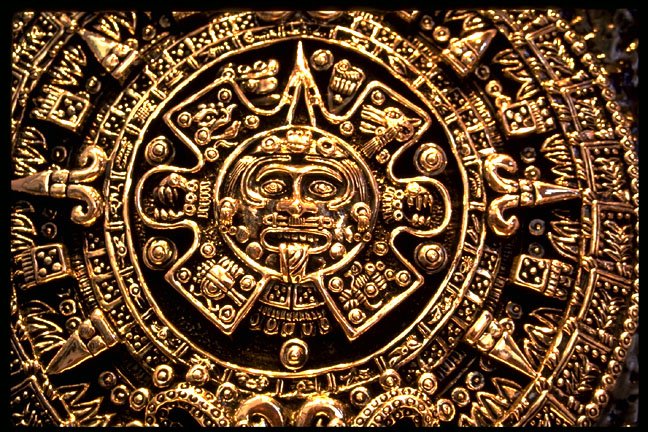
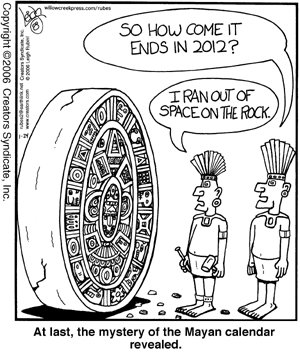
The Mayan Calendar - 2012 A.D.

Whether it is just a fantastic man-made notion, or if there really is some kind of singularity or transcendence of the human experience on this date of December 12, 2012, it has huge resonance with the collective consciousness of people on this planet. It is the date calculated from Mayan Long Count calendar in which the 5,125 year age we are currently living in (one-fifth of a 26,000 year Great Cycle) will come to an end as the winter solstice sun passes through the galactic plane of the Milky Way.

I think ancient people were more aware of subtle levels of existence and the cosmic cycles of the universe than we are, and we are beginning to gain that wisdom and insight again as the world we know approaches a transition from ignorance to awakening and rebirth as beings and as a world.

The question is - what kinds of hell will we have to endure in the meantime?

The Mayan Prophecy of 2012

(On the other hand,
it could be much simpler than all that...)


Click to enlarge
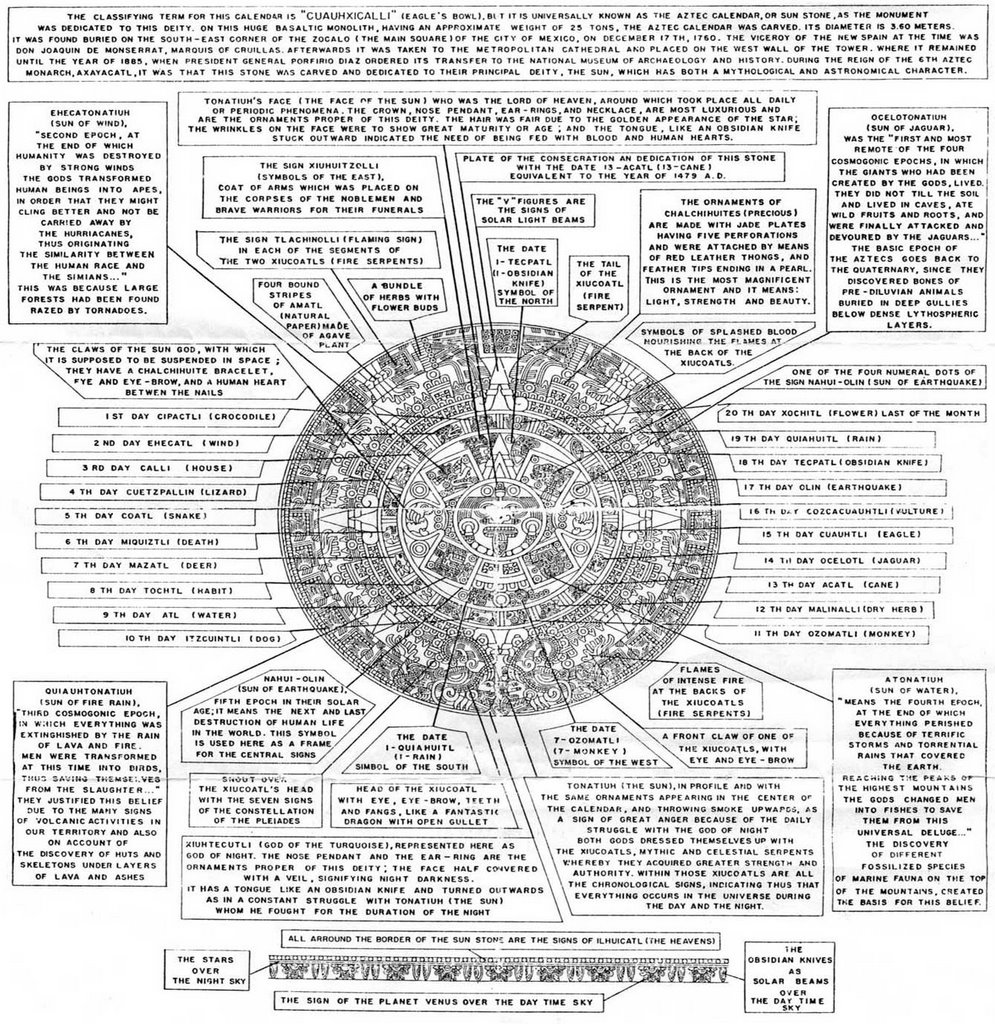
this interesting breakdown of a Aztec Calendar

Thursday, December 04, 2014

Game Review: Mass Effect 3


I just finished Mass Effect 3, the final installment in what has become my one of my favorite video game series.

Here is my review for the first Mass Effect-

The Monkey Buddha Archives

I've also played Mass Effect 2, but didn't write a review for it. Most of the good things I had to say about the first game apply to the whole series. However, I've been so blown away by the Mass Effect games that I wanted to write my thoughts after finishing the trilogy.

This is a work of fiction that is on par with Star Wars, Star Trek, or any other great work of sci-fi. The virtual galaxy you can explore is full of unique planets, alien creatures, and ponderous questions which our entire species must face. I'll repeat them again, because I think they are so vital to consider:

• Is there other Life in the universe, sentient or otherwise?

• What happens when interplanetary species begin to contact each other?

• What is humanity's place in the cosmic order? What role does the individual play in this order?

Is it possible for ANY form of intelligence, or even information, to survive the incomprehensibly vast cycles of cosmological time, on the scale of billions of years?

Mass Effect takes place in the future, after 2147 CE, when humanity has found alien devices & "Element Zero" in our solar system. These artifacts allow us to develop FTL (Faster Than Light) Travel. The subsequent discovery that Pluto's moon, Charon, is actually a "Mass Effect" Relay allows humanity to instantaneously travel to other Relays throughout the galaxy. A vibrant galactic civilization already exists, with a 45km-long space station, called The Citadel, acting as its capital. All advanced alien races are represented here, and after the events of the first two games, humanity has become a major force in galactic affairs.

Your character is Commander Shepard, and you can carry over your character's traits from previous games' save information. Humanity's high standing in the galaxy is, in part, due to the earlier actions of Shepard- most notably fending off an attack on The Citadel by a Reaper.

The Reapers are central to the Mass Effect series. Tens of thousands of these gigantic, conscious machine creatures come out of deep space every 50,000 years to "harvest" sentient organic life, for their genetic information. It is a mysterious cycle that has gone on for at least a billion years and was initiated by an "Intelligence" that's even older than the Reapers.

It turns out this seemingly destructive cycle is actually meant to preserve life, since any advanced biological species will eventually create synthetic Artificial Intelligence (A.I.) that inevitably wipes out all organic beings. The "Intelligence" sees this cyclical harvesting as a way to maintain order and allow new species to evolve. It is revealed that the Mass Effect Relays and the Citadel itself are actually part of an elaborate trap, developed by the Reapers to accelerate the harvesting process of sentient beings and make it more efficient.

In this game, the merciless Reapers have arrived, landing on the home planets of the advance species throughout the galaxy, including Earth. The game starts with an awesome sequence in Vancouver, Canada, where imposing Reapers, taller than skyscrapers, are completely annihilating the city. This is the threat you face from the very beginning, and gives a sense of enormity that such an existential threat would pose to us. In addition to the numerous & varied enemies throughout the game, you actually get to face down a few Reapers in different situations.


It is a rich story, that touches on many deep issues that the human race may one day have to consider. As literally out-of-this-world as this game is, I feel that it is a visionary & realistic depiction of what humanity may one day experience when we are able to travel among the stars...

The planets and alien races are fantastic, yet convincing. The number and uniqueness of the locations throughout the galaxy made it endlessly visually interesting. Although you can no longer land on & explore planets as side missions, I'm glad that the act of scanning planets for resources was made much less tedious than in ME2.

As far as the actual gameplay, there's a perfect balance of customization, role-playing elements, and intense combat. The RPG aspects of the game include dialog options, morality choices, and engaging characters. The combat is excellent, with the ability to use five weapons and a half-dozen powers. The weapon variety and the ability to freeze the action to switch weapons on the fly don't interfere with the intensity of the battles. 


I chose to be in an Adept class, so my character had biotic powers that were effective and fun to use, such as- • the ability to project a destructive warp field • launching a shockwave that throws enemies in the air • creating a mini black hole, a singularity, that holds enemies. The ability to also coordinate your teammates' powers with your own attacks makes the combat much more strategic.

Overall, I was engaged the whole time and couldn't wait to see what the next mission or story sequence would bring. Games like this are such monumental creations, and why I still play critically acclaimed titles such as this one. Even though I've played video games my whole life, I am still awestruck by the technical achievement as much as the game play. It's pretty common for me to just wander around an area, observing visual details and marveling at the artistry behind the level design.

One of the very few reasons I can't give it a 10 is because the game's ending left me unimpressed. I picked the ending where Shepard can take control of The Reapers, using technology developed by an ancient race. I thought there should have been a more cinematic finale, with more impact for the end of such an action-packed story.

Despite my slight disappointment with the ending, the rest of the game was so superb & awe-inspiring that it didn't diminish my overall view of a great game and a undeniably epic series.

• The Monkey Buddha's official rating: 9.75

Monday, January 06, 2014

Game Review: Mass Effect

 
Mass Effect is not just a deeply-engaging game...
It's not just a sci-fi masterpiece, either...

It is both those things... but most importantly, it's an eye-opening commentary on the fundamental questions of existence:

• Is there other Life in the universe, sentient or otherwise?
• What happens when interplanetary species begin to contact each other?
• What is humanity's place in the cosmic order?
Is it possible for ANY form of intelligence, or information, to survive the incomprehensibly vast cycles of cosmological time, on the scale of billions of years?

I've always been a Star Wars fan & generally like science fiction stories. I believe they help map the future of humanity, while helping us understand our place in the larger scheme of things. Mass Effect deserves the many positive reviews it has received. It is an immersive exploration of these ideas, throughout the vast galaxy waiting for us once we become interstellar travelers.

Usually a game of this scope would take more than a month for me to play. Over the holidays I got to put in some marathon sessions, to finish it by the new year. I completed most of the side missions & explored alot of the game, so the total time was a little over 50 hours. Like many of the best video games, it was a better time investment as any engrossing book or TV series. The story raised issues & thoughts that will now be bouncing around in my brain permanently.

Mass Effect is a 3rd person role-playing (RPG) shooter. You create your own version of the main character, Commander Shepard, as a male or female. From the start, you want to pick a persona to guide the choices & interactions the character will make throughout the game. I decided to follow my own personality, as if it were really me in the role.

There is a morality 'scale' that gives you either 'Paragon' or 'Renegade' points, depending on how you react to situations. I decided to generally follow the Paragon path, since I'm not a negative person & I wanted to make decisions that felt natural. Although it is very cool to have this level of character interactivity, I unfortunately take forever to go through the dialog options. It's a bit of cheating, but I found myself looking up the consequences of different decisions online, so I could decide how I wanted the story to proceed. This greatly added to my overall time playing the game.

On a related note, the one complaint I have about the game is the very large amount of dialog. I was playing the game for a little bit over my brother's house while he was doing stuff. He'd walk through & it was early in the game, where you have to interact with alot of characters. He asked me "Is that all you do in this game is talk?!?" I know it is a role-playing game so it's kind of necessary, & I initiated non-essential conversations because there is alot of information in the story that can be learned. Luckily, as the game goes on there's more action & awesome battles to make up for the RPG parts...

The game takes place in the year 2183. Mankind has discovered ruins on Mars, from an ancient civilization. This lost race of beings, known as the Protheans, left ruins & technology all over the galaxy after their mysterious extinction 50,000 years ago. Other alien races have also found relics from the Protheans, that have led to their rapid technological advancement. Finding the remnants of this ancient culture has led to the discovery of faster-than-light travel by humans & other species, resulting in the formation of a galactic community. The center of galactic civilization is a massive space station, known as The Citadel:


Despite its hi-tech look, The Citadel is actually an ancient structure, also thought to have been originally built by the Protheans. Now, it is the home of millions of beings, from many different areas of the known galaxy.


Humanity is the most recent addition to the races on The Citadel & is still trying to prove itself as worthy of inclusion to the more elite aspects of galactic society, like membership on The Council. This is a ruling body that consists of members of several different races, overseeing galactic affairs.

Early on in the game, Commander Shepard's heroism results in the honor of being named the first human "Spectre"- an elite commando who is not bound by galactic military protocol. Shepard's mission is to track down another Spectre, named Saren, who has gone rogue and is conspiring with alien A.I. to overtake the galaxy.

Commander Shepard is given his own ship to carry out his quest- an advanced stealth frigate, The Normandy. This is the base of operations for Shepard & his crew. In the center of the ship, there is a Galaxy Map that is used to choose what star system The Normandy will visit, to carry out the latest missions.

You start out with an overview of the galaxy, then you can zoom in & out of the various levels: Galaxy <-> Star cluster <-> Star system <-> Planet.

This map gives you a good sense of the vastness of interstellar space. Here's video showing navigation between star systems:


In each system, there are several planets you can remotely scan for resources or artifacts. There is usually one planet in each star system that you can actually land on, to carry out a main mission or side quest.

These planets all have different environments, and makes you realize the potentially infinite diversity of worlds that exist throughout the cosmos. Some of the planets' environments are really stunning, where you can see large moons, unusual star formations, or falling meteors in the alien skies. These unique planetary maps really give you the sense of exploring extraterrestrial worlds.

You land on each planet inside a 6-wheeled rover, called the Mako. This vehicle has a cannon & missiles for combat, but most of the time you are driving over the strange landscapes of the worlds you are visiting. You can also get out of the Mako & go on foot with the 2 characters you pick for your squad. The map of each planet is fairly large, with plenty of area to explore for scattered hidden items. Driving over these large areas can get little tedious, despite the amazing environments. I started to wonder why Shepard & his team would be driving a relatively slow wheeled vehicle. Wouldn't they have anti-gravity technology, for some kind of flying scout ship??? This was my only other minor complaint about the game, but I still enjoyed exploring the many different planets in the Mako.


The game's 3rd person combat is very fun & action-packed. A great thing about this game is the effective system of upgrades to weapons and "biotic" powers- which allow you to do things like levitate enemies or create a 'singularity' that rips apart anything near it. Unlike some other games I've reviewed, you have alot of awesome abilities fairly early on. You pick 2 members from your team to join you for each mission, so you can combine teams with different combat or biotic power attributes.

As the game progresses, your character continues gaining even better gear & enhanced powers. I never felt like my character was lacking for proper enhancements. This makes the game much more fun, in my opinion, since you feel like you're properly leveled-up & ready to kick ass at all times.


There's also a major, mind-bending twist to the story that sets up the sequels.

*Some slight spoilers here-
As the story of the game continues, you find out that The Citadel & the Mass Relays allowing superluminal travel were NOT created by the Protheans. They merely found & utilized this technology, like the various races in the current galactic community.

The truth is that this network of space stations & relays, used by the galactic community, are actually a cosmic trap!

Every 50,000 years, a giant fleet of hybrid synthetic-organic sentient starships, called The Reapers, emerge out of the dark space at the edges of the galaxy. They destroy all advanced organic life, then retreat back into the void. Many millenia later, when another interstellar civilization develops, another activation signal is sent to them & the cycle of destruction begins again.

The Citadel is actually a giant portal that The Reapers use to pour through & immediately destroy the heart of galactic civilization! From there, they spread out & eradicate all intelligent life on the various star systems, taking centuries if needed. They turn organic beings into a genetic 'paste' that they incorporate into their own being, as a sort of evolution. The reasons for this cyclical genocide are still mysterious, but there is speculation that this grim process has been going on for millions of years, at least.

I look forward to playing the other Mass Effect games & experiencing more of this awe-inspiring series.

Mass Effect is a truly epic game, in the scope of it's storytelling & depth of game play. It is a sci-fi classic that serves as a virtual experience of mankind's destiny among the stars.

I would highly recommend it to anyone who is interested in space, sci-fi, or just an amazing story about the future of humanity.

• The Monkey Buddha's official rating: 9.25