Since then, we have been continuously expanding our boundaries of experience, using tools that help us to understand reality at different scales and in different modes. It's possible to see things that people in previous times not only were unable to see, but were unable to even imagine.
I've posted before about the Nikon Small World photography contest. It is a contest that combines science and art, with entries of photos which show fascinating images of mostly biological systems & phenomena in the microscopic realm.
On Neatorama, I saw the winners of this years contest. The winner was this awesome closeup image of the compound eye of a honey bee, covered in particles of pollen.
To see the other images, check out the site for the contest:
It seems that consciousness and the creative principle pervades the entire Universe, including the temporal collection of phenomena we call a "human being".
Our individual consciousness is a specific manifestation of the information processing that happens at the quantum level & pervading all existence.
Last night, I was able to watch the entire debate between the Democratic candidates for President. I wanted to post a few quick thoughts about it.
First of all, it was much more of an adult conversation than the perverse spectacle put on by the dozen Republican candidates in their debates. I would rather have any of the Democrats on the stage in the Oval Office before any single one of the Republicans. The GOP have knack for putting forth horrible candidates, and they are mostly only pandering to the lunatic right-wing fringe & big money donors that have come to dominate the party.
As far as the Democrats, I am sticking with my man- the Independent Senator from Vermont, Bernie Sanders. Bernie came out swinging in his opening remarks, blasting his top issue- economic inequality in this country.
Overall, I think Bernie was pretty strong. Someone who I was watching the debate with (who is fairly conservative) commented that he was the most forceful out of the group. He spoke clearly about the serious issues facing this country, and he explained where the U.S. is behind compared to other industrialized countries- wealth disparity, lack of universal health care for all citizens, absence of paid family leave, no tuition-free public education, etc.
He was also the only one with a realistic view of gun control in this country. He emphasized the importance of mental health in preventing gun violence. He was also correct to believe that we shouldn't be going after gun manufacturers with lawsuits if their products are used for evil purposes. It would be the same as suing a car manufacturer if someone uses a car to run people over. I'm not a big gun advocate, but the reality is that there are millions of people with guns in this country & that's not going to change. What we need to do is to make it more difficult for psychologically disturbed people to aquire guns & get these people the mental health care they need.
Hillary Clinton did very well in the debate. I'm not a big fan of her & definitely think we need someone other than a Clinton or a Bush in office. However, she came off as empathetic to the needs of the people in this country. She is undoubtedly a war hawk, but that's perhaps compensation to look like she'll be tough enough to handle a foreign policy crisis. She clearly has no love for the Republican party, who have demonized her relentlessly over the decades.
Martin O'Malley is someone who I was unfamiliar with, but he impressed me during the debate with insightful answers and a vision for how to lead the country, including the goal of clean energy independence.
Lincoln Chafee seems like a nice guy who made clear he is "scandal-free". I think he is well-intentioned but I'm not sure he has the mass appeal of the other candidates.
Jim Webb is a typical military guy who has serious experience & credentials, but he kept complaining about how he wasn't getting enough time to talk... which wasted a lot of time. It also made him look like he was whining.
Like I said, any one of the Dem candidates would be a better choice than a Republican. However, I'm sticking to my choice of Sen. Sanders while looking forward to more debates in the coming months.
I have always had a deep interest in biology & anatomy. The more I learn about living systems, the more I am utterly amazed.
Recently, I have been particularly curious about our digestive system & the details of its workings on a microscopic level. I have been posting about the connection between the microorganisms in the gut and how they affect us, without us even being aware of its influence. The microbes in our digestive tract can affect our metabolism, food cravings, and even our mood or personality traits.
I saw this informative post about another important aspect of our gut that we don't think a lot about, even though it is our "second brain". I'm referring to the complex array of 500 million nerve cells that line our digestive organs, called the enteric nervous system, or ENS.
This system of nerve cells in our gut are not only responsible for controlling digestion. It is also being found to have complex effects on our overall physical health & mental states.
The ENS is a part of our unimaginably complex feedback loop of physical & chemical stimuli that regulates body function. The chemical processes controlled by these neurons in our gut include the creation of hormones & neurotransmitters.
This is important because the creation of neurochemicals such as serotonin (the "feel good" molecule) & dopamine (the "pleasure & reward" molecule) by these cells could affect our physical sensations & perhaps even our personality or mood.
As we gain more knowledge about the intricately interconnected nature of all these subtle systems in the human body, we will also gain better insight into all aspects of the human being. Disease, mental disorders, physical ailments, and the keys to healthy & happy living will all be understood better.
This will lead to an ever-improving quality of life for people who are willing to take steps to improve their interaction with their own body. This can be done through better diet and healthier lifestyle, as a result of more conscious attention to the workings of our wonderfully complex biological systems.
Although I tend to have progressive views & identify with priorities of Democrats more than Republicans (who, I feel, as a party have gone completely crazy), I am personally registered to vote as an Independent.
I refuse to align myself with any party or ideology, because I prefer to make my own conclusions about the issues facing our country & our world. I'd encourage other people to stop identifying with a particular political party & think for themselves. This poster I saw on Tumblr sums up my thoughts pretty well on the subject of party politics:
American politics has been crippled by the two-party system, and any attempt to run as a third party candidate results in being a spoiler for one of the other parties. It's explained well in this video, using animals to illustrate the screwed-up dynamics of our election process:
If the day ever comes where people in the U.S. muster the collective will to force change upon our system of elections, we will need to overhaul the way we vote. This video, also by CGP Grey, describes how to change the process using the "Alternative Vote" so that we are no longer locked in to the D vs. R dichotomy:
Although he hasn't been getting as much air time so far from the corporate-controlled media as Donald Trump, Senator Sanders has an ever-growing tide of online & grassroots support. My dream was probably prompted in part by the story I read last night, about Sanders drawing another crowd of tens of thousands, this time in Massachusetts.
Although he has served about seven years in Congress as an Independent, Sanders is running as a Democrat. Siding with the Democrats wisely prevents him from being a third party candidate- who would draw votes away from any other Democratic nominee & result in a Republican president (which in recent history has usually resulted in disaster).
Although Hillary Clinton has been seen as the likely Democratic candidate, this conventional wisdom was proven wrong last time around. As time passes, it becomes more apparent that Hillary's flaws and lack of conviction on important issues are preventing her from gaining the enthusiastic, widespread support that Sanders is gaining on a daily basis.
After the Democratic debates, more people will be familiar with Bernie Sanders, his voting record, and his proposals. When people become familiar with Bernie, they tend to like what they see & hear. For decades, he has worked tirelessly for the majority of people of this country.
Sen. Sanders has been constantly fighting for the benefit of the average person while exposing the true "welfare queens" of our society, the Wall Street mega-banks, multinational corporations, and the top 1% of the super-wealthy- who are all siphoning off & hoarding the nation's wealth, so they can have more money than could be used in dozens of lifetimes. Meanwhile, reform & investments in infrastructure, education, health care, and the general welfare of our country are neglected.
I have no idea who could possibly emerge out of the current Republican circus to be their nominee. I think the most interesting matchup in the 2016 Presidential election would clearly be Bernie Sanders & Donald Trump.
The reason this would be so interesting is that it would be a clear-cut war of ideologies- Capitalism vs. Socialism. Trump is the epitome of American-style capitalism, in which wealth, power, & ego reign supreme. Sanders, on the other hand, is an open advocate for Democratic Socialism, in which pursuit of profit is not the only goal of a society. Instead, some of the nation's wealth should be pooled together to reach common goals that benefit everyone.
"Socialism" has become a somewhat dirty word in this country, thanks to unrelenting corporate propaganda from Fox News, right-wing radio, and other conservative media outlets. However, Socialism is basically the use of tax money to fund effective government & public programs. Anyone who doesn't like the idea of socialism should stop using public roads, the mail, the service of the police, or any other public service paid for by our tax dollars.
I agree that government can be horribly inefficient, but that means we should work to improve it. It does not mean we should continue to privatize public assets, making already-rich people even more money at the expense of the general population. The problem with the conservative approach to government is that they want to destroy it from within, not improve it. This helps no one, & degrades the state of our country as a whole.
Having Trump & Sanders debate the merits of their respective ideologies would give Americans the clearest choice yet of how we should collectively choose to lead this country into the future. I actually think both systems can co-exist, with different aspects of society using socialist or capitalistic means, depending on which achieves the most effective outcomes.
It would be a hell of a comparison, though, and perhaps it would also be the contrast that people need to properly set our priorities as a nation. I am supporting Bernie all the way, but I think there needs to be a substantial debate from both sides about creating a vision of how to run our society. We'll see if we get this debate in the coming year.
I am now looking for a new publisher, and also for a way to get an electronic version of the game developed. I created the animation below to demonstrate the way I envision an app or video game to look & play. I know that experienced game developers would have many ways to make it look even better.
For more info, ideas, or licensing opportunities, please email 3amoebas_@_comcast.net (delete the spaces) or visit the official Facebook page. Thank you.
This animation shows concept art for a "Da Vinci's Challenge" app or video game.
"Da Vinci's Challenge" is an award-winning, classic strategy game, based on the ancient wisdom of sacred geometry. The game board is 'The Flower of Life' symbol, used in the art and architecture of many cultures around the world for thousands of years.
The game play is simple, yet full of strategy:
• Use the triangle & oval pieces of your color to form the 'Secret Symbols' on the score sheet.
• You can block a Symbol being made by your opponent to play defensively & prevent them from forming a pattern in their color.
• A player can strategically place a piece to form a 'combo pattern'- where two or more Secret Symbols are formed in a single move.
• The player who scores the most points by the end of the game- WINS!
On several websites, I've seen links to this amusing Tumblr blog. It features images that combine the rainbow colors & cutesy animals seen on artwork by "rainbow-gulag" founder Lisa Frank- with nihilistic quotes that reflect despair, emptiness, and a sense of existential crisis. It's a great mashup of contrasting elements, on par with Nietzsche Family Circus.
Look upon these images, and feel the sense of a happy, bright brand of nihilism.
I saw this abomination on The Chive, in a post about bad toy knockoffs. It looks like it's supposed to be a Transformer-style toy, but the colors and packaging are hilariously crappy.
The name says, in Mexican/Italian colors, "Knight Rider Becames Robert" instead of what I believe should be, "Knight Rider Becomes Robot". This, along with the crazy overall neon color scheme and primitive graphics, makes for a memorably bad example of graphic design.
It is a very interesting look at all the brilliant minds & fortuitous events throughout the 20th century that led to the rediscovery of the Mayan language.
During the Spanish Conquest, much of the heritage of the Maya was systematically destroyed by the conquistadors like Cortes and friars like Diego de Landa. The combination of greed and religious fervor, along with a sense of ethnic superiority, led the Europeans to wipe out a culture rich with art and knowledge of nature, mathematics, and astronomy. Of course, the Maya were human and had many brutal aspects to their society, as well. However, the loss of knowledge and life was horrific and inexcusable.
It is amazing that certain geniuses from around the world were able to slowly reconstruct the lost language & ideas of these ancient people, centuries later. Of course, the pattern-detecting abilities of the human brain played a huge part in this, but I also wonder if there is a kind of all-pervasive information field on some level, that our minds can tap into to unlock or access information. Maybe once something is created or thought on a mass scale, it can be pulled back up within a certain time or under certain conditions.
Regardless of how this feat of archaeology has been performed, we are now the benefactors of all the research that has gone into the complex history of the Maya. There is a lot to learn from the limited information we have from them, and there will undoubtedly be more discoveries in the future.
On a related note, this summer at a flea market I came across this exquisite art book that replicates a Mayan codex-style book. It was about the Mayan calendar & their system of numbers. It's called Calendario Maya (1997) and came in a woven pouch. At first, I thought it was just a plaque because of the hard cover, until I opened it and saw the beautifully designed pages inside.
I was coming home from work one day, and saw a large black critter run under the ledge of my front door.
It was dark, so I used the flashlight on my phone to look below the edge of the step. I saw that it was a very large spider holding & eating a big cricket.
I was like "Woah!" & obviously had to try to get some photos. I couldn't really see what I was doing because of the short ledge- which I put the phone right up against, so I could get as close to it as possible. I tried to tap the screen to focus, but it was too dark to see. I just took a bunch of pics with the flash to see what I got. Luckily, the spider was too busy eating the cricket it was holding to run away.
When I felt like I had some good images, I chased him into a small flower pot nearby and carried it to the woods. It kept jumping out, so I'd scoop it back in until I got it away from the house.
It was a pretty big spider, and afterward I confirmed my suspicion that it was a wolf spider. I got pretty close on it, so it looks even crazier in the photos.
I saw this tiny green caterpillar with red spots & cool markings crawling on a leaf. I picked up the leaf and got in close with my iPhone to get some pics of it.
My finger in the one photo to give an idea of its small size. It was about as long as my fingernail.
Fractals have always been a subject of deep fascination for me. I've created fractal images & posted about the fractal-like qualities of reality here many times.
Fractals are mathematical formulas that result in infinitely complex images when plotted point by point. When calculated on a computer, it's possible to "zoom" in & out of the image to render the image at different resolutions. In fact, I like to think of fractals as being 2.5 dimensions, because there is a "virtual" dimension of depth when you zoom throughout the image.
The main feature of fractal geometry is the recursive nature of the visual elements. As you zoom into & out of the picture, there are self-similar features that continuously appear. I wouldn't go so far as to say the the Universe is a fractal, but it definitely contains fractal-like qualities & features.
On Awakening Our Truth, I saw this animation of a zoom into the Mandelbrot fractal, named after the discoverer of fractal geometry, Benoit Mandelbrot. It is 15 minute long & shows the endless continuum of features that a simple fractal formula can produce.
On fUSION Anomalog, I saw a sequence of animated GIFs that show an ape using matches to light a fire & roast marshmallows.
This is one of the many examples that demonstrate tool use among animals, especially primates. The perceived gap between human beings and other creatures is not as wide as traditionally believed. Primates, in particular, have most of the same senses & perceptions that people do. It's just a matter of degree when it comes to our respective cognitive abilities.
I recently read a book about baboon communication & social hierarchies that was interesting. It was another reminder how close we humans are to animal behavior in so many ways.
Like so many other people, I'm anticipating the next installment "Episode VII: The Force Awakens". It will be interesting to see how the series plays out after the events in "Return of the Jedi". From what I've seen so far, it looks like it could live up to the high expectations.
One of the reasons I think that the Star Wars saga is one of the greatest works of fiction of all time is the sheer artistic vision that went into them. The story & visuals draw from sources of history, myth, and art from around the world.
This video examines the visual poetry among the scenes. thematically linking the various movies together. There are many correlations that I've never noticed, even after seeing them so many times. It's really well done.
I saw this cool video last night, and it brought forth many thoughts on the future of virtual reality & how we will use this technology to create new mental experiences.
Master Disney animator Glen Keane uses VR tools to create and explore virtual spaces, that only exist as abstract data and as experiences in the brain of the individual.
The merging of consciousness with the luminous world of digital information is another step
in the evolution of what we know as the mind. There is a strange
interplay of inner thought and external stimuli going on here, that could be a transition to an entirely new mode of thought & perception.
We have an invisible world around us. Energetic fields permeate our space, and humans have no biological way to detect these forces. We are surrounded by magnetic fields, radiation, and the majority of the light spectrum that are hidden from our senses.
This video, called Magnetic Movie, explains magnetic fields and how they would "look" if we could see the lines of force they produce.
Anyone with some awareness of our cosmic situation knows that The Earth is a giant rock that is spinning & also orbiting around the Sun.
However most people don't realize that the Sun (& therefore the entire solar system) is also orbiting the center of our Milky Way galaxy.
I've posted before about the motion of our solar system and how the fact that the Sun is in motion relative to the galactic plane causes the planets to trace out helical paths through space.
I recently came across another animation visualizing the dance of the planets around our closest star, as they travel around the center of the galaxy.
This led me to investigate how accurate these representations really are. I found this excellent article that explains what is right & wrong about these animations.
There is another animated GIF in the article, by Rhys Taylor, that depicts the motion a bit more accurately. It turns out that the orbital plane of the planets is about 60º relative to the motion of the sun. So, it looks more like this.
Redding wrote an essay reflecting on the time & work he put in with his ad agency, in light of his terminal illness.
His conclusion was that personally connecting with people & family should be one's top priority. Some people are so fixated on success & their job that they don't make time to actually enjoy life.
This resonated with me, because I am a graphic artist and have posted many times here about art & design.
I don't feel like what I do is useless, but I also realize many of the products & packaging I create are ultimately disposable. One quote in the essay, by his typography teacher, stood out to me: "We are fillers of landfills." That is a pretty cynical view, but to some extent, true.
Throughout my adult life I have been keenly aware of my own mortality and the transience of all human endeavor, including my own.
I have entertained the question, "Why bother with anything, if no trace of it will exist in a billion years, anyway?" The only answer I can come up with is, "Because I am here, and I feel compelled to do so."
Through the lens of impermanence, it's easy to question the relevancy of any commercial profession. I definitely don't think I'm "saving the world" with my professional work, as Redding put it. However, I truly enjoy it and can express a lot of creativity through the variety of projects we get. I've also spent time on plenty of my own art and other creative work, like this blog. I find any creative outlet immensely satisfying. I definitely try to keep a balance between my job, creating art, & my personal life.
I think each person should question their existence every day, on both the personal & cosmic level. Doing so makes you aware of how little precious time you actually have in this life, and gives you the "perspective" that Linds Redding was trying to convey.
These pictures are from this summer, before I started the album online. I'll continue to add older photos from previous years & any new ones I take.
I love nature & being outdoors, and have been lucky to see many different creatures in my lifetime. I am endlessly fascinated by the endless diversity of Life.
This is one of the many rabbits around my house, blending in with the leaves:
This dragonfly was busy devouring another insect, so it was too busy to notice I was sneaking up close to it to get this picture:
I was outside my work one day & heard a loud rustling on the side of the building. This groundhog was trying to get past the gate to the yard:
I've posted before about the discovery that ancient Greek sculpture was not plain white marble, as previously believed. The Greeks actually painted their sculptures in vivid colors.
We weren't the only ones to have a misinformed view of art history. During the Renaissance, artists like Michelangelo sculpted in white marble, because this how they believed classical sculpture looked. All the paint from antiquity had been stripped away by that time, so it appeared that the ancient Greeks & Romans created bare marble statues.
Last week, my family was on our annual summer vacation at Slaughter Beach in Delaware.
My family are experts at vacationing & relaxing. I started out the vacation by going with my girlfriend to visit her family in Avalon, NJ for the weekend. On Monday, we took the Cape May Ferry to Lewes, Delaware and drove to Slaughter Beach, where my family was staying.
It was a great week and we all enjoyed ourselves. I love sitting on the beach, running by the marshes, watching the sky at sunset, then making a beach fire pit in the sand under the stars. Being in nature is what I enjoy the most.
Nature can also be creepy, though. On the last day of vacation, my brother Joe almost ran into this large spider which had trapped a butterfly in its web. I added it to my album of nature photos.
One of my recent topics of particular interest has been molecular biology & microscopic life.
Many people don't even realize that each of us human beings is actually an ecology of microbial life, living symbiotically with human cells. We are a biome of billions of tiny life forms essential to our physiological functions.
The reason I don't fear germs, bacteria, etc. is because not only are they throughout our body- they are everywhere!
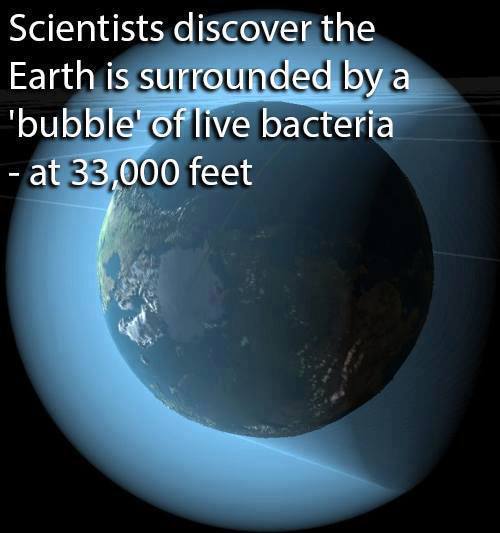
Research is showing that microbes even live in the air, all the way up to the very edge of our atmosphere. I saw an article on Neatorama about living organisms that survive floating miles up, at the edge of space.
Here is the National Geographic article with more info about the research:
Luckily, it wasn't too cold out, and the night sky was very clear. For the hour or two I was out there, I saw at least a dozen meteors. A few of them were very bright, with visible smoke trails. Early on, there was a meteor that was so large that it looked like a missile shooting across a large section of the sky!
Although they are known as shooting stars, meteors are actually small pieces of rocky debris that fall into our atmosphere. As they hit the air & burn up, we see the result as a fireball with a trail streaming behind it.
The annual Perseid shower is caused by Earth's orbit crossing the much larger orbit of the Comet Swift-Tuttle. As we pass through the debris field, hundreds of rocky fragments floating in the wake of the comet are pulled toward Earth.
Most of these meteors burn up before they get near the surface of the planet,
although some that impact the ground are later found, when they are designated as "meteorites".
One of the biggest priorities of the human race should be to locate large asteroids that have the potential to cause major damage should they impact the planet. There are giant rocky bodies hurtling through space that could cause major planetary catastrophe, yet humans are blissfully unaware of the potential for disaster that exists because we have not made the effort to plan for such an event.
Hopefully, the cosmos and its random processes spare us for awhile longer until we get our act together. We either need to find a way to track & deter an asteroid, or we learn to exist off this planet for extended periods of time...
Originally a congregation of cells that evolved to react to electromagnetic radiation, the organ we call the eye is one of the countless marvels of biology.
Despite the power of sight, our eyes only pick up a small slice of the energetic reality surrounding us. We adapted to see only what we need to to survive in our particular circumstances.
As technology advances and digital interfaces are developed to enhance our senses, it's possible that one day humans will be able to detect other energy wavelengths or have a wider range of vision.
I always wondered what the "resolution" of human eyesight is compared to the pixel dimensions of computer screens. It turns out we see at about 120 pixels per degree of arc, which ends up being around 500-600 megapixels.
The eye and visual perception are sources of constant wonder for me. The ability of the eye and the brain to process light energy into recognizable form is a marvel, but it is also fundamental to how humans and other lifeforms perceive our world.
Luckily my studio doesn't really have to deal with clients like these, but I've seen plenty of similar requests over the years.
People don't typically understand the patience & mental telepathy required to be a good graphic artist or designer. This is probably true for any profession where you interact with people in any capacity, though.
There are few technologies that have been as useful for advancing our understanding of the world as computer imaging & 3D modeling.
Using computers and software to simulate previously unknowable systems, we can visualize phenomena from the microscopic to the cosmic scale. One area where these visualizations are extremely helpful is in biology and anatomy. The human body is an extraordinary collection of parts & processes, and there are aspects of it that can only be experienced through computer simulation.
I recently saw this article about the imaging of a small slice of a mouse's brain neocortex, or gray matter.
The neocortex is the outer area of the brain that is responsible for complex information processing. The area of brain tissue that was studied was smaller than the cross-section of a human hair, and was sliced up into extremely thin slices. The slices were scanned & the area was reconstructed digitally, so it could be analyzed in precise detail.
The imaged area was based around two nerve cells, and included all the other cells that intersected that densely-packed space. The different cells are encoded using colors to differentiate them. The awesome thing about having a digital model is that the various elements can be separated, isolated, and manipulated to understand their different aspects.
I am fascinated by these kinds of studies and the insight they give into ourselves & the incomprehensibly complex nature of our bodies.
Here is a link to the study from Harvard University: