Showing posts sorted by relevance for query game review. Sort by date Show all posts

Thursday, January 15, 2015

Game Review: Crysis 3


I played Crysis 2 about a year ago, but now realize that I never wrote a game review for it. Having finished Crysis 3 recently, I feel that this review can apply to either game.

Crysis is a first-person shooter (FPS), in which you are in control of a piece of wearable futuristic technology called a nanosuit.


The nanosuit enables the player to have innate abilites, such as heads-up display, super strength & greater jumping ability. The suit also has two enhanced functions that you can activate at any time - 'Cloak' & 'Armor'. You can either turn invisible for stealth tactics using Cloak, or fortify your nanosuit in the heat of battle with Armor. These are powerful features that seem vital once you get used to using them throughout the game. Unfortunately, my biggest pet peeve with the Crysis games is the synthetic voice that says "Cloak Engaged!" or "Maximum Armor!" every damn time you activate these functions. I don't know why it annoys me so bad, but it does, and actually took away from my enjoyment of the game.

Anyway, the game, overall, is fun to play. It takes place in a ruined New York City, after an alien invasion by a species called the Ceph. These creatures operate using a hive mind connection. They are controlled through a main intelligence, called the Alpha Ceph. They have millions of years of communal intelligence among them & have developed technologies that humans cannot even comprehend. It turns out that the Ceph invasion from Crysis 2 was just an advance force for an incursion from a much larger alien army. The massive Ceph swarm is preparing to come from the other side of the galaxy through an Einstein-Rosen bridge- a dimensional portal allowing instantaneous interstellar travel.


NYC is the epicenter of this larger invasion, but has already been destroyed from the events of the previous game. The city's ruins have become partially wilderness, covered in trees, plants, & water, which makes for an interesting setting. There are some stages that take place inside buildings or underground as you seek out the Alpha Ceph, but I felt that the literal urban jungle environments were the most fun to play through.


The controls & game mechanics are pretty straightforward for an FPS. There are a decent variety of guns & weapons, but I found myself mostly sticking to the same ones. The nanosuit powers, such as cloaking & armor, still make the combat more interesting, but I don't feel like Crysis 3 offered any substantial improvement from the second game. There wasn't too much in this one that really "WOW!-ed" me from a gameplay standpoint. Even the final battle against the Alpha Ceph felt like a fairly standard boss battle, even though it was an intense encounter.


The story is a good one, with the dual themes of man merging with technology & the possible consequences of encountering a hostile alien race. These two themes are integrated when it's discovered that alien technology used to make the nanosuit is allowing your character, Prophet, to become directly connected to the Ceph.

Despite the strong story elements, I never really felt immersed within the game, like I have with titles such as the Assassin's Creed series. I'm playing AC: Black Flag now & it's much more engaging on all levels than the Crysis games. For some reason, I find myself liking 3rd-person games, where you can see the character. Even Far Cry 3, though, (another FPS game) was much more immersive than Crysis. Maybe it'll be more fun if ever I go back and play some levels on a harder difficulty, but it's rare for me to go back & play games I've finished. My gaming time is limited, so I feel like I usually want to get right to the next title in the lineup.

All-in-all, Crysis 3 is not a bad game. I just don't think it was as engaging as it could have been. I can't pinpoint exactly why I felt a disconnect with the gameplay, but it definitely did not feel like it lived up to its potential. I'd recommend it if you like FPS-style games, just don't expect to be blown away by the experience.

• Official Monkey Buddha Rating: 7.5

Thursday, December 04, 2014

Game Review: Mass Effect 3


I just finished Mass Effect 3, the final installment in what has become my one of my favorite video game series.

Here is my review for the first Mass Effect-

The Monkey Buddha Archives

I've also played Mass Effect 2, but didn't write a review for it. Most of the good things I had to say about the first game apply to the whole series. However, I've been so blown away by the Mass Effect games that I wanted to write my thoughts after finishing the trilogy.

This is a work of fiction that is on par with Star Wars, Star Trek, or any other great work of sci-fi. The virtual galaxy you can explore is full of unique planets, alien creatures, and ponderous questions which our entire species must face. I'll repeat them again, because I think they are so vital to consider:

• Is there other Life in the universe, sentient or otherwise?

• What happens when interplanetary species begin to contact each other?

• What is humanity's place in the cosmic order? What role does the individual play in this order?

Is it possible for ANY form of intelligence, or even information, to survive the incomprehensibly vast cycles of cosmological time, on the scale of billions of years?

Mass Effect takes place in the future, after 2147 CE, when humanity has found alien devices & "Element Zero" in our solar system. These artifacts allow us to develop FTL (Faster Than Light) Travel. The subsequent discovery that Pluto's moon, Charon, is actually a "Mass Effect" Relay allows humanity to instantaneously travel to other Relays throughout the galaxy. A vibrant galactic civilization already exists, with a 45km-long space station, called The Citadel, acting as its capital. All advanced alien races are represented here, and after the events of the first two games, humanity has become a major force in galactic affairs.

Your character is Commander Shepard, and you can carry over your character's traits from previous games' save information. Humanity's high standing in the galaxy is, in part, due to the earlier actions of Shepard- most notably fending off an attack on The Citadel by a Reaper.

The Reapers are central to the Mass Effect series. Tens of thousands of these gigantic, conscious machine creatures come out of deep space every 50,000 years to "harvest" sentient organic life, for their genetic information. It is a mysterious cycle that has gone on for at least a billion years and was initiated by an "Intelligence" that's even older than the Reapers.

It turns out this seemingly destructive cycle is actually meant to preserve life, since any advanced biological species will eventually create synthetic Artificial Intelligence (A.I.) that inevitably wipes out all organic beings. The "Intelligence" sees this cyclical harvesting as a way to maintain order and allow new species to evolve. It is revealed that the Mass Effect Relays and the Citadel itself are actually part of an elaborate trap, developed by the Reapers to accelerate the harvesting process of sentient beings and make it more efficient.

In this game, the merciless Reapers have arrived, landing on the home planets of the advance species throughout the galaxy, including Earth. The game starts with an awesome sequence in Vancouver, Canada, where imposing Reapers, taller than skyscrapers, are completely annihilating the city. This is the threat you face from the very beginning, and gives a sense of enormity that such an existential threat would pose to us. In addition to the numerous & varied enemies throughout the game, you actually get to face down a few Reapers in different situations.


It is a rich story, that touches on many deep issues that the human race may one day have to consider. As literally out-of-this-world as this game is, I feel that it is a visionary & realistic depiction of what humanity may one day experience when we are able to travel among the stars...

The planets and alien races are fantastic, yet convincing. The number and uniqueness of the locations throughout the galaxy made it endlessly visually interesting. Although you can no longer land on & explore planets as side missions, I'm glad that the act of scanning planets for resources was made much less tedious than in ME2.

As far as the actual gameplay, there's a perfect balance of customization, role-playing elements, and intense combat. The RPG aspects of the game include dialog options, morality choices, and engaging characters. The combat is excellent, with the ability to use five weapons and a half-dozen powers. The weapon variety and the ability to freeze the action to switch weapons on the fly don't interfere with the intensity of the battles. 


I chose to be in an Adept class, so my character had biotic powers that were effective and fun to use, such as- • the ability to project a destructive warp field • launching a shockwave that throws enemies in the air • creating a mini black hole, a singularity, that holds enemies. The ability to also coordinate your teammates' powers with your own attacks makes the combat much more strategic.

Overall, I was engaged the whole time and couldn't wait to see what the next mission or story sequence would bring. Games like this are such monumental creations, and why I still play critically acclaimed titles such as this one. Even though I've played video games my whole life, I am still awestruck by the technical achievement as much as the game play. It's pretty common for me to just wander around an area, observing visual details and marveling at the artistry behind the level design.

One of the very few reasons I can't give it a 10 is because the game's ending left me unimpressed. I picked the ending where Shepard can take control of The Reapers, using technology developed by an ancient race. I thought there should have been a more cinematic finale, with more impact for the end of such an action-packed story.

Despite my slight disappointment with the ending, the rest of the game was so superb & awe-inspiring that it didn't diminish my overall view of a great game and a undeniably epic series.

• The Monkey Buddha's official rating: 9.75

Monday, April 21, 2014

Game Review: Bioshock Infinite


I finally got around to playing through Bioshock Infinite, and it was a solid addition to the iconic series.


Previously, I reviewed the first Bioshock, & I've also played the sequel. This was a similarly memorable game, that took the theme in a new direction, but was still consistent with the previous titles.

The Monkey Buddha Archives:

The Bioshock games are first-person shooters, but they have deep, immersive storylines that lead the player to question his own perspective and moral judgments.

What I especially like about this series is its look at the shortcomings of different political ideologies, when they are actually applied to society.

In the first two Bioshock games, the setting was an underwater city called "Rapture". This was supposed to be an art deco-style Libertarian utopia, founded by business magnate Andrew Ryan in the 1940's. He & the city's other founders were Objectivists who wanted to escape government control, so the "Free Market" could reign supreme.

As anyone with a rudimentary understanding of the real world could predict, a Libertarian 'paradise' will quickly devolve into a hellhole, as the power of selfishness and greed are allowed to run rampant. The city of Rapture falls apart, due to the scientific discovery of "plasmids" that grant their users superhuman powers. These powers led to class warfare among the inhabitants of Rapture, and a fatal rivalry between Andrew Ryan and Frank Fontaine, another unscrupulous businessman.

In Bioshock: Infinite, the setting is Columbia in the year 1912. This is a city that is literally floating in the sky, due to a powerful anti-gravity technology. 


Columbia was founded by Zachary Comstock, who wanted to break away from the United States, while retaining an ultra-conservative vision of America. The complete merging of religion and nationalism create a right-wing dream world, where today's Tea Party patriots would feel right at home.

In Columbia, "Father" Comstock styles himself as a political leader & religious prophet, the U.S.'s Founding Fathers are revered as demi-gods, patriotic propaganda is everywhere, & the city has a traditional feeling that gives the overall impression of "the good ol' days".


Not far into the game, however, you begin to see through the facade of the image of Columbia that Comstock has built up. It is actually a place of elitism & racial segregation, in which all non-whites are officially recognized as second class citizens, or worse.


The resulting social tensions have manifested themselves in the form of the revolutionary group "Vox Populi" fighting to bring equality to Columbia. At first, it's easy to sympathize with the Vox, in contrast to Comstock's dystopia. However, it later becomes clear that having the Vox Populi take control would also lead to its own disastrous consequences.

The ultimate message here is one that I try to emphasize all the time, when talking about politics & government: No matter who's running things, human society is always going to be f*d up.

You play the game as Booker DeWitt, a detective who has incurred a large debt. To pay this debt, he is recruited to go to Columbia and rescue a girl named Elizabeth. She is apparently Comstock's daughter & heir, and she has the ability to open "tears" in the fabric of space-time. These tears allow observation & interaction with alternate universes.

A sly Star Wars reference, 
as Elizabeth opens a space-time tear into her dream destination, Paris.

This scientific aspect of the game, which deals with multiverse cosomologies, quantum physics, and relativistic concepts, was unexpected and the most interesting for me.

As the game progresses (especially at the end) the idea of infinite parallel universes, with countless versions of oneself, comes to the forefront. It leads to mind-bending plot twists and plenty of points to ponder long after the game is over. The theoretical physics in the plot also answered a question that bothered me before I even started the game: "Why did they call this game 'Infinite'?!?!"

On a functional level, the gameplay mechanics are a continuation of the original Bioshock games. You carry a weapon in one hand & have another hand that can emit various powers you discover as you progress.

Unlike the claustrophobic underwater setting of Rapture, Columbia is an open air city with awesome visual presence among the clouds. In this game, you can hook onto sky rails and soar around certain areas. It takes some getting used to, but is a pretty cool feature. Despite the open setting, the game is fairly linear, with a set succession of missions and limited area to travel through for each stage.

Although the combat on 'normal' difficulty was sporadic and there were some minor issues I had with the game, overall it was very engaging. As is characteristic of major productions like this, the artistic vision and attention to detail in the game is amazing. What really made the game stand out for me, though, was the thought-provoking story elements, dealing with the unlikely combination of political issues and the theoretical physics.

I definitely recommend Bioshock Infinite for a look at the conceptual heights to which a video game can aspire, while maintaining exciting FPS & role-playing elements.

• The Monkey Buddha's official rating: 8.25

Monday, September 09, 2013

Game Review: "Batman-Arkham City"


 A few years ago, I reviewed the ground-breaking game, "Batman-Arkham Asylum", in which Batman fights his way through the infamous asylum for the criminally insane. Arkham had become a giant trap, set by the Joker & his other arch-enemies.

Monkey Buddha Archives:

Due to the glacially slow pace at which I play video games, I've only recently gotten around to playing the sequel, "Batman- Arkham City". After beating the campaign & all the side missions, I finally found every single Riddler trophy & hidden item on all the maps. It took me a while & I finally called it quits to move on to the next title.

Arkham City was just as excellent as the first game. The same iconic look, dark mood, & mechanics in both games made it feel like a true sequel that was just as faithful to the Batman mythos. This time, instead of being confined to the grounds inside the asylum, a whole section of old Gotham City has been cordoned off to hold criminals & gangs in a "prison city". 


The leaders of the various gangs are well-known Batman villains, such as Penguin, Two-Face, Mr. Freeze, and of course the Joker. All the characters, including Batman, are handled pretty much perfectly. At first I was like, "the Penguin has a British accent?!?!" ..but he's great in the game, a ruthless jerk. These games make brilliant use of the entire roster of Batman's many foes.


 click to enlarge

This is a huge complement coming from me, because I'm a harsh critic when it comes to comic book movies or games. I drive my one brother nuts, because I'm always nitpicking plot details or stylistic choices in the superhero genre. I simply know that I could do things better! The Avengers was the one movie that I thought was as close to flawless as I've seen. Man of Steel was a pretty good one that I've seen recently, & I couldn't believe they didn't release a licensed game to coincide with the movie. We'll see what happens with the upcoming Batman vs. Superman movie. Ben Affleck was totally mis-cast as Bruce Wayne/Batman, but I'll wait to tear apart the decision further until after I see the trailers.

As far as a superhero game goes, the Batman: Arkham titles quite convincingly put you into the role of Batman fighting his way through the grittiest areas of Gotham.  Playing as 'The World's Greatest Detective' is an immersive experience, that combines combat, stealth, & puzzle-solving that truly uses the many facets of Batman's character. You really get into the experience of the man behind the mask.

 click to enlarge

The only major complaint I have about the game mechanics is that the melee combat always felt clunky & repetitive. The stealth aspects of the game are great, though. You're kind of forced to play silently & intelligently, since more than a couple thugs with guns can take you out quickly. Batman is just a man in body armor, after all. This recognition of Batman's vulnerability makes the game that much more convincing. The controls involved in climbing, grappling, & gliding make traveling around the many cool areas of Arkham City fun, in a way that superhero games should be.

Spoiler Alert!...
My only other complaint, about ending, is that you don't even fight The Joker. He just dies. It's kind of anti-climatic. Also, I finished the story mode when it said the game was only "40% Complete" on the save screen. I guess there are Catwoman missions that are a large chunk of the game, but I didn't download them. This percentage threw me off & thought there was alot more of the main campaign to play. I still enjoyed playing the remaining side missions, the challenge maps, & searching all the areas to find the Riddler items.

Speaking of The Joker, the voice acting by Mark Hamill, aka Luke Skywalker, is one of the best parts of these games- despite his lame demise at the end. He also voiced 'The Clown Prince of Crime' in the Batman cartoons. The portrayal of Batman's arch-nemesis in these games is the best anywhere.


Playing these games, I was thinking back to the old Batman game I had for the Commodore 64 computer. I remember seeing the neat graphics on the box & dying to play it. 


I was already jaded with computer graphics as a kid & wasn't really impressed by the game once I tried it. Even though they were trying to deliver similar elements to the current Batman games, I thought it sucked & was a pain in the ass to play, even at the time. Looking back, I was just biding my time, until the gaming technology got to its current state. 

Oh... the humanity!!!!!

The graphics on these modern games are so damn ridiculous, though, that I often find myself wandering around the open world game maps- simply exploring & finding every hidden item, just so I can see every inch of the area. I can spend as much time scrutinizing the countless details in the amazing virtual worlds as I do actually playing the game! (That's also why it takes me so long to finish a well-produced title with alot of content like this.)

Anyway, I finally had to put this great game aside & move onto my next virtual adventure- which will probably take me at least a few months, at the rate I play. 
I'll be immersing myself back into The Animus & reliving the genetic memories of Ezio Auditore in "Assassin's Creed: Revelations".

Batman: Arkham City is a definite "must-play" for any comic book or superhero fan. It's as close as you can get to the experience of being 'The Caped Crusader'. Truly an awesome & epic game...

• The Monkey Buddha's official rating: 9.0


Tuesday, May 22, 2012

Game Review: Assassin's Creed 2


I'm not even sure where to start when reviewing Assassin's Creed 2, other than, "Holy Crap, that was impressive."

Since I don't spend crazy amounts of time playing video games, I try to only pick titles that I know I'll enjoy after reading reviews & watching previews.  That's why many of the games I've reviewed are 9.0's, because I don't waste my time if I don't think it'll be really good.

Gamespot review:

The story behind the Assassin's Creed series actually takes place in the modern day. The main character, Desmond Miles, is a descendant of a line of members of a secret historical faction, the Assassins. Their rival faction, The Templars, have been fighting for control of a mysteriously advanced technology over the course of hundreds of years.

Through experimental technology known as "The Animus", memory imprints can somehow be extracted from a person's genetic makeup. This DNA 'memory' is used to mentally re-create the historical experiences of Desmond's ancestors in a virtual reality experience. The player takes the role of Desmond- accessing his ancestors' memories to learn deeper truths about mankind's forgotten history.


I played the first Assassin's Creed a couple years ago. The original game takes place in the Holy Land during the Crusades, as Desmond's ancestor Altaïr Ibn-La'Ahad. I thought the re-creation of these ancient sites such as Jerusalem were awesome. Despite the fact that I like to try completing a game's side missions, though, they started getting very repetitive. Then, the game kept freezing every time I reached a certain point, & I couldn't continue playing. I sure as hell wasn't starting over, so I said 'screw it' & gave up on it.

Even though I didn't plan on playing any other games in the series after that, one of my brothers had Assassin's Creed 2. It is set in Renaissance Italy (which seemed really interesting) & got overwhelmingly positive reviews, so I decided to give it go. I'm extremely glad I did because it is an amazing game, with a superior level of production value that still has me awe-struck.

The sequel continues with Desmond trying to flee a Templar mega-corporation, Abstergo, that has been using him in experiments with The Animus. After he escapes with the help a small band of collaborators who have their own Animus machine, Desmond begins to recall the genetic memories of his Italian ancestor, Ezio Auditore da Firenze.

Being a designer & art history scholar, I found the opportunity to virtually explore cities of Renaissance Italy to be enjoyable in itself. Like most games that are produced with this high level of quality, I often found myself just wandering around the expansive locales- observing the meticulous detail of all the costumes, textures, architecture, and atmospheric effects that most people probably take for granted. As someone who has been playing video games since Pac-Man on the Atari 2600, I find the graphic quality of modern games like this to be spectacular.

I couldn't stop marveling at the impressive feat of reconstructing multiple, highly-detailed whole towns in an historically accurate way. Ezio gets to explore the sights & sounds of urban Florence, the country setting of Tuscany, and the canals of Venice. The crazy final sequence also takes you to Rome. The last scene takes place inside the Sistine Chapel, whose ceiling has not yet been painted by Michelangelo.

In addition to the beautiful graphics, Assassin's Creed 2 incorporates some actual art history into the gameplay. Ezio's family estate, Villa Auditore, is initially in disrepair. Throughout the game, items that you aquire help you improve the villa. One way to do this is to buy paintings by contemporary artists, like Leonardo da Vinci, Sandro Botticelli, & Titian. By the end of the game, you collect a large gallery of virtual paintings that would be any art lover's dream.

Another aspect of the game which I think is really cool is the deeper thread in the story, concerning the search for the mysterious origins of mankind and ancient knowledge, lost to history. This is a theme that was similarly explored in a book I read over the summer, Fingerprints of the Gods, by Graham Hancock.

The search in Assassin's Creed revolves around "Pieces of Eden" which are technological devices from a now-extinct civilization of beings who created humans as slave labor. (It's sort of like the Ancient Astronaut Theory, but these beings were from Earth- just older & more advanced than mankind.) Some humans rebelled against their masters & stole one of the artifacts, The Apple, that controls human neurological functions. Using this power, they recruited other humans to wage war against their creators. However, both groups became so caught up in their conflict that they neglected a cosmic threat that nearly destroyed them all. There were enough humans scurrying around like cockroaches to rebuild with the help of the few survivors from the First Civilization, who were now regarded as gods by their primitive creations.

To uncover details of this mystery, you must find clues left by Altaïr & the mysterious 'Subject 16', whose mind has become trapped in the virtual worlds of The Animus. An awesome aspect of this game is that Leonardo da Vinci appears throughout the game to supply equipment upgrades & also to help in deciphering the Codexes left by Altaïr. There are also mysterious 'glyphs' hidden in certain areas that open very challenging puzzle sequences. These make you feel like a genius when you figure them out. I'm proud to say that I figured out all the puzzles without looking up any answers. I did come really close to cheating on a few of the puzzles, after staring at the screen for a 1/2 hour or more trying to figure them out! Unlocking these scattered clues help piece together the story behind the age-old battle between the Assassins & the Templars for the powerful Pieces of Eden, which has occurred behind the scenes of history's major events.

Unlike the first one, Assassin's Creed 2 never lost my interest or seemed repetitive. I was enthralled by the visuals, the gameplay, and the story... all the way to when the end credits rolled, during which there is still a bit more of the game to play!

The only complaint I'd personally voice would be that the targeting and combat can be annoyingly inaccurate at times, but it doesn't hinder the overall experience. 

The depth of this game is mind-boggling. Elements as diverse as Renaissance art, ancient mysteries, and ponderous philosophical questions are weaved between the open world free-running & the brutal assassination missions in a masterful way.

I'm planning on writing a post about the idiotic argument over whether video games can be considered works of art. This excellent game is 'Exhibit A' in the assertion that video games can actually represent the pinnacle of creative effort & are indeed artistic masterpieces unto themselves.

• The Monkey Buddha's official rating: 9.0


Monday, January 06, 2014

Game Review: Mass Effect

 
Mass Effect is not just a deeply-engaging game...
It's not just a sci-fi masterpiece, either...

It is both those things... but most importantly, it's an eye-opening commentary on the fundamental questions of existence:

• Is there other Life in the universe, sentient or otherwise?
• What happens when interplanetary species begin to contact each other?
• What is humanity's place in the cosmic order?
Is it possible for ANY form of intelligence, or information, to survive the incomprehensibly vast cycles of cosmological time, on the scale of billions of years?

I've always been a Star Wars fan & generally like science fiction stories. I believe they help map the future of humanity, while helping us understand our place in the larger scheme of things. Mass Effect deserves the many positive reviews it has received. It is an immersive exploration of these ideas, throughout the vast galaxy waiting for us once we become interstellar travelers.

Usually a game of this scope would take more than a month for me to play. Over the holidays I got to put in some marathon sessions, to finish it by the new year. I completed most of the side missions & explored alot of the game, so the total time was a little over 50 hours. Like many of the best video games, it was a better time investment as any engrossing book or TV series. The story raised issues & thoughts that will now be bouncing around in my brain permanently.

Mass Effect is a 3rd person role-playing (RPG) shooter. You create your own version of the main character, Commander Shepard, as a male or female. From the start, you want to pick a persona to guide the choices & interactions the character will make throughout the game. I decided to follow my own personality, as if it were really me in the role.

There is a morality 'scale' that gives you either 'Paragon' or 'Renegade' points, depending on how you react to situations. I decided to generally follow the Paragon path, since I'm not a negative person & I wanted to make decisions that felt natural. Although it is very cool to have this level of character interactivity, I unfortunately take forever to go through the dialog options. It's a bit of cheating, but I found myself looking up the consequences of different decisions online, so I could decide how I wanted the story to proceed. This greatly added to my overall time playing the game.

On a related note, the one complaint I have about the game is the very large amount of dialog. I was playing the game for a little bit over my brother's house while he was doing stuff. He'd walk through & it was early in the game, where you have to interact with alot of characters. He asked me "Is that all you do in this game is talk?!?" I know it is a role-playing game so it's kind of necessary, & I initiated non-essential conversations because there is alot of information in the story that can be learned. Luckily, as the game goes on there's more action & awesome battles to make up for the RPG parts...

The game takes place in the year 2183. Mankind has discovered ruins on Mars, from an ancient civilization. This lost race of beings, known as the Protheans, left ruins & technology all over the galaxy after their mysterious extinction 50,000 years ago. Other alien races have also found relics from the Protheans, that have led to their rapid technological advancement. Finding the remnants of this ancient culture has led to the discovery of faster-than-light travel by humans & other species, resulting in the formation of a galactic community. The center of galactic civilization is a massive space station, known as The Citadel:


Despite its hi-tech look, The Citadel is actually an ancient structure, also thought to have been originally built by the Protheans. Now, it is the home of millions of beings, from many different areas of the known galaxy.


Humanity is the most recent addition to the races on The Citadel & is still trying to prove itself as worthy of inclusion to the more elite aspects of galactic society, like membership on The Council. This is a ruling body that consists of members of several different races, overseeing galactic affairs.

Early on in the game, Commander Shepard's heroism results in the honor of being named the first human "Spectre"- an elite commando who is not bound by galactic military protocol. Shepard's mission is to track down another Spectre, named Saren, who has gone rogue and is conspiring with alien A.I. to overtake the galaxy.

Commander Shepard is given his own ship to carry out his quest- an advanced stealth frigate, The Normandy. This is the base of operations for Shepard & his crew. In the center of the ship, there is a Galaxy Map that is used to choose what star system The Normandy will visit, to carry out the latest missions.

You start out with an overview of the galaxy, then you can zoom in & out of the various levels: Galaxy <-> Star cluster <-> Star system <-> Planet.

This map gives you a good sense of the vastness of interstellar space. Here's video showing navigation between star systems:


In each system, there are several planets you can remotely scan for resources or artifacts. There is usually one planet in each star system that you can actually land on, to carry out a main mission or side quest.

These planets all have different environments, and makes you realize the potentially infinite diversity of worlds that exist throughout the cosmos. Some of the planets' environments are really stunning, where you can see large moons, unusual star formations, or falling meteors in the alien skies. These unique planetary maps really give you the sense of exploring extraterrestrial worlds.

You land on each planet inside a 6-wheeled rover, called the Mako. This vehicle has a cannon & missiles for combat, but most of the time you are driving over the strange landscapes of the worlds you are visiting. You can also get out of the Mako & go on foot with the 2 characters you pick for your squad. The map of each planet is fairly large, with plenty of area to explore for scattered hidden items. Driving over these large areas can get little tedious, despite the amazing environments. I started to wonder why Shepard & his team would be driving a relatively slow wheeled vehicle. Wouldn't they have anti-gravity technology, for some kind of flying scout ship??? This was my only other minor complaint about the game, but I still enjoyed exploring the many different planets in the Mako.


The game's 3rd person combat is very fun & action-packed. A great thing about this game is the effective system of upgrades to weapons and "biotic" powers- which allow you to do things like levitate enemies or create a 'singularity' that rips apart anything near it. Unlike some other games I've reviewed, you have alot of awesome abilities fairly early on. You pick 2 members from your team to join you for each mission, so you can combine teams with different combat or biotic power attributes.

As the game progresses, your character continues gaining even better gear & enhanced powers. I never felt like my character was lacking for proper enhancements. This makes the game much more fun, in my opinion, since you feel like you're properly leveled-up & ready to kick ass at all times.


There's also a major, mind-bending twist to the story that sets up the sequels.

*Some slight spoilers here-
As the story of the game continues, you find out that The Citadel & the Mass Relays allowing superluminal travel were NOT created by the Protheans. They merely found & utilized this technology, like the various races in the current galactic community.

The truth is that this network of space stations & relays, used by the galactic community, are actually a cosmic trap!

Every 50,000 years, a giant fleet of hybrid synthetic-organic sentient starships, called The Reapers, emerge out of the dark space at the edges of the galaxy. They destroy all advanced organic life, then retreat back into the void. Many millenia later, when another interstellar civilization develops, another activation signal is sent to them & the cycle of destruction begins again.

The Citadel is actually a giant portal that The Reapers use to pour through & immediately destroy the heart of galactic civilization! From there, they spread out & eradicate all intelligent life on the various star systems, taking centuries if needed. They turn organic beings into a genetic 'paste' that they incorporate into their own being, as a sort of evolution. The reasons for this cyclical genocide are still mysterious, but there is speculation that this grim process has been going on for millions of years, at least.

I look forward to playing the other Mass Effect games & experiencing more of this awe-inspiring series.

Mass Effect is a truly epic game, in the scope of it's storytelling & depth of game play. It is a sci-fi classic that serves as a virtual experience of mankind's destiny among the stars.

I would highly recommend it to anyone who is interested in space, sci-fi, or just an amazing story about the future of humanity.

• The Monkey Buddha's official rating: 9.25

Monday, September 22, 2014

Game Review: Assassin's Creed 3


 I've recently finished another installment of one of my favorite video game series, Assassin's Creed.

Assassin's Creed III is another virtual trip back in time to another era in history. Unlike the previous 3 Assassin's Creed titles, which took place in the "Old World" mainly in Renaissance Italy & Constantinople, this game is set in the American colonies during the Revolutionary War.


You still are playing as Desmond Miles, a modern day Assassin who can virtually tap into his ancestral memories, using Animus technology that unlocks past experiences from the information in one's DNA. The game is basically a virtual reality simulation, experienced by the virtual character within the video game itself. Virtuality within virtuality...

The enigmatic "First Civilization" still plays a role in the series, as a society of advanced humanoids who were destroyed by a catastrophic eruption of solar energy, many thousands of years ago. Their holographic personalities remain embedded in certain locations, to guide the human race toward preventing another mass extinction event like the one they experienced. There are various technological artifacts they left behind, "Pieces of Eden", which grant the user extraordinary powers. The historical conflict between the Templars & the Assassins is a race to find these powerful devices, in order to use them to further their own agendas.

I think this series should really be called "Time Traveler", because the amount of detail put into recreating the look & feel of each time period is nothing less than astounding. My biggest complaint about the game is that I personally find colonial America to be an incredibly dreary time period. Even though there were many pivotal historical event going on, the architecture, dress, and lifestyles of the day were dull & uninspiring.


Despite my personal lack of enthusiasm for the time period, the Ubisoft team did an extraordinary job of capturing the feel of America's early days. You get to experience first-hand the major events of the Revolution- The Boston Massacre, Paul Revere's ride, Lexington & Concord, and The Boston Tea Party.

There are also many locations recreated with meticulous detail- such as, colonial Boston with the famous Green Dragon Inn where the Revolution was planned, British-occupied New York City, the encampment at Valley Forge, and several British forts. There is also an expansive wilderness with seemingly endless areas of forest, streams, mountainous terrain, and wildlife that can be hunted to use for trade items.


The wilderness is also the location of a Native American village, which is the home to the main character, Connor. His real name is Ratonhnhaké:ton, and is half-European & half-Iroquois. He got the name Connor from the old Assassin, Achilles, who trained him at the Davenport Homestead- which becomes like a home base during the game.

You actually start out playing the game as Connor's father Haytham Kenway, a British Templar. As Haytham, you travel by sailing ship to America, to start the journey that will lead to Conner's birth and eventually reunite father & son later in the game. The way in which the game has you travel to the colonies by ship & makes you feel like you are en route to the new land is a very immersive way to introduce the game.

Besides the main characters, you also interact with some of the famous figures in early American history- including a raunchy Ben Franklin, Paul Revere, Sam Adams, Marquis de Lafayette, and even George Washington, who is shown as the powerfully charismatic (yet flawed) human being he undoubtedly was in real life.


The gameplay is very much in the tradition of the other AC games, with stealth elements, easier free-running (with the ability to travel through the treetops), an array of weapons from the period including the customary Assassin's blade, and improved combat mechanics- which makes taking on large groups of enemies very fluid.

There is also the added element of naval missions, in which you take the wheel of a large sailing ship to steer it and direct cannons at enemy vessels. At first I wasn't too impressed with the naval aspect, but as I played through more of the missions I really got into captaining the ship & sailing into the intense battles at sea.


The main campaign of the game is characteristically expansive. Due the limited amount of time I devote to video games nowadays, it took me a couple months of sporadic playing to complete the main sequences. Unfortunately, instead of feeling a sense of wonder at exploring, as in Renaissance Rome & other locations like in previous episodes, I mostly wanted to just get through this game & finish it- so I could get the hell out of the dismal Colonial experience.

This was probably my least favorite Assassin's Creed so far, for the reasons I stated above, but that doesn't take away from the monumental achievement that the production of this game represents. If you want to get a taste of the events & life in America during the Revolutionary War, there is no better way than Assassin's Creed 3.

• Official Monkey Buddha Rating: 8.0

Saturday, February 27, 2010

Game Review: "Batman-Arkham Asylum"

When I was young, I used to collect many different comics- X-Men, Superman, Silver Surfer, Spider-man, etc. Even though Batman didn't have the awesome superpowers the other heroes had, his use of technology, trained skills & the dark mood of the comics has made him one of the timeless comic brands.

Compelling Batman graphic novels like "Killing Joke" & "Dark Knight Returns" changed my perceptions of comic book stories as a kid & of the Batman character specifically. Heroes weren't necessarily morally righteous 'good guys' with clear moral boundaries.

In the spirit of this more complex view of the world of superheroes, Batman: Arkham Asylum delivers an experience as close to being the Dark Knight as technically possible. It is simply an outstanding game that captures every aspect of the twisted world of Batman & his villains.

The game trailer gives a good visual summary of the game:


I actually finished the game a few weeks ago, but I've been occasionally playing the dozen Challenge Mission levels that are unlocked. These are short levels where you either have to rack up points by beating up waves of enemies, or stealth missions where you have to defeat all the enemies & complete ambush objectives without being detected.

There are so many cool features in this game I don't even know where to start. The graphics are perfectly detailed & provide the dark mood you would expect to surround Batman while he's trapped in a old asylum full of evil lunatics.


The game fully covers all of Batman's abilities: physical superiority, intellectual detective work, & technological prowess. The way these are employed & work together really make you feel like a superhero- despite the very human vulnerability to gunfire that is ever present, which often forces you to stay in the shadows.

The most useful feature is Batman's 'Detective Vision' that allows you to basically switch on enhanced X-ray view of your surroundings. You can see the skeletal outlines of enemies through walls & obstacles, allowing you to create a preemptive strategy for how to take out enemies so you can proceed.


As you go through the game, you get all kinds of awesome gadgets. These are not only for offense, like different batarangs. There are also devices that allow you to reveal & explore parts of the extensive Arkham Island that were previously inaccessible.


Being Batman himself is awesome, but the familiar villains encountered often steal the show & make this game the roller coaster experience that it is. The Joker is voiced by Mark Hamill, aka Luke Skywalker, like he is in the TV cartoons. This might seem a weird choice, but he is absolutely perfect.


The appearance of the game's many arch-villains are all actually perfect, in my opinion. The Joker though, is exactly how I would envision him, unlike the horrible 'disheveled hobo' appearance of Heath Ledger's Joker in "Batman: The Dark Knight" movie. Jack Nicholson & Heath Ledger's movie Joker characters both sucked.

Besides The Clown Prince of Evil, the other characters are also evil & deranged almost to the point of being intimidating. Fighting the enormous Bane, running frantically through the sewers to escape from Killer Croc, & trying to take out Ivy 's gigantic botanical assault are all crazy. There are also tons of references to other villains not shown, like The Penguin, hidden around the island. The villain that is a really surprising factor in the game, though, is The Scarecrow.

Scarecrow actually affects Batman's mind
, leading to several separate hallucinatory segments that uncover hidden horrors from the haunting memories of Bruce Wayne/Batman. Scarecrow himself then appears in a purely psychological realm as a menacing giant scanning the evil dreamscape for you.

This game is so great on so many levels that I can't say enough to praise it. It has to played to be appreciated, although the video gives a sense of the experience. There is endless amount of satisfaction to be gained from taking out your enemies directly and by stealth, finding all of the Riddlers scattered clues, & exploring the richly detailed island w/ its famed asylum as you hunt down the Joker.

This game is a giant among ever-improving superhero games, while not being tied to an existing movie franchise. In that respect, it is allowed to stand on its own as a unique telling of the Batman legend.

• The Monkey Buddha's official rating: 9.0


Uh-oh, looks like Batman: Arkham Asylum 2 is already coming.

Monday, December 16, 2013

Game Review: "Deus Ex- Human Revolution"


I recently finished "Deus Ex: Human Revolution". The concept & story was interesting enough to make it worthwhile for me, but in my opinion the actual game play could have been much better.

Deus Ex takes place in the near future, 2027, where humans are physically merging with machines to an unprecedented degree. People with cybernetic augmentations are called "Augs," and they have abilities that are unavailable to natural humans.

As a result of the inevitable socio-political tensions that arise from one group having an advantage over another, an anti-augmentation movement forms, called "Purity First".

Far from being a mindless waste of time, games like this can actually offer powerful commentary on ethical issues like human augmentation & the role of technology in our evolution. These are emerging problems that are already in the news, and we are going to have to deal with very soon.

NOVA:

Gizmodo:

io9:

New Scientist:


Deus Ex is a 1st-person RPG shooter, so it has role-playing elements for the character interactions. Although I like the idea of influencing the story through the player's decisions, it was a little too much talking for my tastes. I've recently started the Mass Effect series, which also features alot of narrative and decision-making elements. It is much more seamless in that game experience, though. My main problem with that kind of interactivity is that I sit there trying to think of all the possible outcomes for any given choice of dialogue. Pondering these choices, combined with taking my time to look at all the visual elements, results in this kind of game taking me forever to play!


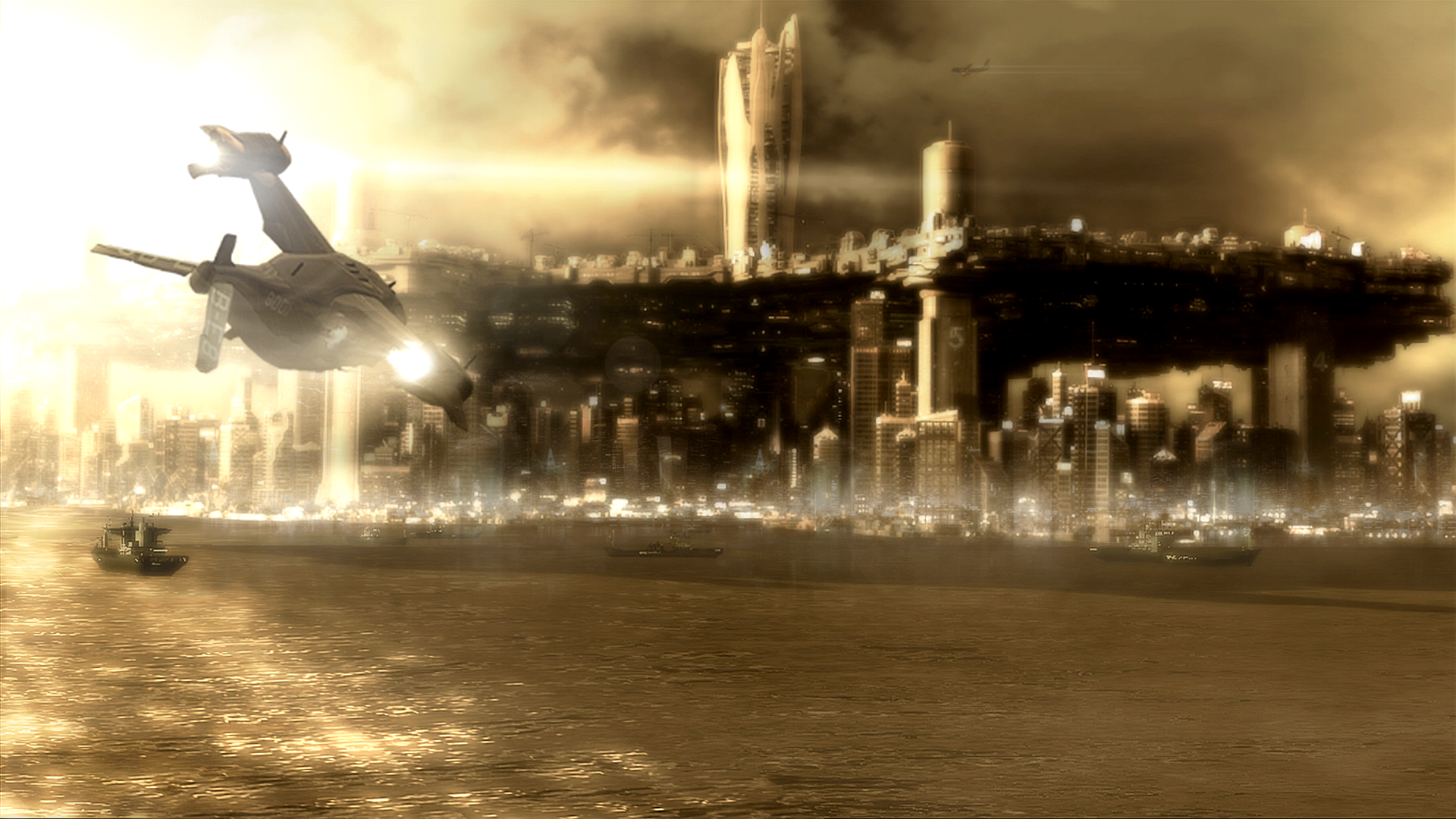
The setting of this game features futuristic locations such as Hengsha (Shanghai), where an upper metropolis level called "The Pangu" towers over the lower city. There is a predictable class division that results from this physical separation of the population.


Although the sci-fi look of the game is cool, the amber color that dominates most of the environments makes everything feel very bland & monotone overall. The city areas are much more open & engaging than the levels that are indoor corridors. The last level is an anti-climatic Arctic base that is mostly hallways. The enemies and firefights are pretty intense in those close quarters, though.

The main character is Adam Jensen, a security officer who got injured in a terrorist ambush. When he came out of his coma, he was augmented with military-grade cybernetic enhancements. He was given these implants & prosthetics by his employer, the biotech company Sarif Industries.

The character of Jensen is basically a clone of Neo from The Matrix- from his look to his voice. It's not too annoying, just not very original. He has all kinds of awesome powers to upgrade throughout the game resulting from his cyber-enhancements. He can increase his physical abilities, such as jumping over 9 ft. high, lifting heavy objects, and sprinting faster. There are also many sensory upgrades like being able to see through walls, targeting improvements, and stealth capabilities like cloaking.

My biggest criticism is one that applies to many games- even ones I really enjoy, like Assassin's Creed. By the time you have your character anywhere near to being fully leveled up... the game is over!!! Deus Ex has all these awesome augmented abilities for your character, but most of them aren't unlocked until the final chapters. Just as you are getting to enjoy these kick-ass superpowers, you realize there's not much game time left to use them.

Overall, it's a good game whose thought-provoking content & ideas about the future of humanity held my attention more than the mediocre game play or its spotty action.

• The Monkey Buddha's official rating: 7.5

Wednesday, May 26, 2010

Game Review: "Dead Space"


My old pal Phil recently let me borrow the game Dead Space & it seemed like a cool theme: a space-based 3rd person shooter.

We both grew up in the first video game generation, with my earliest childhood memories being simultaneous with the advent of the Atari 2600. I've been able to witness the state of the art progress from Asteroids to a highly-detailed, immersive virtual reality like Dead Space.

This particular game was new for me because I haven't played "survival horror" type games, & this one's a doozy. I don't really care for horror movies either- because usually they simply don't frighten me. Dead Space was by far a creepier & sometimes scarier experience than I've ever had watching a horror movie, though.

It actually blew me away how effectively the visuals & sound created a mood paranoid isolation that was almost overwhelming at times. The crazy thing's that it's not an abundance of common noise like gunfire or dialogue that's unnerving- it's the lack of constant noise that makes the creaks, scuttering of unseen creatures, & droning ambient sounds much more eerie. The most constant sound is the thuds of each step in your heavy suit, & your breathing- which becomes faster or more labored if you are running or hurt. When a zombie-like infected monster jumps out at you or appears from a hidden dark corner with a blood-curdling shriek, it was often startling enough to make me yell all kinds of profanities at the screen.

Even more intimidating are the parts where you enter zero-gravity or travel to the outside of the ship & there's no sound at all in the vacuum, beside your own breathing inside the suit. You can be walking & quickly turn to see a grotesque creature creeping up right behind you that you can't even hear coming.

This trailer below actually sums up the overall atmosphere of game perfectly, especially since the evil 'lullaby' can be sometimes heard in the distant background during the game:


Visually, the awe-inspiring graphics are at different times either stunning or horrific. At certain points it felt almost like I was there, taking in the serene view of outer space. Although there are alot of corridors & rooms because it's a ship, at certain points there are amazing vistas of cosmic scenery. When you are outside the ship or in front of large glass panels you can look out to see asteroid fields, planets, & stars. The great thing about many modern games is the ability to roam around the virtual world at will & check out the awesome artistic detail that goes into these game titles.


Basically, the story revolves around an infection that turns people into mutant space creatures of different kinds, called Necromorphs. This mass infection has something to do with a religious cult and a powerful alien artifact. The story is secondary to the unpredictable, yet inevitably sudden appearance of monsters continually trying to kill you. Although there are gigantic creatures you have to battle, the most disturbing are little infected babies with writhing tentacles growing out their backs.


To destroy the many creatures stalking you, you can use a number of different weapons, the main one being a plasma cutter that shears off limbs or heads. You also have the cool ability to use a type of telekinesis to move objects from a distance. Another attack option, if they're too close, is to just stomp on them until their body smashes apart. Even if you shoot of a limb or two, the Necromorphs will often continue to relentlessly crawl after you until you decimate them. Needless to say, it is a really gory game with blood & body parts splattering or floating around everywhere.

Spoiler Alert:


The game's dark, threatening mood puts you in constant survival mode & you're ready to blast anything that pops out at you. It turns out that the alien force is also psychically messing with your character's mind & perceptions, which adds a psychological twist to the story. I was reading about the development of the sequel "Dead Space 2" & there were actually complaints that this 1st game was TOO SCARY. This is coming from people who play games fighting off killer zombies and enemy hordes of all kinds.

I didn't expect this kind of terrifying intensity from a video game, so Dead Space is now definitely one I highly recommend... just not for the faint of heart.

• The Monkey Buddha's official rating: 8.5

Saturday, January 23, 2010

Game Review: Bioshock


I recently finished Bioshock for PS3 & it kind of blew me away how sophisticated video games have become.

Gamespot:
Bioshock


Having grown up owning most of the major video game systems ever created, from Atari 2600 to the PS3, I have witnessed first hand the evolution of the art & technology involved.

Playing games like Pitfall & PacMan were adequate back when I was 5yrs old, but even then I had some idea that there was room for alot of improvement.

Experiencing a game like Bioshock is like a whole different universe. Modern games like this one engage the player on multiple levels. There is the intense action of a first person shooter, as well as the intellectual challenge of puzzles & moral choices. Of course, the amazing HD graphics on games like this can make you want to just look around at the virtual environment. As a designer, I am easily enthralled by the detail that goes into the visual aspects of a game. Bioshock's locations have a unique look inspired by early 20th century Art Deco style, but the twisted fate of the place is reflected in the deteriorating facade.

In Bioshock, you find yourself at the bottom of the ocean- in a city called Rapture, one man's utopia gone wrong. The city has degraded due to addiction to a genetic tonic that gives people superhuman powers. There are now zombie-like genetic mutants called Splicers roaming the areas that you encounter. You acquire different superpowers as the game progresses, and you end up having an awesome arsenal of ordinary weapons like guns on one hand & crazy powers like incinerate, freeze, telekenesis, etc. on the other.

The undersea environment gives the game a unique mood that is effectively creepy & very cool. This is enhanced by the occasional rumblings of a large creature in a diving suit walking around, called a Big Daddy. These behemoths protect eerie girls called Little Sisters who harvest the genetic tonic from Splicer corpses around the city.


These Little Sisters are the source of tonic for your powers, so you have to deal with them by either saving them... or harvesting the parasite inside them & killing them- which makes you feel like an evil bastard, but gives you significantly more tonic for your powers. To get to these Little Sisters, though, you have to take down the Big Daddies protecting them, which ends up being a major battle.


The addition of moral decisions & emotional responses to situations give depth to game that really puts you into it. I played through saving almost all of the Little Sisters, but the ending still made me out to be a bad guy, which was weird. Apparently you have to save ALL of the Little Sisters to get the 'good' ending.

My only complaint about the game is the repetitive act of having to 'hack' devices through constantly completing the same puzzle- arranging a maze of pipes with liquid flowing through them. Gets old quick.

The game is definitely challenging but I enjoyed it & thought it was great overall. The 'evil' ending I got kind of disappointing, but the entirety of the game is so exceptional that it didn't bug me as much as it might otherwise.

• The Monkey Buddha's official rating: 8.5