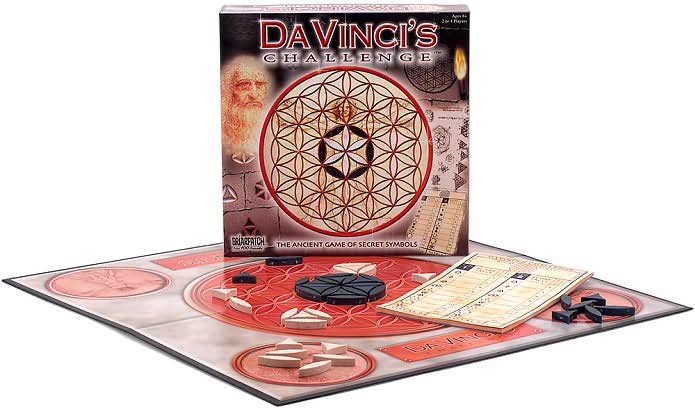
Showing posts sorted by relevance for query The Flower of Life. Sort by date Show all posts

Sunday, September 25, 2005

Secrets of Da Vinci's Challenge


As a designer, I feel that all my work can be considered art - regardless of whether it's a package graphics, art for stationery products, or toy/game design. "Da Vinci's Challenge" is a special case for me, though, because it carries more of a classic sense of what art is; a creation that can evoke intellectual and emotional response, holds symbolic meaning, and has a unique aesthetic value.

The most amazing thing about "Da Vinci's Challenge" as a piece of functional art is its timeless heritage. The pattern of interlocking circles that defines the playing surface of the gameboard is an ancient symbol known throughout history by various names; The Flower of Life, the Language of Light, and the Language of Silence... all of which hint at the transcendental and mysterious essence of this beautiful design.

Flower of Life Carving at Osirian Temple in Egypt


The oldest known physical example of this symbol is in the 6,000 year old Osirian Temple in Abydos, Egypt. The temple was a subterranean complex dedicated to Osiris, the god symbolizing death and regeneration... the afterlife and resurrection. The once-underground chambers are the most ancient of all the ancient Egyptian ruins. "The Flower of Life" symbol is carved with laser-like accuracy on huge granite blocks in the temple walls.

In the context of ancient Egyptian mystery religions, "The Flower of Life" represented the infinite, yet structured matrix that subtly forms the reality we experience. This underlying order can be called God, the Universe, the Quantum Field, the Tao, or whatever you prefer to call it. It is the complete, all-encompassing flux of the world- from the smallest electron fields to the largest scales of the cosmos.


This symbol was used by ancient priests and spiritual initiates as a mandala, a geometric or symbolic pattern that is used to focus on a particular state of mind or experience. "The Flower of Life" was used as a meditation on Unity and Interconnectedness. This is not some metaphysical, abstract mumbo-jumbo, but reflects the basic nature of the world we live in.

Every aspect of the universe is connected and meshed at a base level. Science has firmly demonstrated the mystical concept that the cosmos is nothing but patterns of energy vibration interacting at different levels. The real Mystery is how this seemingly random quantum soup organizes itself into recognizable forms and a mind that can perceive these forms. It's easy to say, "God does it all." God IS the mystery, though, so in order to really understand this statement, one has to really investigate the Mystery!

When you look into ideas such as sacred geometry, divine proportion, fractals, physics, cosmology, and other such disciplines, you gain a greater appreciation for the beauty and unexplainable complexity of the universe. The greater your awareness of the structure and nature of reality, the better prepared you will be to utilize it to the benefit of yourself and others. Because of the connective neural structure of the human brain, our mental perceptions of the entire universe are based on our perceived patterns of causal or physical connection. "The Flower of Life" perfectly illustrates this ordered intricate web of scale, structure, and vibration that defines the world. "The Flower of Life" represents the face of God more ideally than any anthropomorphic painting by Michelangelo.

Besides the philosophical meaning that can be drawn from "The Flower of Life" symbol, there is also rich mathematical knowledge that can be found within the perfectly symmetrical form of interlocking circles. Leonardo da Vinci used his keen intellect and sense of observation to study the geometries found within the Flower of Life.
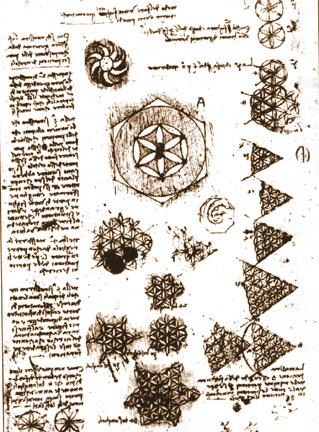


Flower of Life Studies 
by Leonardo da Vinci
  

The pattern is deceptively easy to create. It is begun by simply overlapping 2 identical circles, so the edge of each circle touches the midpoint of the other.


This symbol itself is one of the most ancient and universal symbols known to man. The intersecting circles form a central shape called the 'Vesica Pisces' which, in Christian art, is the basis for the 'Jesus fish' and also the symbol of the womb that the Virgin Mary is often portrayed within. This is a symbol more widely used and much older than Christianity, though. It is a symbol of life, creation, vision, and birth. Incidentally, the Vesica Pisces also defines the energy patterns that lead cells to organize into vital human forms such as the eye, the urethra, the womb, and the mouth. When you start to see such patterns in nature, it is almost as if you are looking into the programming code of reality and the mind.

The third circle is added by placing its midpoint on one of the places where the first two circles intersect. Now the pattern has been establish and it becomes a self-replicating pattern. This step in the pattern can be seen to symbolize the Trinity where a third-dimension of Spirit and Space define the Creation pattern so it becomes a self-regulating phenomenon. From now on, a circle can be placed with its midpoint centered anywhere that the edges of two other circles intersect. The pattern can continue to be repeated and extended endlessly.

A circle is considered rightly to be the perfect form. It represents 'oneness' and 'completeness' its edge has no beginning and no end, but a definite form. This is the fundamental shape that represents the planets, the stars, the moon, the eye, bubbles, water drops. It is the most efficient and sound way to structure matter.

A circle is also the most pleasing to the eye, because of the structural self-similarity. This is easy to prove through understanding human nature. When we are first born, our mind is programmed to search for circles!!! We are automatically drawn to the circular eyes of our mother for recognition, and the round nipples of our mother for nourishment.

This is truly the universal form, and has become the optimal natural shape to guide the survival instincts of human life. Even when we grow older, we are entranced by the circle and compelled to reproduce and continue our species through such mechanisms as our attraction to the 'round' parts of the anatomy. This is part of the wonder of the process of nature and how it is organized in such a fascinating, yet effective way.
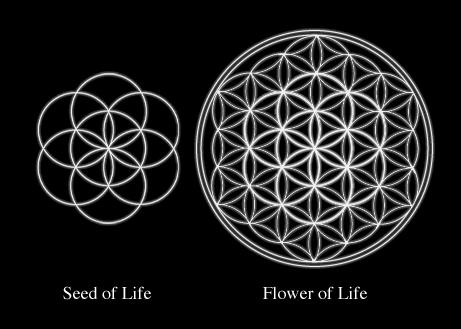

The symbol made from the seven circles at the center of "The Flower of Life" is called "The Seed of Life". It can be seen as a metaphor for the 7 days of Genesis from which all Creation expands out of the One, the single center circle. From this basis, the pattern of Creation can expand indefinitely and can contain endless number and types of forms. "The Flower of Life" is a representation of the infinite, yet orderly, matrix that describes both the interconnected structure of the mind and of the Universe that it perceives.


The shapes and colors of the game pieces in "Da Vinci's Challenge" represent the duality that seems to be ingrained in our mental experiences and perceptions. The patterns that are made using these shapes on the game board can be seen as a representation of the infinite forms that can arise from the underlying matrix of order in the Universe and in our brains. The dual black and white colors, as well as the triangle and long oval shapes can be thought of as representations of yin and yang, male and female, active and passive, 0 and 1 binary characteristics that our duality-based consciousness is trained to experience.

By contemplating the overall, random pattern these shapes make when they are all placed on the the underlying matrix of the game board by the end of the game- you can draw comparisons to the structure and nature of the universe and the infinite forms that also arise from basic elements and principles.

All good art and symbolism packs the maximum amount of information in the minimum amount of space. "The Flower of Life" has been recognized throughout history as a symbol of prime importance because of the infinite amount of geometric, spiritual, and symbolic information that it can represent.


I encourage you to explore the concepts I've talked about here to help deepen your understanding of your own mind and the world we experience through the limiting filter of the mind. From the beginning of its conception, "Da Vinci's Challenge" has always been intended to be a source of insight, inspiration, and a connection to timeless wisdom for everyone who encounters it.

Most of all, I hope it continues to be a source of enjoyment and bonding for those who play it.

The Official Facebook Page: 

Sunday, July 31, 2016

Flower of Life Artifacts


Recently, a reader left a comment on one of my posts about "The Flower of Life".

The Monkey Buddha Archives:

The Flower of Life is an ancient symbol, made of interlocking circles, that represents the interconnected nature of reality & the myriad forms that arise from it. It has been used in art & architecture throughout history.

I created the strategy game, "Da Vinci's Challenge," based on this beautiful & profound symbol.


Official Facebook Page:

The reader I mentioned above is Marko Manninen, and he has done very extensive research into the legacy of The Flower of Life. He has also compiled image galleries with examples from around the world of both the pattern & it's base visual component, the 6-petal rosette.

Here are a couple of his links:

Pages 1-9 of this document
have numerous examples of this symbol

This is his main website, with a vast amount of information 
about the history, geometry, and artistic use of The Flower of Life

One of the oldest examples of the use of The Flower of Life motif is this cosmetic box from Egypt that Marko posted in his gallery- and there are many, many more examples on his website:


Circular Cosmetic Box with a Swivel Lid, Thebes, Egypt (1500 BC)

Tuesday, July 10, 2012

"Da Vinci's Challenge™" & Flower of Life History

 The original hand-made version of
"Da Vinci's Challenge™"
featuring the Flower of Life game board

As a college design student, one of my senior projects was to create an original board game. At the time, my interest was piqued in ancient history & sacred art traditions. I read about the pattern of interlocking circles called "The Flower of Life' & thought it would make a perfect game board.

It was one of those lightning-strike moments I'll never forget. I had an immediate & complete vision of how the game should be, from the rules to the visual appearance.

To give it a look like it was from the ruins of an ancient temple, I made the original version out of stone- with a copper playing surface & wood case. I had never worked with some of these materials before, but my professor pushed me to make it into the amazing piece of fully-functional art in the photo above.


In the beginning of my career as a graphic designer, Briarpatch produced it as a retail board game, "Da Vinci's Challenge™". Leonardo da Vinci himself studied the properties & proportions of the equidistant, geometrically arranged circles.

Wikipedia;

To maintain my unique vision for a game using a Flower of Life game board pattern, I patented the game play (Patent US7114721). Inside the oval & triangle spaces formed by the interlocking circles, you must form "secret symbols" with your playing pieces. These are familiar patterns worth more points as they increase in complexity.


This summer, I'm FINALLY working toward developing "Da Vinci's Challenge™" as a digital app for mobile devices like the iPhone. If things go according to plan, I'll post updates here on the process. This past weekend, my brother worked with me to film a test shoot & edit a rough cut of the pitch video that'll be used to raise funding for the project. We inserted some of the graphic elements I've been creating & it's looking like it might turn out pretty cool.

"Da Vinci's Challenge™" is probably the single creation I'd like to live on after I'm gone, because it really does contain profound qualities that transcend the label of a mere 'game'. With the right perspective, it can be seen as a reflective meditation on the mind & Reality itself.


It also possesses a rich legacy, that spans human history.

Through one of my random Google searches, I just came across an excellent Flickr group. It's a pool of photos showing the many uses of the Flower of Life & the central 6-petal motif in ancient art.


Here's the front page for the Flickr group, with some basic Flower of Life & Petal Motif info. 
http://www.flickr.com/groups/1341262@N25/

Here's a link to the full photo pool, with a collection of amazing examples of this motif used around the world.
http://www.flickr.com/groups/1341262@N25/pool/

Monday, February 26, 2007

Flower of Life Design in "Tomb of Jesus"

I am fortunate as a designer to work on different types of creative projects. The published game I created, "Da Vinci's Challenge," is something special because, for me, it really is 'classic' in every sense. When I was designing the game as a student back in 2000, the thing that fascinated me the most was the sense of history and universality of the symbolic pattern of circles called the Flower of Life. It is a recurring visual device in that art of cultures spanning the globe; India, Egypt, Japan, Spain, and even in the studies of Leonardo da Vinci - hence the title of the game!

Despite being familiar with the widespread use of the Flower of Life patterns, I was in for a bit of a surprise tonight. I clicked on a news article about the discovery of the supposed tomb of Jesus and his family that is the basis of a documentary by James Cameron. This is obviously highly controversial & it is already getting crazy coverage.

In most articles I've seen, there's also photos of stone coffins & one in particular that they are claiming belonged to a 'Mary'. The decorative carvings form the "Seed of Life" - a simpler design that forms the center 'seed' of the Flower of Life pattern. In fact, the Seed of Life flower-in-a-circle design is in the center of the art on the Da Vinci's Challenge game box.

Of course, the claimed connection between the tomb & the Bible characters might just be a load of crap. Regardless, the decorated coffin is an interesting example of the use of the Flower of Life pattern in the sacred art of ancient cultures.

Here's a close-up of the carved ossuary from New Zealand Herald :The homepage for the documentary on Discover.com has the carved design peeking out from the bottom corner:The story, with the Mary ossuary, has already made a stir on Google News:

Monday, February 10, 2020

The Flower of Life in "Assassin's Creed: Origins"

I am currently playing "Assassin's Creed: Origins" and it is a virtual journey through time that is taking me months, at the rate I play video games nowadays. Having played most of the other titles in the Assassin's Creed series, this one is just as amazing. Because I have so little time to spend gaming, I only choose titles that I know are going to be worth it.

All of the Assassin's Creed games take place in different time periods, and the level of research and immersion that goes into the stories and visuals just blows my mind. "Origins" takes place in Ptolemaic Egypt, right before the birth of Jesus.

I will give a full review & an album of my in-game snapshots once I finish the main story, but there was a cool tidbit I wanted to share now...

Back in college, I created a strategy game called "Da Vinci's Challenge" that is based on The Flower of Life, an ancient symbol that is part of a system called sacred geometry. This is the study of geometric and mathematical properties that have mystical or profound qualities that hint at the patterns defining reality.

The Monkey Buddha Archives:

"Da Vinci's Challenge™" & Flower of Life History


As I was playing Origins, I entered a bathhouse as part of a mission, and began to explore (as I find myself doing in every other part of the game). There were mosaic floors that were part of the intricately detailed decorations in the building. I was pleasantly surprised to see that a section of The Flower of Life pattern was used in the floors of the baths.


Then, I walked into a side chamber to see a more complete Flower of Life symbol, formed in the mosaic floor tiles:


The Flower of Life has been used as decoration throughout history, all around the world.

Flower of Life Artifacts


This kind of attention to detail is what makes these games so damn awesome, and so rewarding to experience.

Stay tuned for the full review! It might be a few months, but I'm sure I'll have plenty to rave about once I'm finished.

Wednesday, February 26, 2014

"Da Vinci's Challenge" at NY Toy Fair 2014


My last post was a gallery of pics I took while attending the U.S. International Toy Fair at the Javits Center in Manhattan, NYC.

I haven't had a chance to post here recently, since I just had an awesome weekend-long birthday bash! I've also had many good things going on in both my business & personal life that are the culmination of years of patience and persistent effort.

Even though I posted a gallery of pics already, I wanted to now feature what was the highlight of the show, for me.

After a hiatus of several years, the game "Da Vinci's Challenge" made a return to Toy Fair this year! 

The Monkey Buddha Archives:
Official Facebook Page:

"Da Vinci's Challenge" is a visual strategy game, that I created as a graphic design student. One of my senior projects was to create an original board game. I found inspiration in the ancient symbol of interlocking circles, known as 'The Flower of Life'. The historic legacy of the design also made me use a classic theme for the look of the game. I hand-made the original version out of • carved stone pieces • a copper plate I etched for the game board • a stone block for the base • a wood case • & parchment paper for the rules.


Once I decided to use the Flower of Life symbol as the basis for the game board, the idea for the game play & rules came quickly to me.

There are 2 types of pieces, an oval & a triangle. Each player chooses their color & takes turns using their pieces to create 9 different patterns, or "Secret Symbols". The patterns are worth different point values, depending on their complexity. The player who scores the most points by the end of the game wins!

The game play is easy enough for children to learn, but there are strategic elements that add to the depth & challenge for advanced players. You can block your opponent's patterns, & also create multiple patterns by placing a single piece. At the end of the game, the pieces covering the game board form a unique design every time. You can look at the finished board & see all the patterns that have made throughout the game.

These are just some of the features that make "Da Vinci's Challenge" so unique.

The publisher decided to produce a new run of the game this year, with several major improvements. The new edition is planned to have a molded plastic game board with slots for the pieces, and also cups to store the pieces. I have personally updated the package design & the graphics for a more polished look. These are all things that were sorely lacking in the first printing, and make a world of difference in the gaming experience.

"Da Vinci's Challenge" is a creation that I believe is truly timeless. I hope that this gets to market again & reaches many people- to give them enjoyment, inspiration, and perhaps insight into the mysteries of sacred geometry & other esoteric wisdom.

Here are some of the pictures featuring "Da Vinci's Challenge" at the Toy Fair booth for Briarpatch, Inc. I got a few photos with my creation, with the updated graphics & components.Check out my Toy Fair photo album for more pics:


 Me, Paul Mic, standing by the display for the new edition of 
"Da Vinci's Challenge", at the Briarpatch booth.


The updated components for the new edition of 
"Da Vinci's Challenge", at the Briarpatch booth.

  
 Me, Paul Micarelli, with the updated box for the new edition of
"Da Vinci's Challenge", at the Briarpatch booth.


 The updated box & components for the new edition of 
"Da Vinci's Challenge", at the Briarpatch booth.


The updated components for the new edition of 
"Da Vinci's Challenge", at the Briarpatch booth.


Tuesday, February 09, 2016

Super Bowl Sacred Geometry


Although I've always been pretty athletic & love playing sports, I'm not a big fan of watching football, or sports in general. However, this past weekend I went to my brother's house since he was having a Super Bowl 50 party.

I was surprised to see in the halftime show, during Coldplay's performance, the use of The Flower of Life symbol- in their stage design, drum kit, & outfits.

The Flower of Life is a symbol of interlocking circles is the basis for a strategy game, based on the philosophy of sacred geometry, that I designed & have had published: "Da Vinci's Challenge".


The Flower of Life is an ancient symbol that represents unity, vibrational energy, and inter-connectivity. It has been used in art & architecture since the beginning of known history.

Because of the NFL's ridiculous copyright protections, the only decent video I could find of the performance so far is here:

SPIN.com

Below, I've posted some screenshots showing the stage with the Flower of Life symbol, and it's use on their bass drum & clothing.

The Flower of Life graphic morphed into a swirling galactic vortex, then a solar burst.

I don't believe there was anything nefarious or Illuminati-related with the use of this symbolism. I actually think the artists recognize the pattern as a symbol of consciousness & cosmic creation.


Wednesday, April 08, 2020

Game Review: Assassin's Creed Origins


 Since I received a PS4 from my wife last Christmas, I have been primarily playing 2 games - Star Wars Battlefront II and Assassin's Creed Origins. Assassin's Creed has occupied most of my limited gaming time for the past 4 months, due to the sheer expansiveness of the game.

I previously posted about the use of The Flower of Life motif in the game, but since I just finished the main storyline I can write a full review.


Let me start by saying that this game is absolutely awe-inspiring. This is coming from someone who has played video games all my life... and I can say that this is as close to the perfect game as I have ever had the privilege to experience!

Because of the camera feature, I was able to screenshot images of some of the amazing visuals that can be seen throughout the game. All the images in this post are from my gallery below. There is so much to see & experience in Origins that it is impossible to document it all.

Click the link below to see my gallery:

Google Photo Album:

The main story is very engaging, and I never got tired or bored of the missions or even the side quests. It follows Bayek of Siwa, who is a Medjay (Magi) or protector of Egypt. He and his wife Aya seek justice for the murder of their son by the Order of the Ancients. The Order searches for relics from a lost "First Civilization" that they use to control mankind. Bayek & Aya eventually form the Brotherhood of Assassins (the "Origin" of the Assassins in the other games of this series) to destroy this Order of the Ancients.

I love history, especially ancient history, and have always been fascinated with ancient Egypt. AC: Origins is set in Ptolemaic Egypt- which was a couple thousand years ago, but the Giza pyramids were already thousands of years old, even back then. These pyramids, as well as other landmarks such as The Great Sphinx, Djoser's pyramid, and countless temples are all present and can be fully explored and climbed upon like everything else in the game.


The Great Pyramid of Giza, 
with it's limestone casing & gold capstone in place

Yes, you can climb to the top of the Great Pyramid!
(It takes awhile to climb, but you can slide down the side to get down)

 The Great Sphinx, with the paint still intact.
(although the head was probably originally a jackal, guardian of the underworld)

The Egyptian temples were absolutely stunning.
There are many more photos in my gallery linked above

Not only is Egyptian architecture and culture showcased, but ancient Greek influence in Egypt at the time is also heavily represented. Alexander the Great and the Ptolemaic pharaohs from Greece had a lasting impact on Egyptian society, through the establishment of Alexandria and the infusion of the Greek pantheon of gods & their temples.  

 The legendary tomb of Alexander the Great.

At the top of The Pharos, or lighthouse of Alexandria.

One of the many temples influenced by Greek architecture.

In addition to the historic landmarks, Assassins Creed titles always put the player in the presence of famous historical figures and situations. In this one, you are involved with pivotal events involving Cleopatra, Julius Caesar, Ptolemy XIII, and Pompey the Great.

Talking with Cleopatra along the Nile River.

Cleopatra becoming acquainted with Julius Caesar.

This is how you encounter Pompey the Great-
decapitated & impaled on a spike by Caesar's army.

As with all the Assassin's Creed games, the historic events are masterfully woven into the main storyline. The great thing about these games, however, is that you are not forced into a linear playthrough. You can go off onto side quests, or just explore at your leisure. It is a true sandbox style experience, where you can go anywhere or just do nothing but look around at all the captivating scenery, if you want. 

Even though there are important figures from history in the story, my favorite aspects were just the ordinary slices of life that are captured everywhere. The level of detail is so astounding, that I was often in total disbelief that something like this could even be created! It truly is an epic work of art that gives a better sense of human history at all levels than any textbook or class could ever approach.

A random merchant's stall, with a dozen detailed items to inspect.

A closer look at the merchant's goods. 
The level of detail, even in this little section, is crazy.

Just some dudes hanging out at the baths.

Street musicians entertaining passersby.

On the other end of the spectrum, another aspect of Assassin's Creed games that make them great are the mythical elements, revolving around the mysterious "First Civilization". This is a race of technologically-advanced beings who created humanity, but were destroyed by a cosmic cataclysm in the distant past. They have left seemingly magical artifacts and "Vaults" containing knowledge incomprehensible to the human race. Although there wasn't as much about Those Who Came Before in this installment, the aspects that were included were pretty cool.

One of The Vaults from the First Civilization
 was hidden below the Great Pyramid

Bayek and Aya discover another Vault,
with a holographic map of the Earth.
They obviously think this is some sort of magic.

The settings in the game, both natural and man-made, are very immersive. There is abundant wildlife, common people doing their daily routines, and beautiful architecture throughout the ridiculously vast map. I still haven't explored and unlocked anywhere near all the areas, despite finishing the story.


The various landscapes and vistas in the cities, towns, and surrounding wilderness are enough to make you often just stop and observe. Then you may be jolted into action by an attacking alligator or cobra out of nowhere!

Crazy random shit happens, like wild animals attacking each other...

...or wild animals attacking you!
 

One really cool feature is the ability to use of your hawk Senu as a scout, to get a literal birds-eye view of the locations, including the enemies and treasures there. You can also use the camera while in Senu mode to get awesome aerial shots.


There's just so damn much to rave about with this game... I put off writing the review because I knew it would take me at least a couple hours. If you've read this far, and haven't been convinced to play this 1st class title, then there's nothing more I can say to persuade you. It's an absolute masterpiece.

I will leave you with a final picture of, not a Monkey Buddha, but of Babi the baboon god... I guess it's close enough!

• Official Monkey Buddha Rating: 10+ out of 10!